


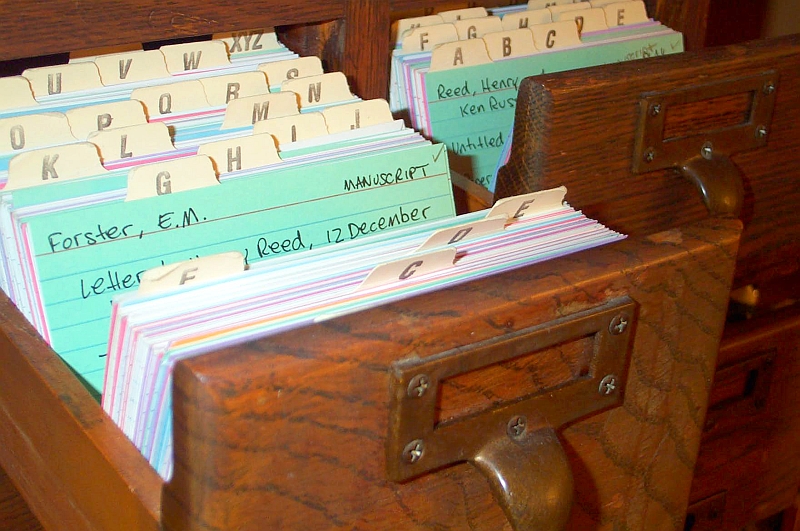
It was Possession which originally inspired me to begin organizing the bibliography, first with 3x5 index cards, and then in a database. The obsessed scholars in the novel all keep detailed card indexes, in which they transcribe, outline, and keep track of the minute facts of the lives of their respective authors. Here is a scene between Roland Michell, a research assistant working for the editor of the collected papers of the (fictitious) poet, Randolph Henry Ash, and Beatrice Nest, gatekeeper to the journals of the poet's wife, Ellen Ash:
Could I see your card index, Beatrice?"
"Oh, I don't know, it's all a bit of a muddle, I have my own system, you know, Roland, for recording things, I think I'd better look myself, I can better understand my own hieroglyphics."
She put on her reading glasses, which dangled over her embarrassment on a gilt-beaded chain. Now she could not see Roland at all, a state of affairs she marginally preferred, since she saw all male members of her quondam department as persecutors, and was unaware that Roland's own position there was precarious, that he hardly qualified as a full-blooded departmental male. She began to move things across her desk, a heavy wooden-handled knitting bag, several greying parcels of unopened books. There was a whole barbican of index boxes, thick with dust and scuffed with age, which she ruffled in interminably, talking to herself.
"No, that one's chronological, no, that's only the reading habits, no that one's to do with the running of the house. Where's the master-box now? It's not complete for all notebooks you must understand. I've indexed some but not all, there is so much, I've had to divide it chronologically and under headings, here's the Calverley family, that won't do... now this might be it....
"Nothing under La Motte. No, wait a minute. Here. A cross-reference. We need the reading box. It's very theological, the reading box. It appears"—she drew out a dog-eared yellowing card, the ink blurring into its fuzzy surface—"it appears she read The Fairy Melusina, in 1872."
She replaced the card in its box, and settled back in her chair, looking across at Roland with the same obfuscating comfortable smile.
"Oh, I don't know, it's all a bit of a muddle, I have my own system, you know, Roland, for recording things, I think I'd better look myself, I can better understand my own hieroglyphics."
She put on her reading glasses, which dangled over her embarrassment on a gilt-beaded chain. Now she could not see Roland at all, a state of affairs she marginally preferred, since she saw all male members of her quondam department as persecutors, and was unaware that Roland's own position there was precarious, that he hardly qualified as a full-blooded departmental male. She began to move things across her desk, a heavy wooden-handled knitting bag, several greying parcels of unopened books. There was a whole barbican of index boxes, thick with dust and scuffed with age, which she ruffled in interminably, talking to herself.
"No, that one's chronological, no, that's only the reading habits, no that one's to do with the running of the house. Where's the master-box now? It's not complete for all notebooks you must understand. I've indexed some but not all, there is so much, I've had to divide it chronologically and under headings, here's the Calverley family, that won't do... now this might be it....
"Nothing under La Motte. No, wait a minute. Here. A cross-reference. We need the reading box. It's very theological, the reading box. It appears"—she drew out a dog-eared yellowing card, the ink blurring into its fuzzy surface—"it appears she read The Fairy Melusina, in 1872."
She replaced the card in its box, and settled back in her chair, looking across at Roland with the same obfuscating comfortable smile.
There you have it: the entirety of my formal training in literary research.
I was brought back to Possession this evening by stumbling across Pile of Indexcards, which lovingly blogs, in painstaking detail, a similar system of organization. Indexcard + Tagging + Chronological order = "Indexcarding". Accompanied by a terrific photoset on Flickr. I particularly like the tagging and starring methods.


