|
|
Documenting the quest to track down everything written by
(and written about) the poet, translator, critic, and radio
dramatist, Henry Reed.
An obsessive, armchair attempt to assemble a comprehensive
bibliography, not just for the work of a poet, but for his
entire life.
Read " Naming of Parts."
|
Contact:
|
|
|
|
Reeding:
|
 |
I Capture the Castle: A girl and her family struggle to make ends meet in an old English castle.
|
 |
Dusty Answer: Young, privileged, earnest Judith falls in love with the family next door.
|
 |
The Heat of the Day: In wartime London, a woman finds herself caught between two men.
|
|
|
|
Elsewhere:
|
|
Posts from December 2006
|
|
|
27.4.2024
|
It would appear the BBC Programme Catalogue has awoken from its long slumber, hungry for keywords to devour, eager to reveal its deepest secrets! Huzzah!
|
1537. Radio Times, "Full Frontal Pioneer," Radio Times People, 20 April 1972, 5.
A brief article before a new production of Reed's translation of Montherlant, mentioning a possible second collection of poems.
|
Microsoft has released in (βeta) their Live Search Books, which contains searchable scans of thousands of pre-1927 titles in the public domain. More information is available on Live Search's Weblog.
Unfortunately, for our purposes, this is slightly less than useful. Let's see: " Thomas Hardy." Good! " Ezra Pound." Okay. " T.S. Eliot?" Not so much. Oh, well.
Microsoft has also gone live with Live Search Academic, their response to Google Scholar.
|
1536. L.E. Sissman, "Late Empire." Halcyon 1, no. 2 (Spring 1948), 54.
Sissman reviews William Jay Smith, Karl Shapiro, Richard Eberhart, Thomas Merton, Henry Reed, and Stephen Spender.
|
I think, given the chance to do it over again, I'd rename this blog The Ghost of Hardy's Cat. (Indirectly, via Peter Stothard.)
|
1535. Reed, Henry. "Talks to India," Men and Books. Time & Tide 25, no. 3 (15 January 1944): 54-55.
Reed's review of Talking to India, edited by George Orwell (London: Allen & Unwin, 1943).
|
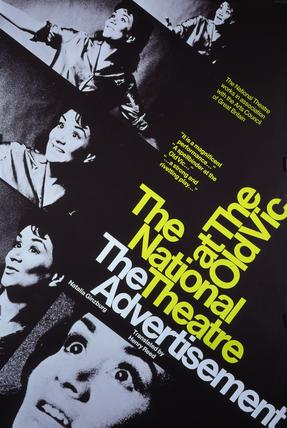
Diehard fans of Joan Plowright (or Natalia Ginzburg) may be interested in these posters offered by the National Theatre Archive. They're from the 1968-69 run of Ginzburg's play, The Advertisement, translated and adapted by Reed. The production was directed by Donald MacKechnie and Sir Laurence Olivier, and starred (besides Dame Joan) Suzanne Vassey, Louise Purnell, Edward Petherbridge, Anna Carteret, and Sir Derek Jacobi.
The National Theatre also has an extensive, searchable catalog of performances and items in their archives.
|
1534. Reed, Henry. "Radio Drama," Men and Books. Time & Tide 25, no. 17 (22 April 1944): 350-358 (354).
Reed's review of Louis MacNeice's Christopher Columbus: A Radio Play (London: Faber, 1944).
|
Here's an interesting bit of trivia: a Collected Poems of Henry Reed was proposed as early as 1979, seven years before his death.
The Archive of Carcanet Press is housed in the John Rylands University Library at the University of Manchester. The collection contains communications to and from Carcanet's editors, authors, and critics. In correspondence from between April 1979 and May 1980, editor Michael Schmidt, co-founder of the Press, and David Jesson-Dibley, go back-and-forth about current, possible, and future projects:
Much of this relates to Robert Herrick's Selected poems, edited by Jesson-Dibley as part of the Fyfield series and published in 1980. Includes references to: Schmidt's initial suggestion that Jesson-Dibley undertake the project, and suggestions put forward by both men of potential poets for Jesson-Dibley to edit; the possibility of editing a Fyfield volume of Edward, Lord Herbert of Cherbury's verse; Jesson-Dibley's suggestion of a volume of lives and anecdotes of seventeenth-century poets; the ultimate selection of Herrick, and plans for the book's content and arrangement; his progress; and the contract. Other topics include: Jesson-Dibley's attempts to find a publisher for a novel he has written and Schmidt's advice on this; the possibility of Carcanet undertaking a Collected Poems of Henry Reed; a play Jesson-Dibley has completed called Ahab and his neighbours; his other work, including some teaching; and Schmidt's book An introduction to fifty modern poets (1979).
I tracked down the library's copy of Fifty Modern British Poets, hoping that Schmidt may have granted Reed a special place among the lives of his peers. But all I found was a small, disappointing note in the editor's Preface: 'Had I been able to include sixty poets, I should have added essays on Robert Bridges, Arthur Symons, John Masefield, Siegfried Sassoon, Norman Cameron, Henry Reed, Seamus Heaney, Alun Lewis, Peter Scupham, and Roy Fisher.'
In his book Reading Modern Poetry, Schmidt asks: 'Will Henry Reed ever be more than an anthology piece and a brilliant parody?' We'll see. Carcanet inherited Oxford University Press's Oxford Poets list in 1999, following OUP's decision to drop contemporary poetry. There is a glimmer that Carcanet intends to reissue Reed's Collected Poems as a paperback in 2007, bringing the book full-circle.
|
1533. Friend-Periera, F.J. "Four Poets," Some Recent Books, New Review 23, no. 128 (June 1946), 482-484 [482].
A short review calls A Map of Verona more pretentious than C.C. Abbott's The Sand Castle; influenced by Eliot, Auden, MacNeice, and Day Lewis.
|
I dug through my bookshelves tonight, hunting for my copy of A.S. Byatt's Possession. Ah, here it is: the trade paperback from before the (regretable) film version was released. I've read it twice, and the spine is creased and the corners dulled. When I first read the book, straight through in about two days, I was sure it was a masterpiece (despite the sometimes tedious Victorian verse). On second reading, I was dismayed that it didn't quite captivate me in the same way, and I attributed the discrepancy to my own deprivations the first time around.
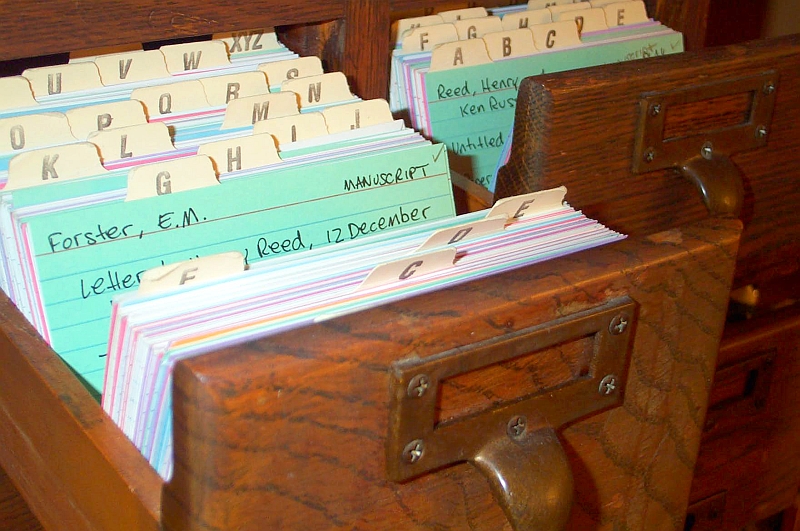
It was Possession which originally inspired me to begin organizing the bibliography, first with 3x5 index cards, and then in a database. The obsessed scholars in the novel all keep detailed card indexes, in which they transcribe, outline, and keep track of the minute facts of the lives of their respective authors. Here is a scene between Roland Michell, a research assistant working for the editor of the collected papers of the (fictitious) poet, Randolph Henry Ash, and Beatrice Nest, gatekeeper to the journals of the poet's wife, Ellen Ash:
Could I see your card index, Beatrice?"
"Oh, I don't know, it's all a bit of a muddle, I have my own system, you know, Roland, for recording things, I think I'd better look myself, I can better understand my own hieroglyphics."
She put on her reading glasses, which dangled over her embarrassment on a gilt-beaded chain. Now she could not see Roland at all, a state of affairs she marginally preferred, since she saw all male members of her quondam department as persecutors, and was unaware that Roland's own position there was precarious, that he hardly qualified as a full-blooded departmental male. She began to move things across her desk, a heavy wooden-handled knitting bag, several greying parcels of unopened books. There was a whole barbican of index boxes, thick with dust and scuffed with age, which she ruffled in interminably, talking to herself.
"No, that one's chronological, no, that's only the reading habits, no that one's to do with the running of the house. Where's the master-box now? It's not complete for all notebooks you must understand. I've indexed some but not all, there is so much, I've had to divide it chronologically and under headings, here's the Calverley family, that won't do... now this might be it....
"Nothing under La Motte. No, wait a minute. Here. A cross-reference. We need the reading box. It's very theological, the reading box. It appears"—she drew out a dog-eared yellowing card, the ink blurring into its fuzzy surface—"it appears she read The Fairy Melusina, in 1872."
She replaced the card in its box, and settled back in her chair, looking across at Roland with the same obfuscating comfortable smile.
There you have it: the entirety of my formal training in literary research.
I was brought back to Possession this evening by stumbling across Pile of Indexcards, which lovingly blogs, in painstaking detail, a similar system of organization. Indexcard + Tagging + Chronological order = "Indexcarding". Accompanied by a terrific photoset on Flickr. I particularly like the tagging and starring methods.
|
1532. Vallette, Jacques. "Grand-Bretagne," Mercure de France, no. 1001 (1 January 1947): 157-158.
A contemporary French language review of Reed's A Map of Verona.
|
I'm watching " The Electric Company's Greatest Hits & Bits" special, on PBS. "Easy Reader," "The Six Dollar and Thirty-Nine Cent Man," "The Adventures of Letterman." It's like my entire adolescence is being rebroadcast. Rita Moreno, hubba hubba! They opened with this gag, which is like a Shakespearean tragi-comedy, for eight-year-olds:
|
1531. Henderson, Philip. "English Poetry Since 1946." British Book News 117 (May 1950), 295.
Reed's A Map of Verona is mentioned in a survey of the previous five years of English poetry.
|
In 1995, to coincide with National Poetry Day, BBC1's television program, "The Bookworm," conducted a six-day poll of the public, seeking Britain's favorite poem ( Independent (London), 13 October 1995). 7,500 votes cast narrowed down 1,000 choices to the 100 best-loved poems. Henry Reed's "Lessons of the War" was ranked at #38:
1. Rudyard Kipling, "If"
2. Alfred Lord Tennyson, "The Lady of Shalott"
3. Walter de la Mare, "The Listeners"
4. Stevie Smith, "Not Waving but Drowning"
5. William Wordsworth, "The Daffodils"
6. John Keats, "To Autumn"
7. W.B. Yeats, "The Lake Isle of Innisfree"
8. Wilfred Owen, "Dulce et Decorum Est"
9. John Keats, "Ode to a Nightingale"
10. W.B. Yeats, "He Wishes for the Cloth of Heaven"
11. Christina Rossetti, "Remember"
12. Thomas Gray, "Elegy Written in a Country Churchyard"
13. Dylan Thomas, "Fern Hill"
14. William Henry Davies, "Leisure"
15. Alfred Noyes, "The Highwayman"
16. Andrew Marvell, "To His Coy Mistress"
17. Matthew Arnold, "Dover Beach"
18. William Blake, "The Tyger"
19. W.H. Auden, "Twelve Songs"
20. Edward Thomas, "Adlestrop"
21. Rupert Brooke, "The Soldier"
22. Jenny Joseph, "Warning"
23. John Masefield, "Sea-Fever"
24. William Wordsworth, "Composed Upon Westminster Bridge"
25. Elizabeth Barrett-Browning, Sonnets From the Portuguese, XLIII ("How Do I Love Thee?...")
26. T.S. Eliot, "The Love Song of Alfred J. Prufrock"
27. John Masefield, "Cargoes"
28. Lewis Carroll, "Jabberwocky"
29. Samuel Taylor Coleridge, from "The Rime of the Ancient Mariner"
30. Percy Bysshe Shelley, "Ozymandias of Egypt"
31. Robert Frost, "Stopping by Woods on a Snowy Evening"
32. Leigh Hunt, "Abou Ben Adhem"
33. Siegfried Sassoon, "Everyone Sang"
34. Gerard Manley Hopkins, "The Windhover"
35. Dylan Thomas, "Do Not Go Gentle Into That Good Night"
36. William Shakespeare, Sonnet 18 ("Shall I Compare Thee...?")
37. W.B. Yeats, "When You Are Old"
38. Henry Reed, "Lessons of the War" (To Alan Michell)
39. Thomas Hardy, "The Darkling Thrush"
40. Allan Ahlberg, "Please Mrs. Butler"
41. Samuel Taylor Coleridge, "Kubla Khan"
42. Robert Browning, "Home Thoughts, From Abroad"
43. John Gillespie Magee, "High Flight (An Airman's Ecstasy)"
44. T.S. Eliot, "Journey of the Magi"
45. Edward Lear, "The Owl and the Pussy-Cat"
46. Rudyard Kipling, "The Glory of the Garden"
47. Robert Frost, "The Road Not Taken"
48. Rudyard Kipling, "The Way Through the Wood"
49. Wilfred Owen, "Anthem for a Doomed Youth"
50. Wendy Cope, "Bloody Men"
51. John Clare, "Emmonsail's Heath in Winter"
52. T.S. Eliot, "La Figlia Che Piange"
53. Philip Larkin, "The Whitsun Wedding"
54. Oscar Wilde, from "The Ballad of Reading Gaol"
55. Thomas Hood, "I Remember, I Remember"
56. Philip Larkin, "This Be the Verse"
57. D.H. Lawrence, "Snake"
58. Rupert Brooke, "The Great Lover"
59. Robert Burns, "A Red, Red Rose"
60. Louis MacNeice, "The Sunlight on the Garden"
61. Rupert Brooke, "The Old Vicarage, Grantchester"
62. John Betjeman, "Diary of a Church Mouse"
63. Walter de la Mare, "Silver"
64. Gerard Manley Hopkins, "Pied Beauty"
65. Louis MacNeice, "Prayer Before Birth"
66. T.S. Eliot, "Macavity: The Mystery Cat"
67. Thomas Hardy, "Afterwards"
68. G.K. Chesterton, "The Donkey"
69. Robert Browning, "My Last Duchess"
70. John Betjeman, "Christmas"
71. Ted Hughes, "The Thought-Fox"
72. T.S. Eliot, "Preludes"
73. George Herbert, "Love (III)"
74. Alfred Lord Tennyson, "The Charge of the Light Brigade"
75. John Clare, "I Am"
76. Francis Thompson, "The Hound of Heaven"
77. Christopher Marlowe, "The Passionate Shepherd to His Love"
78. W.B. Yeats, "The Song of Wandering Aengus"
79. George Gordon, Lord Byron, "She Walks in Beauty"
80. A.E. Housman, "Loveliest of Trees, the Cherry Now"
81. John Donne, "The Flea"
82. F.W. Harvey, "Ducks"
83. Philip Larkin, "An Arundel Tomb"
84. William Shakespeare, Sonnet 116 ("Let Me Not to the Marriage of True Minds")
85. Alfred, Lord Tennyson, "Ulysses"
86. Louis MacNeice, "Snow"
87. Roger McGough, "Let Me Die a Youngman's Death"
88. Thomas Hardy, "The Ruined Maid"
89. Hugo Williams, "Toilet"
90. Wilfred Owen, "Futility"
91. Edgar Allan Poe, "The Raven"
92. Robert Burns, "Tam O' Shanter"
93. Percy Bysshe Shelley, "Love's Philosophy"
94. H.W. Longfellow, from "The Song of Hiawatha" (Hiawatha's Wooing)
95. Gerard Manley Hopkins, "God's Grandeur"
96. Michael Rosen, "Chocolate Cake"
97. Leigh Hunt, "Jenny Kissed Me"
98. Seamus Heaney, "Blackberry-Picking"
99. William Wordsworth, from "The Prelude" (Childhood and School-Time)
100. Carol Ann Duffy, "Warming Her Pearls" That puts things in perspective. Reed beats three Louis MacNeice poems by at least 22 places, is only outshone by Eliot's "Prufrock," beats John Betjeman, is only three slots below Dylan Thomas's "Do Not Go Gentle Into That Good Night," and even outranks his idol Thomas Hardy's best-known verses.
These selections were published in 1996 as The Nation's Favourite Poems (Amazon.co.uk), and spawned something of an industry in poetry anthologies. It'd be interesting to see, in the polls taken in the following years, whether Reed rose, or fell, or (God forbid) fell off, altogether.
|
1530. Radio Times. Billing for "The Book of My Childhood." 19 January 1951, 32.
Scheduled on BBC Midland from 8:15-8:30, an autobiographical(?) programme from Henry Reed.
|
|
|
|
1st lesson:
Reed, Henry
(1914-1986). Born: Birmingham, England, 22 February 1914; died: London, 8
December 1986.
Education: MA, University of Birmingham, 1936. Served: RAOC, 1941-42; Foreign Office, Bletchley Park, 1942-1945.
Freelance writer: BBC Features Department, 1945-1980.
Author of:
A Map of Verona: Poems (1946)
The Novel Since 1939 (1946)
Moby Dick: A Play for Radio from Herman Melville's Novel (1947)
Lessons of the War (1970)
Hilda Tablet and Others: Four Pieces for Radio (1971)
The Streets of Pompeii and Other Plays for Radio (1971)
Collected Poems (1991, 2007)
The Auction Sale (2006)
|
Search:
|
|
|
Recent tags:
|
Posts of note:
|
Archives:
|
Marginalia:
|
|