About:

Documenting the quest to track down everything written by (and written about) the poet, translator, critic, and radio dramatist, Henry Reed.

An obsessive, armchair attempt to assemble a comprehensive bibliography, not just for the work of a poet, but for his entire life.

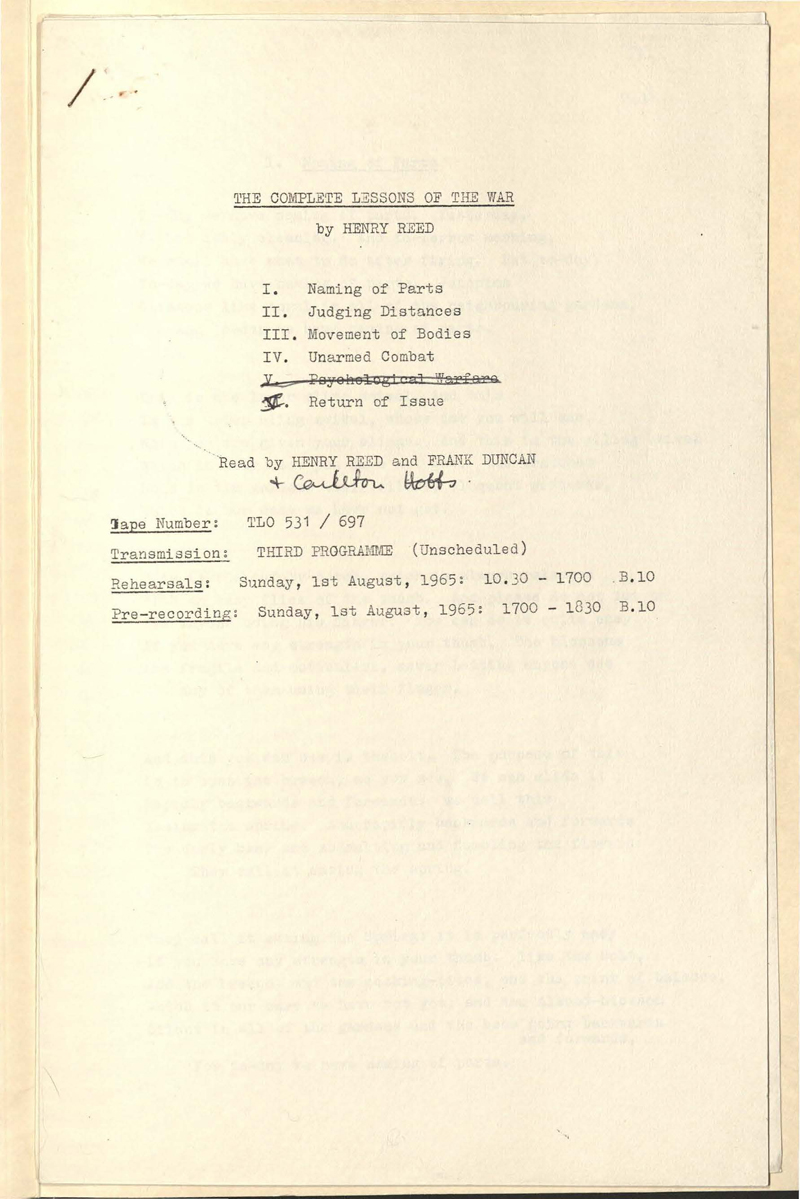
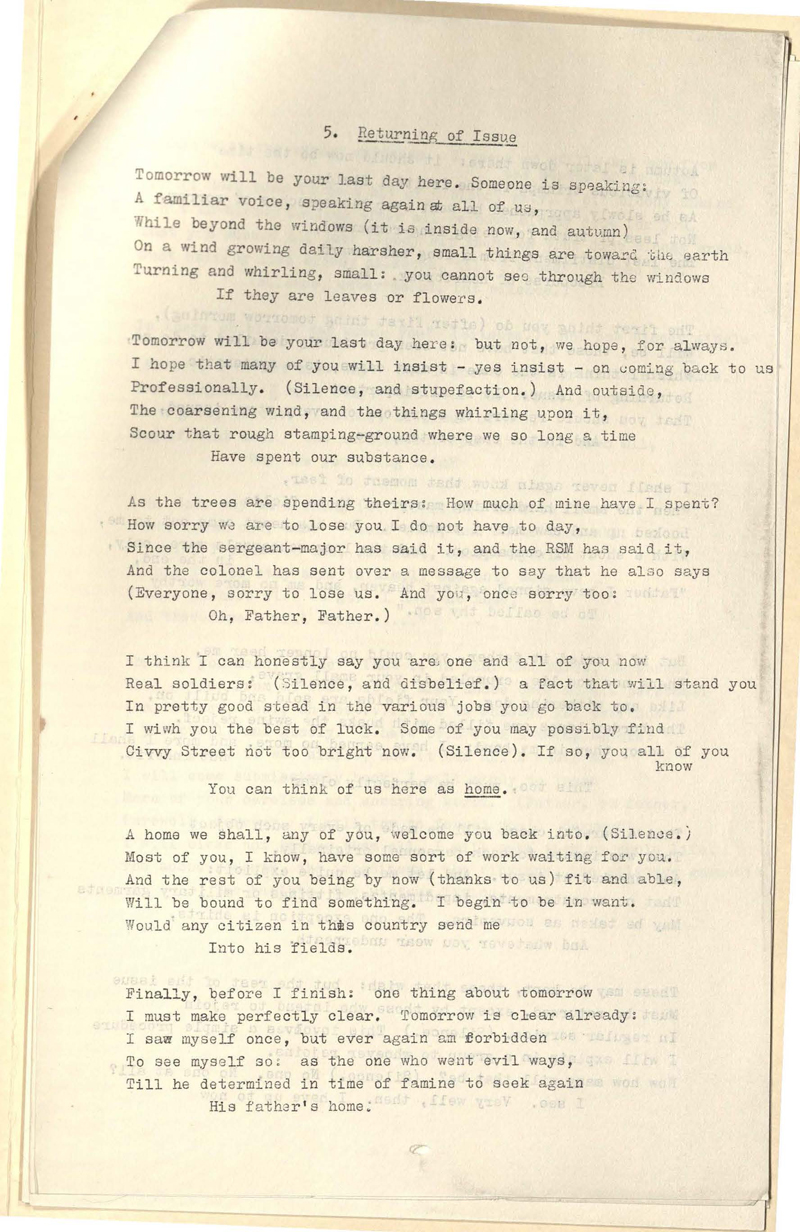
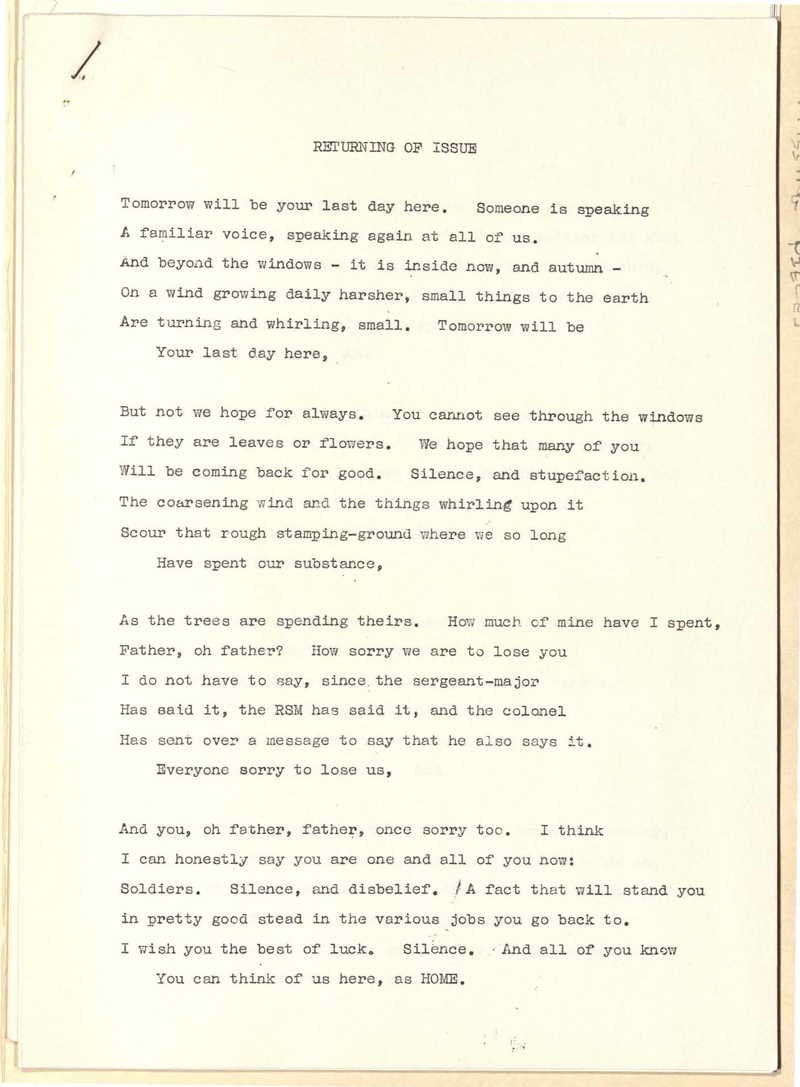
Read "Naming of Parts."

Henry Reed Henry Reed
Henry Reed, ca. 1960


Contact:


Reeding:

Black Swan Green: A year in the life of a thirteen-year-old in Cold War England.
84, Charing Cross Road: Letters between a New York writer and a London bookshop.
Cakes and Ale: Maugham's witty satire of English literary society.


Elsewhere:

Books

Libraries

Weblogs, etc.


Did yer press the tit, or anything?

Reeding Lessons: the Henry Reed research blog

18.6.2013


This review of the premiere of Reed's second installment in the Hilda Tablet series, The Private Life of Hilda Tablet, appeared 59 years ago today, in The Listener for June 3, 1954. The reviewer was J.C. Trewin (later OBE), drama critic for The Observer for more than sixty years.

I began by typing a few excerpts of Trewin's (and Reed's) best bits. The "best bits" turned out to be the article entire.

Hilda Tablet

Sound Broadcasting
DRAMA
Alive and Dead

And now we must have the private life of Stephen Shewin. I can hardly wait for it. Henry Reed, who has discovered these curious people—clearly they have been hovering, in a lather of excitement, to come to the microphone—has just reached the story of Hilda Tablet. A very fine story it is. When it appears in print, if poor Herbert Reeve is still alive, it will run into twelve volumes—though that, as Reeve murmured in the plaintive, melancholy-desperate tones of Hugh Burden, must be years and years ahead. Years and years.

You must forgive me. I may be talking to myself, and you may not have met these people. I hope you have. It is eight months since Henry Reed, in the Third, has had his joke at the expense of the conscientious, burrowing biographer. The resolute Reeve looked for the facts beneath the work of the 'poets' novelist', Richard Shewin, and, in the course of his researches, he met the most extraordinary bevy of personages on and around the comic literary fringe. At the time I liked the 'composeress' Hilda Tablet. Now Herbert, even fainter than before, but still pursuing, has saddled himself with another assignment.

The title, 'The Private Life of Hilda Tablet' (Third Programme), says just what has happened. In seeking Shewin, poor Reeve has found Hilda coiling herself furrily about his neck. He is hers forever, and it is going to be a ticklish journey. As someone observes, it needs tact to write the biography of a living subject. And Hilda is living. Undeniably. Her all-woman opera, 'Emily Butter', 'embraces the whole of music'; she has written a quintet for eight instruments ('a lot of instruments for a quintet, I freely grant you'); and she seems to have a passion for adding to her works: at least, to works about her. The idea is simple when it begins: 'A couple of fellows called Faber and Faber are after my life—only 350 pages by this autumn'. But, a few months on, she has resolved, and Herbert has agreed—could he have done otherwise?—that the biography shall be in twelve volumes. It has to have Epic Scope (no doubt Cinemascope as well, if things go much further).

Once more, Mr. Reed has written with the sharpest, wittiest point. Some of his people are old friends; I plead—see first sentence—for a third installment on Stephen Shewin, who still lives, with his wife, in the cat-filled house, shooting his phrases (thanks to Carleton Hobbs) like poison-tipped arrows. But there are new pleasures also. We meet the librettist, who finds Hilda a trifle vexing. Has she not changed the original story of 'Emily Butter', set in the sixteenth century on a boat anchored off Rimini, to something about the bargain basement of a department store? Then there is the Vicar of Mull Extrinseca ('We rub along, you know'), who is delighted that Hilda's embalmed feet are to preserved in the church—in due course. There is the Duchess who begins every sentence with 'One wonders', and who can wonder with surprising effect. There is the Viennese singer who has not yet said 'Goodnight Vienna', though all her attempts are thwarted.

And there is always, and massively, our old acquaintance Hilda herself (Mary O'Farrell), to explain that 'Music fell for me; I was flirting with architecture at the time', or else that she is neither the marrying sort of girl nor a girl who easily offended. 'Please don't mind my saying it', she begins briskly, and at once a storm-cone is hoisted. Mr. Burden is a dolorous joy: then, most of this effort is a joy, though I think Hilda's speech to her old school goes on too long at the end. We know her reasonably well by then, and some of her effects are expected.

Still, the 'Life', which was produced by Douglas Cleverdon, is a cheerful find for what Mr. Reeve-Burden calls 'the ever-admirable Third Programme'. Now let us have a few more poisoned arrows from Stephen Shewin. And his wife, I am sure, can be helpfully elaborated.
[pp. 983-984]


The Private Life of Hilda Tablet was followed by Emily Butter (1954), A Hedge, Backwards (1956), The Primal Scene, As It Were (1958), Not a Drum Was Heard (1959), and Musique Discrète (1959). The plays were collected (not including Emily Butter) in Hilda Tablet and Others: Four Pieces for Radio (British Broadcasting Corporation, 1971). Because of the poor quality of my Listener scan, I have illustrated this post with a picture from the Radio Times for Musique Discrète.

«  Radio Plays Criticism  0    


1495. Reed, Henry. "Proust's Way." Reviews of Marcel Proust: A Selection from His Miscellaneous Writings translated by Gerard Hopkins, and The Two Worlds of Marcel Proust by Harold March. Observer, 16 January 1949, 4.
Reed says, 'Proust, like Shakespeare, should be read as early in life as possible, and should be read entire.'


I've only just remembered today that I am sitting on a vast hoard of newspaperly gems from The Guardian and Observer, including this small vote of confidence from none other than Vita Sackville-West.

Ms. Sackville-West (you may remember) had a bit of a run-in with the poetry committee of the Society of Authors in March, 1946, in the midst of trying to decide who would read at an upcoming poetry recital for the Queen. If she held any ill-will towards Reed she does not show it in her review of A Map of Verona for The Observer on May 5th ("Seething Brain," p. 3), little more than a week before the recital.

Indeed, she reports being 'much taken with the poem called "Lives," which seemed to express so admirably Mr. Reed's sense of the elusiveness as well as the continuity of life':

Observer blurb

In addition to Reed's A Map of Verona: Poems (Cape) and Durrell's Cities Plains and People (Faber), Sackville-West also reviews (at length): Dylan Thomas's Deaths and Entrances (Dent); Edwin Muir's The Voyage and Other Poems (Faber); Four Quartets Rehearsed by Raymond Preston (Sheed and Ward); Pushkin's Poems, translated by Walter Morison (Allen and Unwin); Modern Czech Poetry translated by Ewald Osers and J.K. Montgomery (Allen and Unwin); and Joseph Braddock's Swanhild (Chaterson).

As for Vita and Henry, well... the poetry committee didn't pick him, either.


1494. Reed, Henry. "Rates for Reviewing." Author, Playwright and Composer 57, no. 4 (Summer 1947): 64-68 [67].
'The whole rackety business is a microcosm of human weakness and wickedness,' Reed says.


An obituary for Henry Reed appears in most surprising place: the classic New York/Hollywood entertainment rag, Variety. How does an arguably obscure British poet rate such an honor, might you ask? Because of Reed's surge of translations of Italian plays for the stage in London during the mid-1950s, which culminated in a New York production of Ugo Betti's Island of Goats at Broadway's Fulton Theatre in October, 1955. The play was a box office disaster and closed after only four days, resulting in the trademark varietyese™ headline:

Variety

Anyway, Foreign Crix Liked Flopperoo 'Goats'

'Island of Goats,' a recent flop on Broadway, had foreign appeal on both sides of the Atlantic. Having previously clicked in Paris, the show repeated with the foreign press reviewers in N. Y. It drew unanimous pans from the first-string Broadway critics.

The Ugo Betti drama, adapted by British playwright Henry Reed, folded Oct. 8 at the Fulton Theatre, N. Y., after seven performances. Following the windup performance, Saul Colin, a member of the Stage & Screen Foreign Press Club, took over the stage to praise the play, noting that 80% of the foreign publication aisle-sitters had turned in favorable notices.

Colin also shook hands with the entire cast, who had been standing on one foot and then the other.

[October 19, 1955, p. 71]

And here's Reed's aforementioned Variety obit, from the New York edition, January 7, 1987, p. 151:

Obituary

«  Variety Biography Betti  0  »


1493. Simon, John. "Are You Illiterate about Modern Poetry?" Vogue 138, no. 8 (1 November 1961): 124-125, 174, 177-180 [177].
Simon mentions Reed's "Naming of Parts," and alludes to "Chard Whitlow."


So, the site experienced a horrible breakdown owing to an upgrade to PHP5 on my hosted server. All links were leading to the main page, and for who knows how long? Hilarious. I had to track down all my calls to get variables sent through the URL on all the page templates, and update them to the correct $_GET['$var'] format (or, in an SQL query, '$_GET[$var]'). That's what I get for not using WordPress or another supported service.

A few things may still not be working (comments, for instance, and will I be able to post this update? I think all my calls to post are properly formatted $_POST['$var']), but at least you can navigate the site!

Update: Aha! I could post, but not edit. Fixed fixed.

«  Updates  0  »


1492. Bogan, Louise. Works in the Humanities Published in Great Britain, 1939-1946: A Selective List. Washington, D.C.: Library of Congress, 1950. 78.
Reed is placed among "new names of interest and importance" in poetry.


Here's a very short critique and quote for Reed's A Map of Verona: Poems (1946). It appears in the Expository Times for November, 1946, in a collection of quick-fire reviews of recent poetry, by an R.W. Thomson (not The R.W. Thomson).

Thomson covers, in rapid succession: Dylan Thomas' Deaths and Entrances; Norman Nicholson's The Old Man of the Mountains; Under T'Hawthorn by Dorothy Una Ratcliffe; Edwin Muir's The Voyage and Other Poems; For Those Who Are Alive (anthology); Sidney Keyes: Poems; Frank Kendon, Each Silver Fly; and C.S. Lewis' George MacDonald Anthology. And, of course, dear Henry's quote:

Cover

Henry Reed, in A Map of Verona (Cape; 3s. 6d.), tells the story of man's struggles, his delusions, and his questionings—

You . . .
. . . tug at the streaming earth to find some spot
In which you may plant your torn chimerical flowers
With a ruined wall to protect them.
[p. 56]

The "torn chimerical flowers" line (a great line) is from a poem in Reed's Tintagel sequence, "Iseult la Belle."

I really should create a page on Henry's site to compile all these short reviews and "recent" mentions. There were a lot of them in 1946 and '47.


1491. Thomson, R.W. "Entre Nous." Expository Times 58, no. 2 (November 1946): 55-56 [56].
Reviews of recent poetry mentions publication of Reed's A Map of Verona, and quotes from his poem, "Iseult la Belle."


In the 1950s, Joan Newton was the radio and television reviewer for the Catholic Herald. Through the magic of the paper's online archive, it's possible to trace Ms. Newton's love affair with Henry Reed's Hilda Tablet plays on the BBC's Third Programme, starting with A Very Great Man Indeed in 1953:

Catholic Herald

Somebody's guardian angel—mine, I suppose—suggested to me to listen to Henry Reed's "A Very Great Man Indeed," produced by Douglas Cleverdon on the Third. Just before, the Vienna Philharmonic Orchestra from Edinburgh had been coming through very badly and I was prepared to have to turn off the play as well. I'm glad I didn't.

It was about "the late Richard Shewin, 'the poets' novelist,'" and his biographer, Herbert Reeve (Hugh Burden), was visiting the great man's relations and friends to get an idea of his character.

"Dear me, I've never heard of Richard Shewin," I was thinking as I listened to the beginning. But when the earnest biographer got upstairs to see the permanently bedded brother of the late R.S., and after meeting with the sister-in-law and her cats, I realised that either it was meant to be funny or something had gone wrong somewhere. And funnier and funnier it grew, and more and more enjoyable.

I find it hard to decide which incident I enjoyed most—Mary O'Farrell as the composeress, Norman Shelley being a contemporary novelist, Harry Hutchinson as the Irish poet, or the glorious ending with the late novelist's nephews singing "Don't Hurt My Heart," a very tearful lyric in the Frankie Laine manner. Repeat, please.

"Looking and Listening," September 18, 1953, p. 6


This loss in a few days of almost all the family's chief stand-bys for lighter listening [Take it from Here, Life with the Lyons, Talk about Jones, and Have a Go] was made bearable only by the further repeat of the Third Programme's "A Very Great Man Indeed," written by Henry Reed and produced by Douglas Cleverdon. I had heard this twice before, but laughed as much as ever.

The only jarring note for me was the Graham Greeneish episode about the worried priest at the end, which was an accurate pardoy in style only and not in content, and had too much the air of mischievous afterthought to make an artistic conclusion.

I wonder if the author and producer—and perhaps more especially, the composer, Donald Swann—will be able to repeat their success in "The Private Life of Hilda Tablet," promised us for May 24 and 26. Those who did not hear "A Very Great Man" may like to know that Hilda is a modern composer. They ought to be warned, too, that the play is unlikely to be wholly suitable for children.


Perhaps it was rather much to expect that Henry Reed should hit the bell so definitely with his "Private Life of Hilda Tablet" (Third Programme) as he did with "A Very Great Man Indeed." All the same, it was a splendid entertainment and one still clamours for more of the same kind.

The defects in this second show—they are defects in comparison only—seemed to me to be that the characters had become more familiarly "types" than they were before, that the satire was slightly less sharp, and that some episodes, such as the "drunk" scene at Hilda's school, were rather too drawn out.

Mary O'Farrell as Hilda, the modern composeress, was as hearty and vigorous as ever but not quite as real as before—less Waugh and more Wodehouse. Herbert Reeve, the scholar through whose reminiscences we become acquainted with all these odd people, was still a deliciously wide-eyed and dedicated Boswell; but in the earlier show his approach was more "dead-pan," more Third Programme, and consequently he came out more amusingly in contrast with the astonishing goings-on in which he gets himself involved.

I hope we shall have more of one gorgeous new character, Deryck Guyler as the Rector of Mull Extrinseca.

Donald Swann's clever musical parodies, which naturally had more scope this time, lived up to all expectations. And that brings me on to the unhappy case of Marjorie Westbury, who was so impressive as Elsa Strauss, Hilda's long-suffering singer—'Throw yourself at the note if you like, but for heaven's sake don't hit it!'—that I am now quite unable to think of her as anything else.

"Entertainment on the Third," June 4, 1954, p. 3


This week they [Said the Cat to the Dog] were assisted by "Mrs. Kerry," a cow, but she is, perhaps, a bit too much of a chatterbox and just a weeny bit too "Oirish" for our liking. I mention her specially because she is played by another of those versatile radio actresses, Mary O'Farrell. It's a far cry from her acting a cow to being the energetic Hilda Tablet in the latest of Henry Reed's witty Third Programme diversions, "Emily Butter."

I was looking forward to hearing Hilda's much-publicised opera. Unfortunately, a slight indisposition prevented me, and I only hope that there will soon be a repeat.

"We Like the Familiar," November 26, 1954, p. 3


In all my years of radio listening I have yet to find purer gold than in the Third Programme's set of plays by Henry Reed about the mythical author Richard Shewin. A few weeks ago we had a repeat of the first play, "A Very Great Man Indeed." I do not usually like hearing a play twice, but this I have heard four or five times and have experienced the same delight each time.

At the end of February, "A Hedge Backwards," which is meant to be a final digression on the subject, gave us nearly as much pleasure. Hugh Burden, as the innocent and revering biographer, is perfect and as sordid fact after sordid fact about the "great" author is brought to light our enjoyment increases with his bewilderment. The musical satires by Donald Swann are also perfect and if you have never listened to these plays you must certainly look out for any repeats.

"New on the Radio," March 16, 1956, p. 5


Last Friday, too, on the Third, I heard again the third of the wonderful trilogy about the works of the fabulous Richard Shewin and Hilda Tablet—this being "A Hedge Backwards." I hope these three plays will be offered to us again and again for many years to come.

"An Experiment for TV Drama," August 17, 1956, p. 4


The only fault I found with this collection [From the Third Programme: A Ten Years' Anthology] was that it had not included some of the lyrics, at least, from Henry Reed's masterpieces, "A Very Great Man Indeed" and "Through a Hedge Backwards" [sic]. This is a strictly personal grouse because the editor has included Reed's more serious "Antigone" in this anthology.

"Gems from the Third," January 11, 1957, p. 3


Thursday was, in fact, a happy day on the radio for everyone, for in the evening we heard again the first of Henry Reed's saga about literary people "A Very Great Man Indeed." I have praised this work and its sequels so often that I am afraid of being accused of some queer kind of fixation.

"Looking and Listening," February 21, 1958, p. 5

My favorite bit: '[U]nlikely to be wholly suitable for children.'

Hilda Tablet is 60 years old this year, and 2014 will be the centenary of Henry Reed's birth. Repeat, please.


1490. Radio Times, Billing for Malatesta, 22 February 1952, 27.
Reed's translation of de Montherlant's play is scheduled for February 26, 1952.


This audio clip is part of "Other Ranks," an installation by sound artist Amie Slavin at the Royal Armouries Museum in Leeds, England (extended until July!). It features the actor Jim Broadbent reading Henry Reed's poem "Naming of Parts" over the sounds of soldiers drilling:


You can listen to other works by Ms. Slavin — including an introduction to "Other Ranks" — on her SoundCloud stream.

«  Audio NamingOfParts  0  »


1489. Times (London), "Broadcasting," 9 April 1951, 6.
Reed's 'play about Leopardi,' The Unblest, is scheduled for this evening.


1st lesson:

Reed, Henry (1914-1986). Born: Birmingham, England, 22 February 1914; died: London, 8 December 1986.

Education: MA, University of Birmingham, 1936. Served: RAOC, 1941-42; Foreign Office, GC&CS, 1942-1945. Freelance writer: BBC Features Department, 1945-1980.

Author of: A Map of Verona: Poems (1946)
The Novel Since 1939 (1946)
Moby Dick: A Play for Radio from Herman Melville's Novel (1947)
Lessons of the War (1970)
Hilda Tablet and Others: Four Pieces for Radio (1971)
The Streets of Pompeii and Other Plays for Radio (1971)
Collected Poems (1991, 2007)
The Auction Sale (2006)


Search:


LibraryThing


Recent tags:


Posts of note:


Archives:


Marginalia: