- Voices in Wartime (DVD). An acclaimed feature-length documentary on the experience of war through the words of poets, soldiers, journalists, historians and experts on combat from around the world.
- Great Poets of the 20th Century (The Guardian). Brings together seven of the greatest poets of the 20th century: Sassoon, Heaney, Hughes, Larkin, Plath, Auden, and Eliot.
- Found: The Secrets of the Little Prince Still Alive (The Independent). Christopher Fletcher re-discovers the personal papers of the poet, critic, and editor, Tambimuttu (1915-1983):
After a three-month sojourn in the blast freezer (it does for the insects), I spread the papers out in the vaults of the greatest research library in the world. There, fixed together with rusting pins and clips, occasionally riddled with pest holes but otherwise intact, lay the substantial remains of a decade's worth of literary endeavour; a decade in which Tambi had issued 14 editions of Poetry London magazine and over 60 books of poetry and prose, often exquisitely illustrated by up and coming artists. Here was something wonderfully—almost spookily—hermetic, beginning in 1938 as soon as Tambi arrived in London, and ending in 1949, on the very eve of his departure.
I have had, on occasion, the pleasure of using and perusing the website of Helen Goethals, Professor of English at the University Lumière Lyon 2. Professor Goethals is "interested in poetry and war during the twentieth century," and has several excellent pages devoted to the
poets of the Second World War, including a select
bibliography and
filmography. She even refers to "Naming of Parts" as 'the most famous poem to have come out of the war'.
As a sort of tangent in my hunt for Henry Reed material, I've been reviewing items from the period which ask (or answer) the question, "
Where are the war poets?", which came as a lament that no Brooke or Owen or Sassoon was seen to emerge from World War II. So it was with interest that I noted several references in Professor's Goethal's conference papers that the famous question was even raised in Britain's Parliament: in "
Talking to India: George Orwell, the BBC, and British Policy Towards the Indian Empire During the Second World War" (
n13), "
Philip Larkin and the Poetics of Resistance to the Second World War" (
n15, collected in
Philip Larkin and the Poetics of Resistance [Andrew McKeown and Charles Holdefer, eds. Paris: L'Harmattan: 2006]), and "
The Muse that Failed: Poetry and Patriotism During the Second World War" (appears in
The Oxford Handbook of British and Irish War Poetry [Tim Kendall, ed. London: Oxford, 2007]).
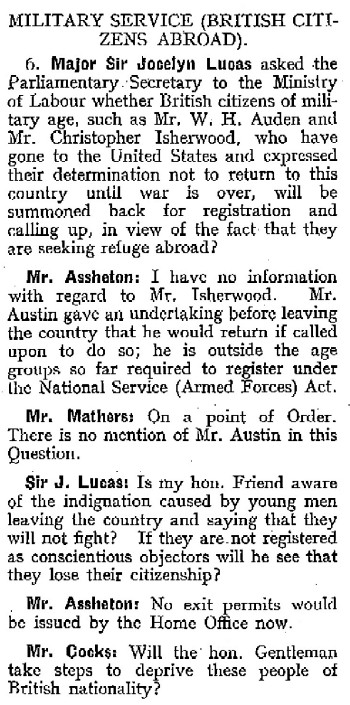
So I was quite surprised when I went to the Parliamentary Debates for June 13, 1940, and discovered that the question raised in the House of Commons was not so much the rhetorical "Where are our war poets?", but the much more literal, "Do you know where Messrs. Auden and Isherwood have got to?"
The question, of course, was what to do about British men of required registration age (between 18 and 41 years old, according to the National Service [Armed Forces] Act of September 3, 1939), who were abroad either by choice or necessity. W.H. Auden had emigrated with Isherwood to New York City in 1939, was 33 years old in 1940, and became a U.S. citizen in 1946.