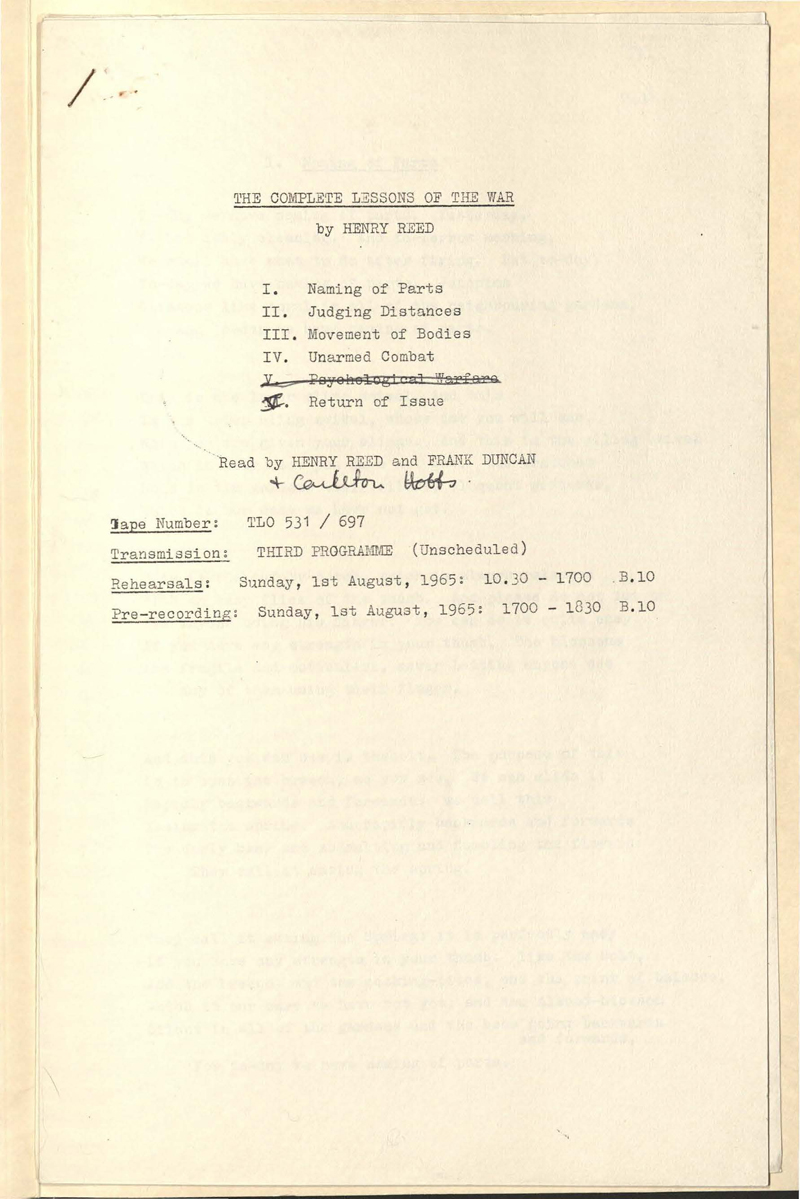
Here is a unique opportunity to see Henry Reed's editing process, over the span of five years' time. Below are shown two scripts for the BBC broadcasts of Reed's The Complete Lessons of the War, the first from February, 1966, and the second from a later broadcast, in December 1970. The 1970 program was in conjunction with the collection Lessons of the War, published by Reed's producer, Douglas Cleverdon and his press, Clover Hill Editions.
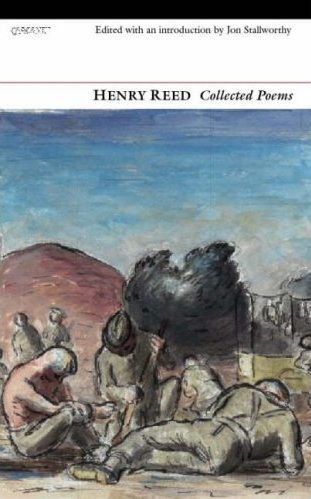
On the front page of the script from 1965, you can see that — in addition to the five Lessons of the War poems read on the air on Radio 3 — the poem "Psychological Warfare" was also scheduled, but ultimately crossed out. Reed was obviously unhappy with it, and it was still unfinished before 1970. "Psychological Warfare" was not published until Reed's Collected Poems appeared in 1991 (edited by Jon Stallworthy), and actually made its debut in March of that year, in the London Review of Books.
The scripts for the other Lessons of the War poems, "Naming of Parts," "Judging Distances," "Unarmed Combat," and "Movement of Bodies," are all the same. But Reed continued to revise "Returning of Issue" — which he always kept last as the coda to the Lessons of the War sequence — until the poems were published in collection. The billing for 1970's Complete Lessons of the War states that "The fifth poem, Returning of Issue, has been largely rewritten since the programme was first broadcast in 1966. This new version has been re-recorded."
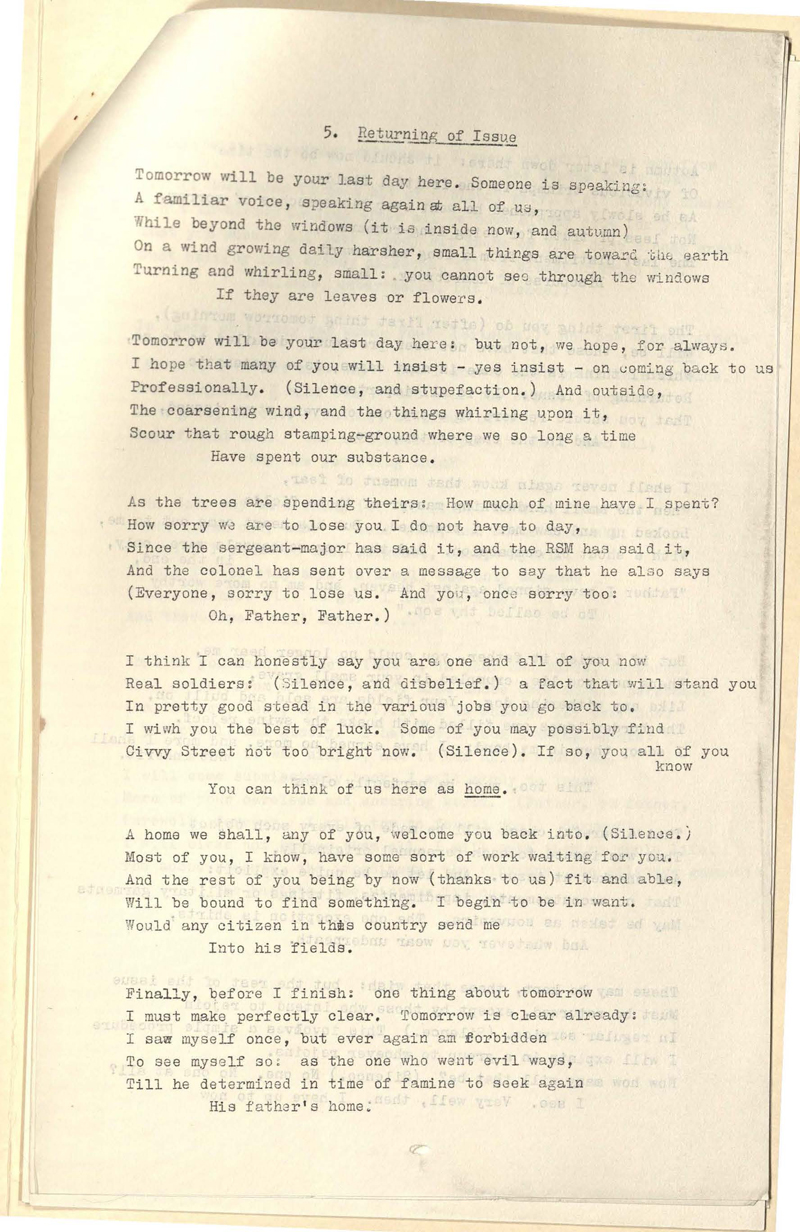
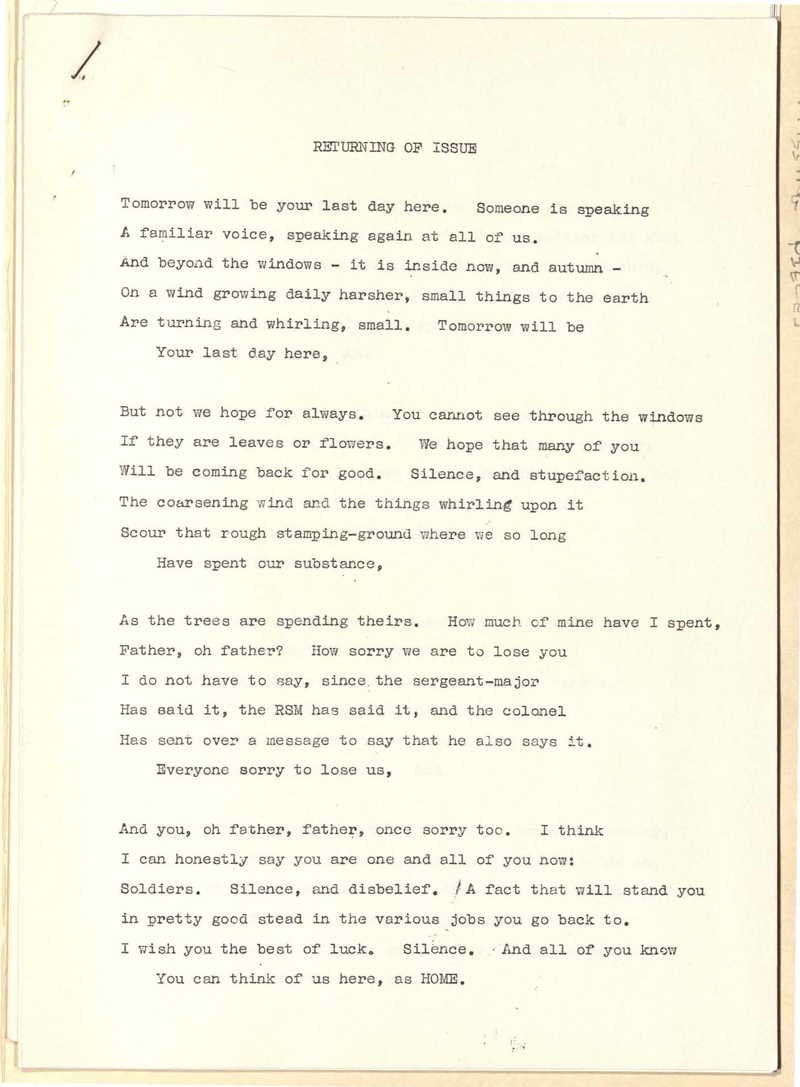
Notice the text cut between the two, the dispensable adjectives lost, and the line breaks shifted:
In the 1965 script for broadcast, the first two stanzas are (and in direct contrast to the season of spring from "Naming of Parts" in 1946):
Tomorrow will be your last day here. Someone is speaking:
A familiar voice, speaking again at all of us,
While beyond the windows (it is inside now, and autumn)
On a wind growing daily harsher, small things are toward the earth
Turning and whirling, small: you cannot see through the windows
If they are leaves or flowers
Tomorrow will be your last day here: but not, we hope, for always.
I hope that many of you will insist — yes insist — on coming back to us
Professionally. (Silence, and stupefaction.) And outside,
The coarsening wind, and the things whirling upon it,
Scour that rough stamping-ground where we so long a time
Have spent our substance.
While in the 1970 script, rewritten and re-recorded for the new broadcast, we find the whole poem much improved, and restructured to conform more with the other early Lessons poems. The revised stanzas are as follows:
Tomorrow will be your last day here. Someone is speaking
A familiar voice, speaking again at all or us.
And beyond the windows — it is inside now, and autumn —
On a wind growing daily harsher, small things to the earth
Are turning and whirling, small. Tomorrow will be
Your last day here,
But not we hope for always. You cannot see through the windows
If they are leaves or flowers. We hope that many or you
Will be coming back for good. Silence, and stupefaction.
The coarsening wind and the things whirling upon it
Scour that rough stamping-ground where we so long
Have spent our substance,
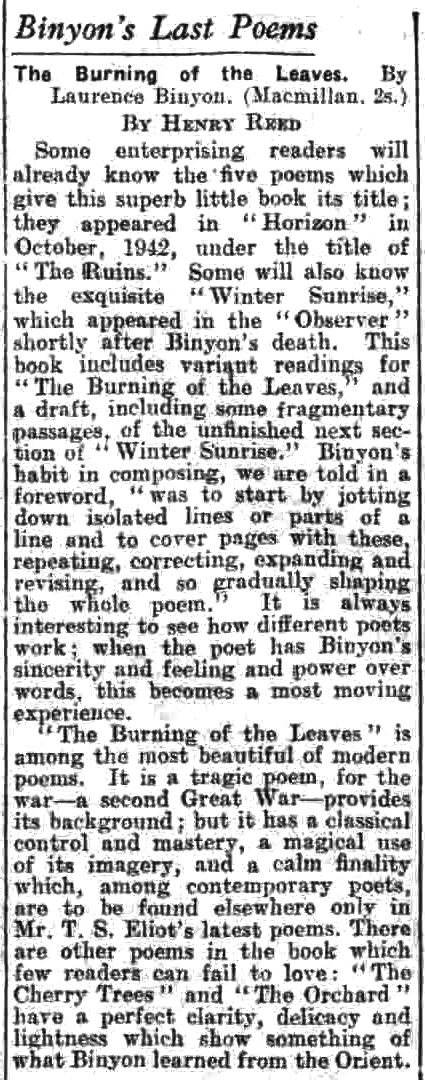
Re-entering the time machine that is the British Newspaper Archive, I have turned up another couple of early book reviews by Henry Reed, in his hometown Birmingham Post during 1944 and 1945. Here, Reed reviews the posthumously published "last" poems by Laurence Binyon (December 27, 1944, p. 2), including the titular "The Burning of the Leaves," written during the London Blitz:
"They will come again, the leaf and the flower, to arise
From squalor of rottenness into the old splendour.
And magical scents to a wondering memory bring;
The same glory, to shine upon different eyes.
Earth cares for her own ruins, naught for ours.
Nothing is certain, only the certain spring."
Interestingly here, Reed refers to the ongoing war as "a second Great War": a war he was still enduring in 1944, working in the Japanese section of Bletchley Park.
Binyon's Last Poems The Burning of the Leaves. By
Laurence Binyon. (Macmillan. 2s.)
By Henry Reed
Some enterprising readers will already know the five poems which give this superb little book its title; they appeared in "Horizon" in October, 1942, under the title of "The Ruins." Some will also know the exquisite "Winter Sunrise," which appeared in the "Observer" shortly after Binyon's death. This book includes variant readings for "The Burning of the the Leaves," and a draft, including some fragmentary passages, of the unfinished next section of "Winter Sunrise." Binyon's habit in composing, we are told in a foreword, "was to start by jotting down isolated lines or parts of a line and to cover pages with these, repeating, correcting, expanding and revising, and so gradually shaping the whole poem." It is always interesting to see how different poets work; when the poet has Binyon's sincerity and feeling and power over words, this becomes a most moving experience.
"The Burning of the Leaves" is among the most beautiful of modern poems. It is a tragic poem, for the war—a second Great War—provides its background; but it has classical control and mastery, a magical use of its imagery, and a calm finality which, among contemporary poets, are to be found elsewhere only in Mr. T. S. Eliot's latest poems. There are other poems in the book which few readers can fail to love: "The Cherry Trees" and "The Orchard" have a perfect clarity, delicacy and lightness which show something of what Binyon learned from the Orient.
Two videos have appeared, with former poet laureate Robert Pinksy using Henry Reed's famous parody of T.S. Eliot's Four Quartets as a teaching tool, in Boston University's Art of Poetry Video Repository.
In the first, Pinsky delivers an excellent reading of "Chard Whitlow" (written by Henry Reed in 1941 and subtitled "Mr. Eliot's Sunday Evening Postscript," after this poem), and then compares it with a selection from Eliot's "East Coker":
Followed up with this conversation with some first-time Reed (and Eliot) readers:
Pinsky's point being that effective parody is more than just kidding around: it can help the reader appreciate or even understand the source material better. "Chard Whitlow" is possibly the best example of this, because it can be backed up with Eliot's own statement (also read by Mr. Pinksy):
Most parodies of one's own work strike one as very poor. In fact, one is apt to think one could parody oneself much better. (As a matter of fact, some critics have said that I have done so.) But there is one which deserves the success it has had, Henry Reed's "Chard Whitlow."
In 1970, Henry Reed was recorded reading eight of his poems, as part of a series co-sponsored by the British Council and the Woodberry Poetry Room in the Lamont Library of Harvard University. The series was The Poet Speaks, created by Peter Orr, then the head of the Recorded Sound Department at the British Council.
Not only were contemporary British and American poets invited to record their work, but they were interviewed by Orr, Hilary Morrish, John Press, and Ian Scott-Kilvert: talking about poetry, the craft of writing, and being a poet (notably among the interviewees, Sylvia Plath). Many of these recordings were released on LP records by Argo Records, starting in 1965.
Some of the recordings for The Poet Speaks, however, were never commercially released, including those of Henry Reed. But they still exist on reel-to-reel tapes, thanks to the preservation efforts of the Houghton Library at Harvard University (TAPE ARCHIVE PR6035.E32 A6 1970x). Here's just a sample in honor of National Poetry Day in the UK, Henry Reed's "The River":
This recording is reproduced with the generous permission of the British Council, the Woodberry Poetry Room at Harvard University, and the Royal Literary Fund. And there's more. Much more, coming soon!
Let us take note of this footnote to a Gavin Ewart poem. Ewart (1916-1995) is known around these parts for his frequent comparison to Reed — Ewart's contemporary — particularly for his Second World War poem, "The Bofors A.A. Gun."
I'm terribly excited—
I have been invited
to join that great bunch of nonentities
who have the inflated identities,
such as Lord Leatherhead and Viscount Foxford
(who knew all the right—or were they the wrong?—
people at Oxford),
metallurgists, musicians,
phenomenologists, physicians
(and almost anyone in Debrett is
sure to be in with the celebrities—
but it's not so common for the neglected scribbler
to get into this exclusive club before he's senile
or a dribbler);
though there you might someday find it,
when you were halt, lame and blinded,
your name—is it really a good dropping one?
Though once one's in there's no stopping one,
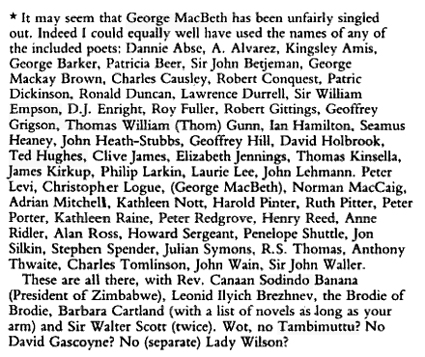
one can drawl, like MacBeth★, 'Oh course I'm in Who's Who now,'
one's poetic specific gravity is certainly multiplied
by more than two now!
I'll be there with the great ones,
the truly honoured-by-the-State ones,
in that Never-Never-Land fathers
never reached (though both my grandfathers),
with conservative academics, donnish and prudish;
among the old women of both sexes my name may seem
a tiny bit rudish?
But the military, the Naval, the flying
(who don't mind people dying),
the Earls and the epistemologists,
the dentists, divines and Catholic apologists,
those who in stately homes discuss a cru or a crumpet,
though they won't like it at all, I'm sure, will just
have to lump it!
[pp. 118-119]
And the MacBeth footnote? (The Scottish poet, not the play.) I've pieced it back together, in toto:
I am particularly fond of the sequence "Pinter Pitter Porter," which I think transforms the footnote into a sort of list poem, and makes it an integral part of Ewart's ode.
Reed seems to have become equally disenchanted with his appearance in Who's Who: he was first added to the rolls as early as 1952, but his 1977 entry contains his personal revisions to his bio and publications.
Excellent synopses of two of Reed's classically-themed poems can be found in Past Ruined Ilion: A Bibliography of English and American Literature Based on Greco-Roman Mythology, by Jeanetta Boswell (Metuchen, NJ: Scarecrow Press, 1982). Oddly, Boswell neglects the third poem in the triptych, "Antigone."
REED, Henry (1914- , English)
1015 "Chrysothemis," in A Map of Verona. London: Cape, 1946. This daughter of Agamemnon and Clytemnestra is presented, as a minor character, only in Sophocles' "Electra." In this play she is sympathetic to her sister's loyalty to their murdered father, but is opposed to defying Clytemnestra and Aegisthus. In Reed's poem, narrated by Chrysothemis herself, she is the haunted survivor of the many tragedies that befell the House of Atreus. She is haunted by the memory of her father's murder at the hands of her mother and Aegisthus; she remembers her brother, Orestes, who later killed Clytemnestra and Aegisthus; she recalls Orestes and Electra fleeing for their lives—she alone remains, to protect and watch over the innocent children of Clytemnestra and Aegisthus. She declares herself "not guilty of anybody's blood," and yet the conclusion of the poem raises the question of her guilt: was she guilty by means of association, by what she did not do rather than what she did? Finally, the all-important question, will she protect the innocent children, or will the old avenging fury fall on them also? There is little mythology concerning these children—a son, Aletes, and a daughter, Erigone. One source says that Orestes killed them when he returned from exile after his mother's death.
1016 "Philoctetes," in A Map (1946), is a lengthy monologue in which the hero reviews his past life and tries to analyze his future. Ten years ago he had been put ashore on the island of Lemnos by Odysseus and other men of the ship because they could no longer bear the stinking wound that Philoctates [sic] had incurred. With him they also put ashore his bow and arrows, the gift that he had inherited from Heracles. Through all these years he has suffered—mentally, from the isolation and loneliness, and physically, from the great wound that would not be healed. He grew bitter and rancorous, but always he knew that Troy could not be taken without him and his bow and arrows. Now they have come for him, and he says, "I have changed my mind; or my mind is changed in me." He prepared to depart with Neoptolemus, the son of Achilles, and Odysseus, whom he has hated above all others. "The wound is quiet, its death/ Is dead within me," he says.
I'm a sucker for a good list poem. Henry Reed's "Naming of Parts" is a list poem, of the cockamamie, villanelle sort. A list poem that includes Henry Reed? That much better. The last one we had, I think, was Anthony Thwaite's "On Consulting 'Contemporary Poets of the English Language'," from the anthology New Poetry (1976), edited by Patricia Beer.
Not surprisingly, this poem also comes from New Poetry (Julian Symons, ed., 1983): "Contemporary Dearth," by Valerie Blake. Blake has a little something to say about Dame Edith Sitwell's decision not to be included in Kenneth Allott's 1950 survey, The Penguin Book of Contemporary Verse (something about which her brother Sachie, apparently, had no qualms):
Contemporary Dearth
Miss Edith Sitwell, from whose work I had selected two 'late' pieces
for inclusion. . .felt unable to grant my request on the ground that
this selection would not do her justice. . .
Yeats and Eliot, Wyndham Lewis
Lawrence, Joyce and de la Mare;
John Heath-Stubbs and William Plomer
Francis Scarfe and Edwin Muir.
Sidney Keyes and David Gascoyne
Williams, Charles, and Laurie Lee;
Lawrence Durrell, Peter Quennell
Herbert Read and Watkins, V.
Normans Nicholson and Cameron
Terence Tiller, Wilfred O.;
Blunden, Rosenberg and Huxley
Empson, Auden, H. Monro.
Robert Graves and Alun Lewis
Edward Thomas, Barker, G.;
Michael Roberts, Dylan Thomas
Fuller, Roy, Day Lewis, C.
Siegfried Sassoon and Arthur Waley
Andrew Young and Henry Treece;
Heppenstall, R., and W. R. Rodgers
Kathleen Raine and Louis MacNeice.
Kenneth Allott, Stephen Spender
Richard Church and Spencer, B.;
Betjeman, John, Sacheverell Sitwell
Henry Reed and Prince, F. T.
Campbell, Roy, Charles Madge, Anne Ridler
Patric Dickinson, Alan Hodge;
Lehmann, John, and Laurence Binyon
Warner, Rex, and Ruthven Todd. . . .
As a result there is a gap, which I regret, in the representative nature
of this collection.
Kenneth Allott, Editor, The Penguin Book of Contemporary
Verse, 1950.
Did Henry Reed play a part, however small, in Vita Sackville-West's renouncement of poetry? In 1946, the Incorporated Society of Authors was charged with putting together a poetry recital of classic and modern verse for the Royal Family. A committee was convened, chaired by Denys Kilham Roberts (the Society's secretary-general), which included George Barker, Louis MacNeice, Walter de la Mare, Henry Reed, Edith Sitwell, Dylan Thomas, and Sackville-West.
Vita Sackville-West (cousin to Edward "Eddy" Sackville-West) was a prize-winning author and a poet, famous for her bisexual romances, including a long relationship with Virginia Woolf. By 1946 she had published fourteen novels, five scholarly biographies, and ten volumes of poetry (not including a Collected Poems in 1933).
In Henry Reed's review of Walter de la Mare's Complete Poems (The Sunday Times, January 15, 1970), Reed makes mention that his first and only meeting with de la Mare took place at one of the meetings of the Poetry Committee:
On the one occasion I had the honour of meeting de la Mare—after some rather fractious gathering convened to decide which verses in our language might not be too tedious or indecent for the young ears of the Royal Family—I fervently recorded this fact to him. He was too modest to believe it; but eagerly, in a damp, dark Chelsea street, he told me of the barely credible circumstances of his first meeting with Hardy, in 1921.
It may be, perhaps, that the "damp, dark Chelsea street" Reed describes is somewhere in the vicinity of the offices of the Society of Authors, 84 Drayton Gardens, London.
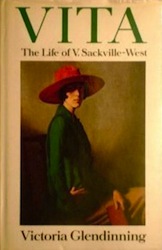
At least one meeting took place in the King's Bench Walk offices of Denys Kilham Roberts, barrister at law; in order to choose which poems would be read at the recital, and by whom. In Victoria Glendinning's biography, Vita: The Life of V. Sackville-West (London: Weidenfeld and Nicolson, 1983), we have this account:
In March she went to a meeting of the Poetry Committee of the Society of Authors, chaired by Denys Kilham Roberts at his rooms near Harold's [her husband, Sir Harold Nicolson] old apartment in King's Bench Walk. The committee—which included Edith Sitwell, Walter de la Mare, Henry Reed, Dylan Thomas, Louis MacNeice and George Barker—was to plan a poetry reading to be held at the Wigmore Hall in the presence of the Queen. Vita made no comment in her diary at the time; only in 1950, in depression, did she write: 'I don't think I will ever write a poem again. They destroyed me for ever that day in Denys Kilham Roberts' rooms in King's Bench Walk.'
(p. 341)
Sackville-West, whose long poem The Garden (London: Michael Joseph, 1946) was just about to be published, was not selected to read her verses for the Queen. "I am prepared to devote all my energies to the garden, having abandoned literature," she wrote, despairingly (Glendinning, p. 341). In truth, she was to end up devoting all her literary energy to gardening: in 1947 she began an immensely popular column for The Observer called "In Your Garden," and the following year became a founding member of the National Trust's garden committee. As a matter of fact, when I was attempting to define the species of flowers in Reed's "Naming of Parts," I turned to the second of Sackville-West's collected essays, In Your Garden, Again (London: Michael Joseph, 1953):
October 14, 1951
It started its career as Pyrus Japonica, and become familiarly known as Japonica, which simply means Japanese, and is thus as silly as calling a plant 'English' or 'French.' It then changed to Cydonia, meaning quince: Cydonia japonica, the Japanese quince. Now we are told to call it chaenomeles...[.]
(p. 134)
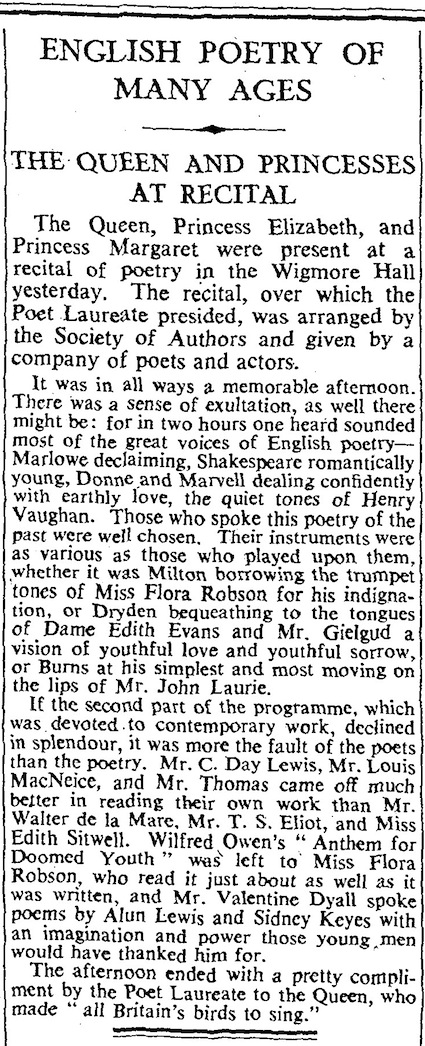
The recital took place on Tuesday, May 14, 1946, at Wigmore Hall. The Queen, Princess Elizabeth, and Princess Margaret were in attendance. John Masefield, the Poet Laureate, presided. The actors Valentine Dyall, Edith Evans, John Gielgud, John Laurie, and Flora Robson read classics of English verse, while C. Day Lewis, T.S. Eliot, Louis MacNeice, Walter de la Mare, Edith Sitwell, and Dylan Thomas presented a selection of more modern poems, which were somewhat less well-received. Thomas, apparently, "at one stage in the proceedings was seen to flick his cigarette ash in the Queen's lap" (Victor Bonham-Carter, vol. 2 of Authors by Profession. London: Bodley Head, 1984, p. 302). This announcement appeared the next day, in The Times:
When I was looking up sources for my previous post on the breaking of Japanese naval codes at Bletchley Park, I stumbled upon an excerpt from a poem by Patrick Wilkinson (1907-1985), a Vice-Provost of King's College and Horace scholar, who had been part of the Italian Naval Section at Bletchley.
In the book Diplomacy and Intelligence During the Second World War: Essays in Honour of F.H. Hinsley (Langhorne, ed. Cambridge University Press, 2004), Christopher Andrew quotes a poem by Wilkinson, "The Other Side," which he describes as an "epic wartime poem" in which the denizens of Bletchley Park are "transformed into the heavenly host." The book is a collection of essays in honor of Harry Hinsley, who studied traffic analysis of German intercepts at Bletchley, was instrumental in the Allied effort to capture Enigma codebooks from enemy weather ships, and later became an historian of British wartime intelligence. Wilkinson wrote:
Wings of all colours from their shoulders grew
From ADCOCK-pink to heavenly LUCAS-blue,
A dazzling sight. On Mrs. EDWARDS' head
There beamed a halo of unearthly red;
STRACHEY'S was black and of stupendous size,
But for extension HINSLEY'S took the prize.
A footnote explains that "[Frank] Adcock had a very pink face; F.L. Lucas, another King's classicist, always wore a sky-blue jackets. Oliver Strachey, brother of Lytton and a founder member of GC & CS, wore a broad-brimmed black hat." (Apologies for the profusion of Wikipedia links in this post. I assure you, they are solely for my benefit, not yours!) "Mrs. Edwards" may be Professor Eve Edwards, in charge of the Japanese courses at the School of Oriental and African Studies during the war.
Aside from this one stanza, the only additional mention of the poem I can find is in a review of Hinsley and Stripp's Codebreakers (Oxford University Press, 1993), in which Noel Annan complains, "Why was not Patrick Wilkinson's droll account of the gaiety, the jokes, the scorn for the 'Other Side' — ie, the spy-masters — published?" Why indeed, when it would seem to be such a unique and colorful perspective of the staff and inner-workings of Bletchley?
1529. Sackville-West, Vita. "Seething Brain." Observer (London), 5 May 1946, 3.
Vita Sackville-West speaks admirably of Reed's poetry, and was personally 'taken with the poem called "Lives," which seemed to express so admirably Mr. Reed's sense of the elusiveness as well as the continuity of life.'
Carol Muske-Dukes, the poet laureate of California, has been holding an extended conversation over the past five months with Lieutenant Colonel Edward Ledford, U.S. Army, and posting the exchanges over at The Huffington Post. Colonel Ledford is stationed in Kabul, Afghanistan, and has been taking the time to share his thoughts on war, poetry, and the poetry of war.
In the first part, "Soldier to Poet: An Exchange," we meet Lt Col Ed Ledford (photo), and learn that in addition to flying helicopters and jumping out of airplanes, he has taught English at the University of Alabama and the United States Military Academy at West Point. Prompted by Muske-Dukes, Ledford talks about the romanticism of war, cowardice and conscience, and by turns, Hamlet.
In Part II, they cover Wilfred Owen and the old lie, "Dulce et decorum est pro patria mori."
The latest exchange, Part III, finds the pair going over "Naming of Parts." Ledford considers April, and spring in Afghanistan, and says:
The first lines point me back to the creation myth and allegorical Eden. Adam 'gave names to all cattle, and to the fowl of the air, and to every beast of the field.' He was on the verge of something: shortly after — the temptation, the fall, the migration to a world of pain, suffering, and death.
And those first lines do put us on the verge of something — today we name; tomorrow is 'what to do after firing.' Between today and tomorrow, we're firing the weapons, and that means one thing — engagement, combat, casualties. These are apparently new troops in training, one could argue that the firing will be at a rifle range, harmless.
But let's not fool ourselves: the firing at the range is a cold rehearsal of killing, firing at paper or plastic silhouettes of the human form — flat, faceless, nameless, anonymous representations of the innumerable and unnameable casualties, very many of whom will suffer agonizing deaths or agonizing lives.
Ledford procedes to uncover the language of "Naming of Parts," camouflaged in a Q&A which took place between Donald Rumsfeld and American soldiers on the eve of the Iraq War, turning the hollow-sounding responses into a found poem:
As you know, you go
to war
with the Army you have.
They're not the Army
you might want
or wish to have
at a later time.
If you think
about it,
you can have
all the armor
in the world
on a tank
and a tank
can be blown
up.
It is something
you prefer not to have to use,
obviously,
in
a perfect world.
It's been used
as little as possible.
Lt Col Ledford is contributing to "Crossing State Lines, an American Renga," a conversation-poem between 54 poets, part of the America: Now + Here project—a mobile, cross-country exhibition of artists, writers, and musicians—scheduled for spring, 2011.
Our constant friend, Bruce, directs us to a lecture by Professor Jon Stallworthy, speaking at the Teaching World War I Literature Conference, held at Oxford University Computing Services, in November of 2007. The conference was convened (according to Stallworthy) in order to discuss the teaching of First World War literature in secondary and tertiary education, with special reference to three topics: 1) The relevance, today, of the poetry of the Great War, 2) whether the canon of that poetry should be extended, and 3) the wider topic of war poetry, and how the poems of the Great War should fit into that category.
Stallworthy argues that society today is suffering from a sort of "trench-tunnel vision," and that our collective newsreel seems to be "jammed at the Somme, in 1916." He makes the case that the current curriculum could be benefited if it "replaced some of the weaker poets of the First World War with some of the stronger poets of the Second," and he goes on to outline such a syllabus, to include: the call to arms for poets during the Spanish Civil War; the American poets; poems by veterans; and, specifically, the work of John Balaban, a conscientious objector who was in Vietnam during the Tet Offensive. The talk is about 30 minutes long:
Professor Jon Stallworthy, Teaching World War One Literature
Amusingly, at several points during his presentation, Stallworthy is compelled to admit that he, himself, is at least partly to blame for the continuing over-emphasis on and popularity of First World War poetry.
There also appears (at about 7:15) an amazing mention of a failed proposal to install a plaque at Poet's Corner for the poets of World War II, including Henry Reed. Stallworthy says:
How often have we all had to ask the question, 'Why, when there was so much marvelous poetry from the First World War, was there none from the Second?' The double misperception can only be the fault of an educational system that over-values the one, and is ignorant of the second.
If you doubt the accuracy of that statement, consider these facts: First, that in Poet's Corner of Westminster Abbey, a stone commemorating the poets of the Great War carries the names of Laurence Binyon, Wilfred Gibson, Robert Nichols, and Herbert Read, among others. Second, that the Dean of Westminster and his advisors have rejected a proposal that a similar stone, commemorating voices from the Second World War, should be erected to carry the names of four much better poets (of whom I'll have more to say, later): Keith Douglas, Sidney Keyes, Alun Lewis, and Henry Reed.
Curiously, I can't find any other references to the proposed memorial for World War II poets. That would be a big deal! Do you know anything about it?
...where Colin Wilson was heeling and pointing out
with flushed-to-the-eyeballs tweedy Henry Reed
naming his parts indifferently for the amusement
of oracular almost-sober Louis MacNeice
whose bagpipe gaze caught Sonia Orwell ready
to leave the guest of honor...
A poem by David Wagoner, from the Hudson Review, Summer, 2009. He seems to be describing an actual party hosted by Stephen Spender, which would have taken place on an evening in October or November of 1956, in the midst of the Hungarian Revolution. According to Wagoner's text, Cyril Connolly, John Hayward, Rose Macaulay, Herbert Read, and Allen Tate were also in attendance.
In the poem, Wagoner specifically mentions St. John's Wood as the destination, and that makes sense, as the Spenders had been living in Loudoun Road (photos on Flickr) since 1945.
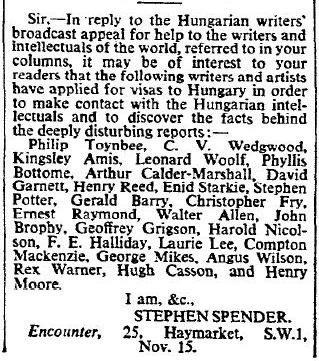
On November 16, 1956, the Times printed a letter from Spender which listed the writers and artists he had garnered in support of the (ultimately lost) Hungarian cause, including Reed:
Edmund Blunden says Reed's Lessons of the War poems 'have captured something of the time-spirit and ambiguity of the recent war in a style of wit and deep feeling united.'
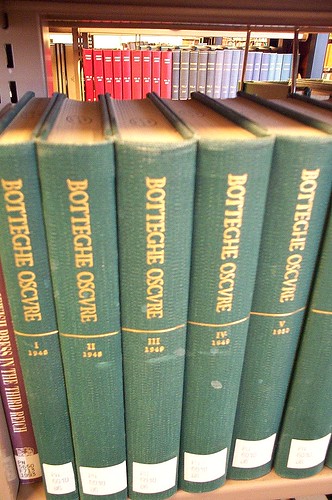
Botteghe Oscure was an international, multi-language literary review which ran for twenty-five issues between 1948 and 1960. The title means "dark shops"—named for the street in Rome where the editorial offices were located. Published twice a year in the spring and fall, the journal offered three- and sometimes five-hundred pages of poetry and prose in Italian, French and English, with alternating issues featuring German and Spanish-language segments. It was edited by Marguerite Caetani, the Princess di Bassino.
The second issue of 1948 features "Poeti Inglesi e Americani," and the table of contents reads like Who's Who: with W.H. Auden, Ronald Bottrall, Lilian Bowes Lyon, Jocelyn Brooke, Hamish Henderson, Walter de la Mare, Laurie Lee, C. Day Lewis, Norman Nicholson, Kathleen Raine, Henry Reed, W.R. Rodgers, Edith Sitwell, and Vernon Watkins representing Great Britain; and Conrad Aiken, Leonie Adams, Hayden Carruth, E.E. Cummings, Owen Dodson, Richard Eberhart, Edward Field, Marianne Moore, Theodore Roethke, Karl Shapiro, Theodore Spencer, William Jay Smith, Dunstan Thompson, William Carlos Williams, and Richard Wilbur for the Americans.
Reed's contribution is an obscure poem titled "Ars Poetica," which (I was disappointed to discover) does actually turn up in the Collected Poems, as "De Arte Poetica." The poem is a long meditation on writer's block, regret, and the author's inability to reconcile his past and future. The two versions are not entirely the same, and Reed seems to have made changes following the poem's appearance in print. Jon Stallworthy, in the textual and bibliographical notes for Reed's Collected Poems, tells us:
de arte poetica (? c.1940). Text from an unidentified cutting among HR's papers, with the title 'Ars Poetae' altered as here, and with numerous (? provisional) autograph revisions in the author's earliest—i.e. 1940s—hand. Lines 53-59 are cancelled, but as no replacement lines are offered they have been restored here.
[p. 163]
So, it would seem that quaderno due of Botteghe Oscure, secundo semestre 1948, is likely the source of the "unidentified cutting" in Reed's papers, despite the slight divergence in the titles. This could easily be confirmed if the cutting displays the journal's pagination (pp. 262-64), and Kathleen Raine's "Self," on the reverse of the first page. If Reed was making revisions directly on his copy of the version published in 1948, then his amendations may have gone on into the 1950s.
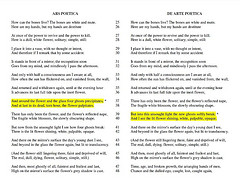
I put together a quick, side-by-side comparison of the two versions of Reed's poem, with the 1948 text on the left side, and Reed's revised version from the Collected Poems on the right. As you can see, everything up to line 36 is exactly the same, he only did away with two couplets, and slightly changed the wording of another to better mate with his changes (.pdf document):
If Reed ever thought of better lines to replace those he "cancelled," they have not been found.
As a multi-lingual literary journal, Botteghe Oscure provides Italian translations of all the poets in this issue, with "Traduzioni a cura di Salvatore Rosati, A.G., Nina Ruffini, Henry Furst, e G.B", in a sort of appendix. Reed's poem is credited as being translated by "A.G." The first issue from 1948 contains an article by the critic and translator Augusto Guidi, so I think it's safe to say he managed the adaptation in Italian.
I'll close here with a few lines from Horace's Ars Poetica, which surely Reed was referencing, and probably knew by heart:
It's not enough for poems to have beauty: they must have
Charm, leading their hearer's heart wherever they wish.
As the human face smiles at a smile, so it echoes
Those who weep: if you want to move me to tears
You must first grieve yourself: then Peleus or Telephus
Your troubles might pain me: speak inappropriately
And I'll laugh or fall asleep. Sad words suit a face
Full of sorrow, threats fit the face full of anger,
Jests suit the playful, serious speech the solemn.
Nature first alters us within, to respond to each
Situation: brings delight or goads us to anger,
Or weighs us to the ground, tormented by grief....
I'm not in the habit of buying Reed ephemera online, though I've occasionally done so in the past. I bought a couple of old Listener issues which are rather difficult to find in libraries in the States, and if I were a richer man, I might consider buying a whole forest's worth of Radio Times back issues. So I was rather torn when I found this short article in The Bookseller for March 3, 1951:
Poetry Sold in Cambridge Streets
Some enterprising Cambridge undergraduates have been trying the effect of offering modern poetry for sale in the streets. The first experiment took place on a Saturday—a market day in Cambridge—and out of 2,000 copies printed, about 1,100 were sold. A further 200 copies were disposed of afterwards.
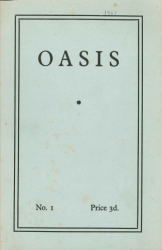
The publication offered was the first issue of a series of pamphlets of poetry, entitled Oasis. The selling price is 3d. The first issue contained poems by W.B. Yeats, T.S. Eliot, W.H. Auden, Stephen Spender, C. Day Lewis, Louis MacNeice, Robert Graves, Dylan Thomas, and Henry Reed. In the next issue, work of lesser-known poets will be printed; and for May Week the organisers hope to bring out a Cambridge Poetry for the previous year.
The aim of the scheme is to overcome present-day apathy to poetry. 'All the authors and publishers allowed us to reprint these poems without fee,' writes Mr. David Stone, of Queens' College. 'Without this help it would have been very difficult to sell the pamphlet at a price attractive to everyone. There has been some disapproval of the street-selling, but most seemed to think it was a good idea.' The pamphlet carried an invitation: 'If you enjoy this selection and are interested in modern poetry come and hear these and other poems read and ask questions to-morrow evening at the Union.' The reader, on the Sunday evening, was Mr. Hamish Henderson.
(p. 344)
At first I was a bit confused by the title, since Reed also makes an appearance in the Salamander Oasis Trust'sFrom Oasis into Italy: War Poems and Diaries from Africa and Italy, 1940-1946 (Victor Selwyn, et al., eds., 1983), but this was evidently an entirely different oasis of poems, a student-published pamphlet from Trinity College, University of Cambridge. According to A Literary History of Cambridge (rev. ed., 1995),
Oasis [was] founded in 1950 by John Mander of Trinity and David Stone of Queens' in conjunction with a series of readings at the Union, was sold directly on the streets by what Gunn called 'a kind of suicide squad' of enthusiasts. It was bought in remarkable numbers (up to three thousand per issue), giving it the largest circulation of any poetry magazine in England. The first issues were devoted to major poets like Yeats and Eliot, later ones to undergraduate work. Fifteen hundred poems were submitted for the Oasis poetry competition. One of the winners was Thom Gunn (who was also on the editorial board).
(p. 275-76)
Gunn would later write of the students' experience hawking poetry in the streets of Cambridge for The Bookseller: "Oasis: An Experiment in Selling Poetry" (March 15, 1952, p. 782).
My curiosity got the better of me, finally, and I went poking around online until I found a bookstore in the UK which was offering copy of Oasis, no. 1 (1951). A short wait for trans-Atlantic airmail later, and I was sitting under the yellow lamp in my living room, magazine in hand. From the editors' foreword:
'Oasis' is the first in a series of pamphlets of poetry. Our aim is to show by a representative selection of good contemporary poetry just what sort of poem has been written in the last decades. In this selection there are many styles and many moods. Poets write about everyday subjects—see if you agree with the last two lines of Louis MacNeice's poem: they write about newsreels, love, religion, the futility of war; Henry Reed makes a poem out of naming the parts of a rifle.
We should like to devote future numbers of 'Oasis' to the works of other poets: and perhaps we might find enough good undergraduate poetry here to fill an issue with Cambridge writers.
Modern poetry is always said to be obscure: we hope you will read these poems and judge for yourselves.
This is followed by the epigraph: "When I hear the word culture I reach for my revolver," a popular paraphrase of Hanns Johst, from his pro-Nazi play, Schlageter (1933): "Wenn ich Kultur höre... entsichere ich meinen Browning!"
I guess I had been hoping to discover an obscure, perhaps unknown poem from Henry Reed, but the issue was, as advertised, devoted to well-known, previously-published poems from established poets. A slim volume at only 12 pages, it contains "For Anne Gregory," by W.B. Yeats; "Journey of the Magi," by T.S. Eliot; "Culture," by W.H. Auden; "Regum Ultima Ratio," by Stephen Spender; "Newsreel," by C. Day Lewis; "Bagpipe Music," by Louis MacNeice; "No More Ghosts," by Robert Graves; "Among Those Killed in the Dawn Raid Was a Man Aged a Hundred," by Dylan Thomas; and, of course, Reed's "Naming of Parts."
1524. Reed, Henry. Letters to Graham Greene, 1947-1948. Graham Greene Papers,
1807-1999. Boston College, John J. Burns Library, Archives and Manuscripts Department, MS.1995.003. Chestnut Hill, MA.
Letters from Reed to Graham Greene, including one from December, 1947 Reed included in an inscribed copy of A Map of Verona (1947).
The smallest of book reviews appears in the August 23, 1946 Spectator's "New Poetry". Sheila Shannon critiques Grigson's Isles of Scilly; Talking Bronco, by Roy Campbell; The Voyage and Other Poems, by Edwin Muir; and Henry Reed's A Map of Verona. She begins by invoking the Romantics:
Shelley, in his preface to The Revolt of Islam, defined as one of the most essential attributes of poetry 'the power of awakening in others sensations like those animate in my own bosom.' It is an attribute often overlooked, this power to communicate not ideas or images but sensations, to reach at some moment the heart of the reader; it is not perhaps the most important, but it is an essential one.
Shannon then devotes half a page to Grigson, spends half a page on Campbell, a mere two paragraphs on Muir, and can finally only lend five sentences to Reed, without so much as a quote.
Henry Reed's first book—A Map of Verona—provides (I can only say for me) a great deal of enjoyment. Here is a young poet. All sensation if you like; but sensation springing from imagination with the true poet's gift of making the real imaginary. It is highly romantic, young poetry, but written by someone with an ear and a self-indulgent appreciation of words and their musical and evocative power. At present the obvious influence is T.S. Eliot, but Mr. Reed has a strong enough talent to assimilate in time even so seductive a master.
Sheila Shannon (p. 198)
At least they were most favorable sentences! I particularly relish her turn of phrase, about true poets "making the real imaginary."
Sheila Shannon was married to Patric Dickinson, and was both a poet and editor of poetry. Her poems appeared in the Spectator, Observer, and Poetry London, and were collected in The Lightning-Struck Tower (1947).
1523. Reed, Henry. "Simenon's Saga." Review of Pedigree by Georges Simenon, translated by Robert Baldick. Sunday Telegraph (London), 12 August 1962, 7.
Reed calls Pedigree a work for the "very serious Simenon student only," and disagrees with the translator's choice to put the novel into the past tense.
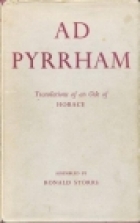
It is always encouraging to find someone who has an odder pastime than yourself. Often, it's uncomfortable when I finally have to break down and tell certain people what I'm working on—that I collect old book reviews written in the 1940s, and that one side of my living room is lined with shelves of photocopies stuffed into manila envelopes. And then I come across Ronald Storrs. From a book review for Storrs' posthumously published Ad Pyrrham: A Polyglot Collection of Translations of Horace's Ode to Pyrrha (1959):
For many years before his death in 1955 the diplomatist and statesman Sir Ronald Storrs made an avocation of collecting 50 translations of Horace's Pyrrha ode (Carm. 1.5). His collection, which by 1955 comprised several hundred versions, has since, under the supervision of Sir Charles Tennyson, increased to four hundred and sixty-three. From these Sir Charles has chosen for the present volume sixty-three English translations, twenty French ones, fifteen Spanish, thirteen German, twelve Italian, and twenty-one in other languages, including a Turkish prose version, several in various Slavic and Scandinavian tongues, a distressing Latin rewriting by a seventeenth-century German professor extolling his own connubial felicity, and (to the reviewer) impenetrable renditions into Maltese, Hebrew, Lettish, Hungarian, Finnish, and Welsh.
That, my friends, is what I call a collector. The text contains a total of 144 versions of Horace's famous poem (six of which are from Latin into Latin), from 25 different languages.
Ode to Pyrrha
What slender youth bedewed with liquid odours
Courts thee on roses in some pleasant cave,
Pyrrha? For whom bind'st thou
In wreaths thy golden hair,
Plain in thy neatness? O how oft shall he
On faith and changèd gods complain: and seas
Rough with black winds and storms
Unwonted shall admire:
Who now enjoys thee credulous, all gold,
Who always vacant always amiable
Hopes thee; of flattering gales
Unmindful? Hapless they
To whom thou untried seem'st fair. Me in my vowed
Picture the sacred wall declares t' have hung
My dank and dropping weeds
To the stern god of the sea.
Not only is Storrs' book uniquely singular in scope, but is of interest to our particular endeavor, as well. In what I believe is a preface written by Charles Tennyson, Storrs' editor, we find the following mention:
The French and German versions have been chosen by Mr. Richard Graves, a lifelong friend of Sir Ronald's, who is himself a distinguished translator, and Mr. Henry Reed has very kindly chosen the examples in Italian.
Reed, I need not remind you, went to university on a Latin scholarship, and is famous for twisting the words of Horace (Carm. 3.26) for the epigram to "Naming of Parts." I'll be adding Ad Pyrrham to my shortlist of items to track down at the nearest library, at which time I promise to post an updated photograph of my living room.
1522. Reed, Henry. "Hardy's Secret Self-Portrait." Review of The Life of Thomas Hardy, by Florence Emily Hardy. Sunday Telegraph (London), 25 March 1962, 6.
Reed says this disguised autobiography is a "ramshackle work," but is still "packed with a miscellany of information not available elsewhere, and readers who care for Hardy will find it everywhere endearing, engaging, and full of his characteristic humour."
Tim Kendall of the University of Exeter has started a blog: War Poetry, "The one-stop shop for all your war poetry needs." Thus far he has not disappointed, with posts on Keith Douglas, Robert Frost and Edward Thomas, and Ivor Gurney. Professor Kendall is currently working on an overview of war poetry for Oxford University Press's Very Short Introductions series, as well as a three-volume edition of Gurney's complete poems, with Philip Lancaster. Lancaster's Ivor Gurney blog is also worth a visit.
Kendall's name may ring a bell from his editing of The Oxford Handbook of British and Irish War Poetry (2007), a collection of essays on poems from the Victorians through the modern era, including a chapter by Reeding Lessons' favorite, Jon Stallworthy ("The Fury and the Mire," which also appears in Survivors' Songs). Several authors in the Oxford Handbook mention Henry Reed, "Naming of Parts," or "Judging Distances."
Reed, however, was conspicuously missing from Kendall's Modern English War Poetry (2006), which I believe at least one reviewer pointed out. Even so, the War Poetry blog is sure to have a global war's worth of poets and poems enough to keep us coming back.
1521. Reed, Henry. "Leading a Dance." Review of Fokine: Memoirs of a Ballet Master, translated by Vitale Fokine. Sunday Telegraph (London), 26 November 1961, 6.
Reed finds Fokine's memoirs "very absorbing and intelligent."
In 1941, the Welsh poet Keidrych Rhys edited an anthology of poetry solicited from men and women in all branches of British military service, Poems from the Forces: A Collection of Verses by Serving Members of the Navy, Army and Air Force. Among the contributors were officers in the Royal Navy, aircraftwomen of the W.A.A.F., and even prisoners of war. The book was closely followed by More Poems from the Forces, in 1943.
Google Book Search has a limited preview of More Poems from the Forces, which includes a large selection from our very own Pvt. Henry Reed, R.A.O.C. The preview provides for at least partial views of "Naming of Parts," and "A Map of Verona," as well as Reed's lesser-known "Lives," "Tintagel" (later retitled "Tristram"), and "Hiding Beneath the Furze."
You can see several wartime photographs of Keidrych Rhys in uniform at the UK's National Portrait Gallery website.
1520. Reed, Henry. "Shocked into Life." Review of The Empty Canvas, by Alberto Moravia, translated by Angus Davidson. Sunday Telegraph (London), 19 November 1961, 7.
Of Moravia's most recent novel, Reed says "there is something unquestionably heroic about the whole enterprise."
Just in time for the holidays, Oxford is reissuing (for the second time) their Oxford Book of War Poetry, edited by Jon Stallworthy (who also edited Reed's Collected Poems). The anthology contains Reed's original three Lessons of the War poems: "Naming of Parts," "Judging Distances," and "Unarmed Combat."
D.J.R. Bruckner, in the New York Times, had this to say about the Oxford War Poetry, first published in 1984:
Mr. Stallworthy comes well prepared to write about that breed. His biography of Wilfrid Owen swept the field of prizes when it appeared; he is the definitive editor of Owen's poems and his knowledge of war literature is wide. In his introduction to this anthology he traces the lineage of World War I poets to the 18th-century English public school, its curriculum chock full of ancient heroic poetry which upper-class youth took as personal inspiration. By 1918 the ideal had died with the class in the in the trenches. The emotional power of the poems written by the best of the group comes not only from their recognition of the degradation and hopelessness of soldiers, but from a feeling they were turning their backs on their upbringing. They would never again believe with James Thomson that 'guardian angels' sang the refrain of his hymn, 'Rule, Britannia!'
("No More Famous Victories," February 24, 1985, p. 340)
1519. Reed, Henry. "What the Master Kept Back." Review of Picasso's Picassos, photographed and introduced by David Douglas Duncan. Sunday Telegraph (London), 29 October 1961, 6.
Reed calls this book "much more than a retrospective" of unseen works by a master: this collection is "infinitely more touching, and possibly more absorbing."
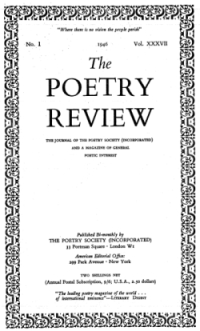
In early 1946, the critic and editor William George Bebbington wrote an article comparing the poetry of the First and Second World Wars: "Of the Moderns Without Contempt" (Poetry Review 37, no. 1 [1946]: 17-28). From the Great War, Bebbington chooses as his examples Rupert Brooke's "The Soldier," and "Battery Moving Up to a New Position from Rest Camp: Dawn," by Robert Nichols. For World War II, the selected poems are "A Wartime Dawn," by David Gascoyne, and "Spring 1942," by Roy Fuller.
In his introductory paragraphs, Bebbington reveals his purpose as championing the arguments made by Henry Reed, whose articles on contemporary wartime poetry for the Listener in January of 1945 resulted in an explosion of vehement letters from readers, which dragged on into March of that year (see "Points from Letters" for the entire exchange). While he calls Reed a "protagonist," Bebbington does not explicitly name the Listener as the source of his inspiration, but trusts that Reed's articles and the ensuing correspondence were well-enough known to his audience:
Of the Moderns Without Contempt
In a recently published correspondence the intelligibility and popularity of modern poetry have been vociferously discussed, and accusations of considerable ferocity have been made. For instance, phrases like "a great sham, a prodigious bubble and a naïve hoax" have been used. The particular writer who expressed this surprising mixture of denunciations spoke simply of "modern poetry," and so far as he is concerned, therefore, all modern poetry is a naïve hoax and every modern poet is a charlatan. It is indeed a sweeping statement, but, to make matters worse, no analysis of how modern poetry is a sham, a bubble and a hoax was offered: the statement stood alone in its thundering glibness. One remembers how Martyn Skinner described "much modern verse": "vomit, nonsense, or mere deep-sea ink."
If only this particular writer (or Martyn Skinner) were concerned, however, there would be no cause for any modern poet or any student of poetry to be alarmed. But he is not alone. Unfortunately, there are all too many like him to-day making similarly unsupported and vulgar attacks on modern poetry, and all too many idle readers prepared to enjoy the saucy manner in which their attacks are made, and to accept their crude statements as true.
As Henry Reed, a protagonist in the correspondence, observed, such attacks on contemporary poetry are not new: history shows that many an artist's work must wait, often until after his death, for a true public valuation of it. T. S. Eliot's and W. H. Auden's poetry, Louis MacNeice's and C. Day Lewis's, is not inevitably destined to be forgotten merely because it has some noisy enemies to-day; nor does the fact of its present mass unpopularity necessarily mean either that it is not poetry at all or that it will never become widely respected and influential.
But let us not ignore present facts. Our modern poets are not popular, any more than our modern musicians or painters; nor are they even politely spoken of by those who do not read them—and it is this latter fact which is both new and disturbing. The poet as a species has not often been an object of public esteem simply by virtue of being a poet, but at least he has not been abused and rejected as a madman, a hypocrite or a criminal. The public at large may for most of our history have regarded him as at best a harmless fellow, but still it has, almost instinctively, believed in his integrity and the integrity of those who have been so idle as to read his work. To-day, however, the term "modern poetry" has become synonymous in the public mind with such expressions as meaningless doggerel," "cut-up prose" and "prodigious bubble." The publisher's blurb is careful to assure us that Julian Symons commands our attention because he is "one of the least obscure of modern poets"; Adam Fox in English (Spring 1943), writes: "the moderns, of whom Mr. Eliot is the leader and main inspiration, are in process of being abandoned even by serious readers of poetry as too unintelligible and only faintly pleasurable"; and even so discreet a poet and critic as Edmund Blunden does not miss the opportunity to stoke up the fire on which the books of the Moderns must be burnt, when in Cricket Country he writes: "but the author had made his meaning sufficiently clear: I trust that this will not be too much against him at the present time." In short, to be a modern poet to-day is to be a literary pariah dog.
It cannot be denied that a considerable proportion of modern verse demands of its reader much concentration and re-reading, but no sincere student of the art of poetry would consider such a demand in itself unjust; far poetry is not merely entertainment or even a form of recreation, it is an art—and art is not always easy either to create or to appreciate. It cannot be denied also that much modern verse is obscure, but much great poetry of the past is obscure in the sense that its subject-matter is uncommon, its imagery intricate and its vocabulary subtle (the love-poetry of Donne, for example). It cannot be denied that some modern verse is meaningless to a sufficient number of its serious readers to render its publication futile. It cannot be denied that some modern verse is not poetry at all. But to say these things is different from saying that all modern verse is obscure or meaningless or not poetry at all. For it is not the function of the critic to make glib generalisations, but to separate, analytically, the good from the bad, the genuine poem from the false verse or the "cut-up prose."
In the correspondence already mentioned, which originated from two articles written by Henry Reed [Poetry in War-Time: "The Older Poets", and "The Younger Poets"] on the subject of contemporary wartime poetry, Alun Lewis and Sidney Keyes, Stephen Spender and David Gascoyne were forced out of the discussion in favour of Rupert Brooke. It was argued that his popularity during the last war and the fact that a few of his lines are often quoted prove that he was a true poet who poetically expressed the general emotion of his day, whereas the modern poets of to-day are unreadable by any but a select few, and even they are as likely as not only pretending to understand.
W. G. Bebbington. [p. 17-18]
In his conclusion, Bebbington seeks to broker a sort of peace between older war poetry, and the new poetry of man-at-war: 'So their poetry is different, belonging to an older order, expressed in an older idiom, quieter, less severe, less analytical, less subjective. They are our modern cavalier poets, still writing for a court which has by now been almost wholly destroyed. They may not wish to recognise the destruction, but it is real enough to other men who are already seeking to build a new and very different court.'
1518. Reed, Henry. "Ageing Passions." Review of The Complete Poems of Michelangelo, translated by Joseph Tusiana. Sunday Telegraph (London), 11 June 1961, 7.
Reed feels that Professor Tusiani's translations have "merely produced page after page of lifeless verse, often unscannable, and stuffed with many images and fantasies of his own."
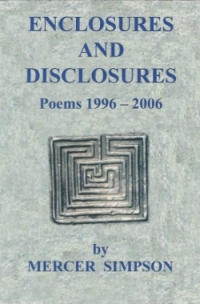
Here are a few lines from Mercer Simpson. Simpson was slow to publish his poetry; born in 1926, his first volume, East Anglian Wordscapes, wasn't released until 1993. His fourth and last, Enclosures and Disclosures, was published just last year, after his death in June of 2007 at the age of 81. Though he was born in London, grew up in Suffolk, and was educated at Cambridge and at Bristol, Simpson lived in Wales for 50 years, where he was a lecturer at the University of Glamorgan in Cardiff (formerly the Glamorgan College of Technology), and it is his studies and work on Welsh literature for which he is known.
Enclosures and Disclosures includes a sequence of poems subtitled "Visions of War". Simpson's visions include "Edward Thomas Looks Through His Periscope" ('they are reciting/unfinished poems/left in diaries/in their dug-outs'), and "After Field Operations: Wilfrid Owen Has a Nightmare in Craiglockhart Hospital" ('Improper advances had been made on many fronts/and there had been reported instances of bleeding...'). This is the fifth and final poem from this section, from the war of words:
Henry Reed Learns Another Lesson of the War
The blank page
has a wall round it:
the guards all in white uniforms
insist, Words shall not pass!
Stop (full stop) and identify yourselves:
admit only one meaning
at a time. Remember, ambiguities
are dangerous, they provoke
revolutionaries to plant their bombs
against the established order.
The weary poets imprisoned inside
scrabbling for words in the blank-faced
snow-white indescribably pure
substitute for earth would prefer
a little dirt to illuminate the human scene.
They are waiting for the guards to admit
words that cross the line, that unhyphenate,
slide off into strange misspellings, come out
in a completely unfamiliar language.
Could it be Esperanto, even if the military
prefer Newspeak? No chance to examine a fresh consignment.
The typewriter has cancelled the invoice.
Now we get the silly old tired words
lined up on the white parade ground,
everything incredibly clean, highly polished.
The regimental-sergeant-major brings the parade
inflexibly to attention. No one dare move.
Everything is equally spaced, with the rhymes
keeping their precise distance at the end
of each line. Now the poem
is marched off into the drill shed
as it's snowing again, and we ought to be
in greatcoats instead of shirtsleeve
order. It's all a whiteout and what we've written
is completely and utterly forgettable.
You can read an excerpt from Enclosures and Disclosures at Rockingham Press, and the book is available for purchase from Amazon.co.uk.
Here's a terrific list-poem by Anthony Thwaite, cataloging entries in (I believe) the 1970 biographical reference work, Contemporary Poets of the English Language (WorldCat), edited by Rosalie Murphy and James Vinson. It's cleverly wrought and understandably long, but with a worthwhile payoff (and includes Reed!):
ON CONSULTING 'CONTEMPORARY POETS
OF THE ENGLISH LANGUAGE'
Dannie Abse, Douglas Dunn,
Andrew Waterman, Thom Gunn,
Peter Redgrove, Gavin Ewart,
Susan Fromberg Schaeffer, Stewart
Conn, Pete Brown, Elizabeth
Jennings, Jim Burns, George MacBeth
Vernon Scannell, Edwin Brock,
Philip Hobsbaum, Fleur Adcock,
Brian Patten, Patricia Beer,
Colin Falck, David Rokeah,
Peter Dale and David Gill,
David Holbrook, Geoffrey Hill,
David Gascoyne and John Hewitt,
William Empson and Frank Prewett,
Norman Hidden, David Wright,
Philip Larkin, Ivan White,
Stephen Spender, Tom McGrath,
dom silvester houédard,
A. Alvarez, Herbert Lomas,
D.M., R.S., Donald Thomas,
Causley, Cunningham, Wes Magee,
Silkin, Simmons, Laurie Lee,
Peter Jay, Laurence Lerner,
David Day, W. Price Turner,
Peter Porter, Seamus Deane,
Hugo Williams, Seamus Heane-
y, Jonathan Green, Nina Steane,
C. Busby Smith and F. Pratt Green,
Fullers both and Joneses all,
Donald Davie, Donald Hall,
Muldoon, Middleton, Murphy, Miller,
Tomlinson, Tonks, Turnbull, Tiller,
Barker, Brownjohn, Blackburn, Bell,
Kirkup, Kavanagh, Kendrick, Kell,
McGough, Maclean, MacSweeney, Schmidt,
Hughes (of Crow) and (of Millstone Grit),
Sir John Waller Bt. and Major Rook,
Ginsberg, Corso, Stanley Cook,
Peter Scupham, Johm Heath-Stubbs,
Fenton, Feinstein, both the Grubbs,
Holloway G., Holloway J.,
Anselm Hollo and Peter Way,
Logue, O'Connor, Kevin Crossley-
Holland, Hollander, Keith Bosley,
Matthew Mead and Erica Jong,
Henry Reed and Patience Strong,
Kunitz, Kizer, Kops, Mark Strand,
Creeley, Merwin, Dickey and
The other Dickeys, Eberhart,
Bunting, Wantling, Pilling, Mart-
in Booth, a Dorn and then a Knight,
A Comfort following on a Blight,
Skelton (not the Rector of Diss— The Poet's Calling Robin, this),
Alistair Elliot, Alastair Reid,
Michael Longley, Michael Fried,
Ian Hamilton (twice—the Scot
With 'Finlay' at the end, and the other not),
Adrians Henri, Mitchell, Stokes,
Lucie-Smith and Philip Oakes,
Father Levi of the Soc-
iety of Jesus, Alan Ross,
Betjeman, Nicholson, Grigson, Walker,
Pitter, Amis, Hilary Corke, a
Decad of Smiths, a Potts and a Black,
Roberts Conquest, Mezey, Graves and Pack,
Hugh MacDiarmid (C.M. Grieve's
His real name, of course), James Reeves,
Hamburger, Stallworthy, Dickinson, Prynne,
Jeremy Hooker, Bartholomew Quinn,
Durrell, Gershon, Harwood, Mahon,
Edmond Wright, Nathaniel Tarn,
Sergeant, Snodgrass, C.K. Stead,
William Shakespeare (no, he's dead),
Cole and Mole and Lowell and Bly,
Robert Nye and Atukwei Okai,
Christopher Fry and George Mackay
Brown, Wayne Brown, John Wain, K. Raine,
Jenny Joseph, Jeni Couzyn,
D.J. Enright, J.C. Hall,
C.H. Sisson and all and all. . .
What is it, you may ask, that Thwaite's
Up to in this epic? Yeats'
Remark in the Cheshire Cheese one night
With poets so thick they blocked the light:
'No one can tell who has talent, if any.
Only one thing is certain. We are too many'.
Anthony Thwaite, A Portion for Foxes (1977)
The quoted remark is from chapter 15 of Yeats' Four Years (Project Gutenberg text). Here's a few poems by the "Patience Strong" (Wikipedia) whom Reed is paired with.
In the late 'Seventies, when I was nine years old, my family took a spring vacation to England, staying with friends in London. My parents gave me a small notebook to write about my travels, which I have just pried of the niche where I squirrel away such things:
Today I went on 3 double decker buses. We went to the London Experience in a movie house. I liked it alot. Then we took a bus to someplace and visited Dr. Samuel Johnson's house. I thought in was very interesting. Then we ate at a resterrant that been open for 312 years. Its called the Cheshire Cheese. Johnson, Boswell and Pepys had lunch there. I had roast beef there. After that we went to the Tower of London.
Apparently Buckingham Palace, Big Ben, and Westminster Abbey couldn't hold a candle to my riding a single red Routemaster bus.
Voices in Wartime (DVD). An acclaimed feature-length documentary on the experience of war through the words of poets, soldiers, journalists, historians and experts on combat from around the world.
Great Poets of the 20th Century (The Guardian). Brings together seven of the greatest poets of the 20th century: Sassoon, Heaney, Hughes, Larkin, Plath, Auden, and Eliot.
After a three-month sojourn in the blast freezer (it does for the insects), I spread the papers out in the vaults of the greatest research library in the world. There, fixed together with rusting pins and clips, occasionally riddled with pest holes but otherwise intact, lay the substantial remains of a decade's worth of literary endeavour; a decade in which Tambi had issued 14 editions of Poetry London magazine and over 60 books of poetry and prose, often exquisitely illustrated by up and coming artists. Here was something wonderfully—almost spookily—hermetic, beginning in 1938 as soon as Tambi arrived in London, and ending in 1949, on the very eve of his departure.
In my lengthy, involuntary exile, I was remiss in not linking to an excellent reminiscence of Henry Reed's time as a professor at the University of Washington, Seattle, between 1963 and 1967. Ed, over at I Witness (appropriately enough), has two spectacular posts from October last year, recounting his days as an English major and teaching assistant in Seattle, and how Reed came to befriend him and his family.
Part one, "Henry Reed in Seattle," tells the story of how Reed came to be invited to teach at the University of Washington, and features a cameo appearance by the poet Theodore Roethke. The second part, "Typography of the Heart," has tea with Elizabeth Bishop, the occasional opera, and Reed's eventual return to England.
I, myself, have been trying to remember precisely when I first discovered Henry Reed. It was his "Naming of Parts," of course. It was in high school, inside a giant, all-encompassing Norton Anthology we had to purchase for sophomore year. My copy was used, well-used, with the notes of various previous owners in the margins in pen and pencil, passages underlined. The pages were onion-skin thin, almost transparent, and it seemed like every single page could be peeled to reveal another, like Borges' infinite library book.
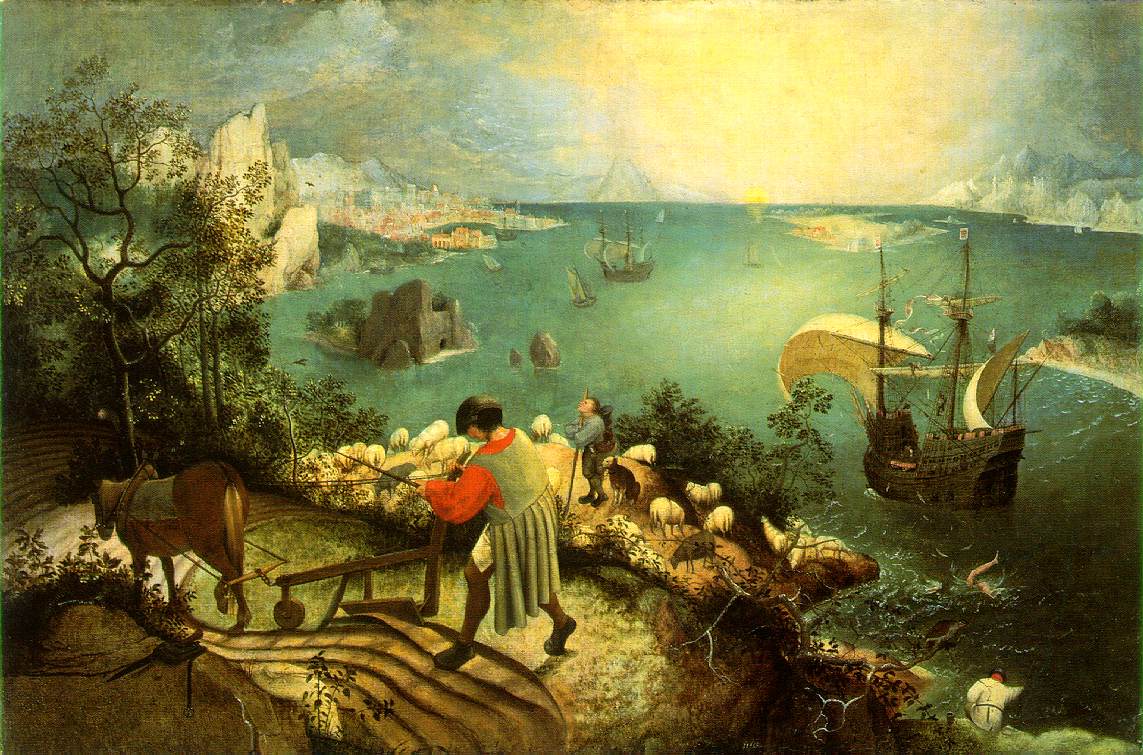
We didn't even read "Naming of Parts" in class. I would read ahead whenever I was bored with whomever we were covering: Homer, Conrad, Eliot. I remember reading Auden's "Musée des Beaux Arts," distinctly. It was the first truly modern poem I had been introduced to, and I was staggered that I could learn something so profound from (and about) a painting I had never seen, Brueghel's "Landscape with the Fall of Icarus." Just a few pages beyond Auden was Henry Reed. Anytime I wrote poetry for a creative writing class in the years that followed, I was imitating either Auden, or "Naming of Parts."
It would be ten years before I would look Henry Reed up, again. I had a part-time job at the reference desk of my local public library, and I spent my shifts answering the oddest questions from our patrons, like "Where can I find a list of all the times the word 'breast' appears in The Bible?" After a while I knew enough about how the library worked and how the books were organized to try and answer some of my own questions.
There was nothing about Reed online in those days. Most of the library's databases were still on CD-Rom. In Louis Untermeyer's anthology, Modern American and British Poetry, I learned there were two more poems to Reed's Lessons of the War: "Judging Distances," and "Unarmed Combat." There was also a long, long poem called "The Auction Sale." I must have known that Reed had written other poems, but I hadn't been prepared to find two sequels to "Naming of Parts," and certainly nothing as good as "Judging Distances."
And it would be a few more years before I would learn of Reed's death, after I had taken a job at a university library. There, it was easy enough to go to the Reference section—so much more comprehensive than the one at my old public library—and look him up. So I finally found out that Reed had died back in 1986, about the same time I first read "Naming of Parts." But there are biographies in the reference sections of many libraries which haven't been updated since before Reed died, and several printed since which failed to notice his passing, and you can still find him listed in the subject headings of library catalogs online with a heartening Reed, Henry, 1914 - .
Todd Swift of EYEWEAR reviewsThe Observer's new poetry section, which kicked off yesterday with 'three white, male poets - one dead, one middle-aged, and one slightly older than that': Henry Reed, John Burnside, and Hugo Williams.
[H]ow about a little balance? It might have been fun to have a poem by one of the younger, rising stars of British poetry - Luke Kennard, Daljit Nagra, Katy-Evans Bush, say - or mention of one of the many fine established women poets currently working in the UK. Instead, the page rather solemnly establishes an establishment feel. . . and a feel that experimental, different, edgy, or more radical poetic efforts will not be looked at.
Reed has a plain eloquence for what goes wrong and for what then holds absurdity at bay. In 'The Door and the Window', a love poem about an absent lover, he writes of 'Waking to find the room not as I thought it was,/ But the window further away, and the door in another direction', as if the room (or the lover) in the world should match the room in the mind and that only in language can a door change direction or have any direction at all. Reed wants to show us, without melodrama, how disoriented we are by what language lets us do, what language lets us notice: 'It is not that courage has risen,' Antigone says in Reed's poem of that name, 'but that fear has failed for a moment.'
The Collected Poems of Henry Reed is available for purchase through the Guardian Bookshop.
1512. Reed, Henry. "The Case for Maigret." Reviews of Maigret Hesitates and The Man on the Bench in the Barn, by Georges Simenon. Sunday Times (London), 2 August 1970: 22.
Reed reviews two translations of George Simenon's fiction.
A biographer researching the critic John Hayward (1905-65) has turned up "a collection" of unknown (or thought to be lost) poems written by W.H. Auden, published in his teens while he was at Gresham's School in North Norfolk, England. John Smart, a former head at Gresham's turned up the poems (The Independent) in old volumes of the school's magazine, The Gresham, which Hayward had edited as a student.
In one of the journals, Mr Smart came across a poem entitled 'Evening and Night on Primrose Hill', which, like most of the verse in the magazine, was unsigned.
In her definitive collection of Auden's 'Juvenilia', the author Katherine Bucknell refers to a sonnet the poet wrote about Primrose Hill in north-west London, which had been lost.
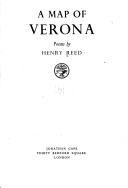
Google Book Search finally got around to digitizing the University of Michigan's copy of Reed's A Map of Verona: Poems (London: 1946) back in May of this year. It's still in copyright, so you can only view it in snippets, but it's still nice to have searchable text at a glance.
Google's keywords for the book are also telling, if not a little strange: 'kharma, dead ground, iseult, tower rises, unspeaking, central sector, draughty, worth describing, harbour, slow wave, gulls, wide road, grotto, never happen, dancers, christmas eve, chard whitlow.'
1510. Birmingham Post, "The Merchant of Venice," 5 March 1937.
Photograph of Henry Reed with members of the Birmingham University Dramatic Society's (BUDS) production of The Merchant of Venice. Shylock played by Ian Alexander.
I've been busy busy busy with library business at work, and haven't had much time for updating here, I'm afraid. Ten-hour+ work days don't leave a poor clerk, however glorified, with energy left over for pleasure-librarying. Tisk tisk. But I have noticed that Carcanet Press' forthcoming reissuance of Reed's Collected Poems has made it to Amazon.com proper, whereas it formerly appeared only on Amazon.co.uk.
The real news is that Carcanet's page for the Poems now shows that, in addition to being edited by Jon Stallworthy, the paperback will include a Foreword by critic Frank Kermode. That will certainly breathe fresh life into the re-release of Reed's poetic oeuvre. Kermode knew Reed personally, both in London and while Reed was teaching at the University of Washington, Seattle, in the mid-1960s.
I do hope Kermode's Foreword does not come at the sacrifice of Stallworthy's excellent Introduction to the original Oxford Poets collection. (I also hope, if they are using the text of Kermode's 1991 review of the Collected Poems, that Carcanet has caught his incidental inversion of 'duellis' and 'puellis', from Horace's Odes and in Reed's "Naming of Parts.")
Let's see: Carcanet has the Collected Poems (ISBN-13: 978-1857549430) listed for £11.69, available in July. Amazon.co.uk has it for just £8.54, beginning July 26th. And Amazon.com has it for $23.95, available on August 1st. A little quick currency conversion, and we get that £8.54 is currently worth roughly $16.86, so perhaps it's cheaper to buy it from the UK, but with shipping it's probably a wash. We'll see!
In honor (or perhaps despite) of April being National Poetry Month, Comedy Central's Stephen Colbert challenges actor and activist Sean Penn to a Meta-Free-Phor-All, moderated by former Poet Laureate, Robert Pinsky.
Amazon.co.uk has an updated page for Carcanet's forthcoming paperback edition of Reed's Collected Poems (due out this July), with a super-large cover image (see "Collected Covered," previously). Available for pre-order, now!
The website of one of my favorite books of poetry to browse on rainy days (and least favorite to try and lug around), The Norton Anthology of English Literature, has a few dozen audio samples of poets reading from from their own work, and others'.
The 20th century is represented by poets like W.H. Auden ("Musee des Beaux Arts"), Eavan Boland ("That the Science of Cartography Is Limited"), Ted Hughes ("Pike"), Philip Larkin ("Aubade"), Edith Sitwell ("Still Falls the Rain"), and Dylan Thomas ("Poem in October").
Dame Helen Louise Gardner (1908-1986) was a professor, critic, and editor, but above all, she was a scholar. Her work on Shakespeare, Milton, Donne, Eliot, and religious verse is still greatly respected, and earned her honorary doctorates from London, Harvard, Yale, and Cambridge Universities, among others. She took an M.A. at St. Hilda's College, Oxford in 1935, and returned to the school in 1941, teaching at Oxford until 1975. She was made a DBE in 1967.
Helen Gardner began her career as an assistant lecturer at the University of Birmingham in 1930. She took a position at the University of London in 1931, but returned to Birmingham as a lecturer in English from 1934-41. In her book, In Defense of the Imagination (Harvard University Press, 1982), Gardner recalls receiving a packet in the mail in the spring of 1940, in the midst of the "phoney war." Inside was the Easter Number of the New English Weekly, which contained a new poem by T.S. Eliot. 'I found myself reading a poem that offered no easy comfort, but only the true comfort of hearing a voice speaking out of the darkness without cynicism and without despair.' The poem would inspire her to recommend Eliot as wartime reading during a series of public lectures that summer. The poem was "East Coker," the second of his Four Quartets, and it had been sent to Gardner by none other than Henry Reed, who had been a graduate student at the University of Birmingham from 1934-36.
I came across a small homage to Reed today, in an article Gardner wrote called "The Recent Poetry of T.S. Eliot" (New Writing and Daylight, Summer 1942). A note to her discussion of "The Dry Salvages" expresses her gratitude:
Mr. Henry Reed, to whom I am indebted for much sympathetic and illuminating criticism, and without whose encouragement this article would not have been written, has pointed out to me a passage in Herman Melville's 'Redburn,' from which some of the sea imagery of 'The Dry Salvages' may derive. The voice of Mr. Eliot's seabell is certainly very like the sound of the Liverpool bell-buoy which Redburn heard as he sailed into the Mersey.
Here is the relevant section from Melville's sea-faring novel Redburn: His First Voyage (1849), concerning the bell-buoy:
After running till about midnight, we "hove-to" near the mouth of the Mersey; and next morning, before day-break, took the first of the flood; and with a fair wind, stood into the river; which, at its mouth, is quite an arm of the sea. Presently, in the misty twilight, we passed immense buoys, and caught sight of distant objects on shore, vague and shadowy shapes, like Ossian's ghosts.
As I stood leaning over the side, and trying to summon up some image of Liverpool, to see how the reality would answer to my conceit; and while the fog, and mist, and gray dawn were investing every thing with a mysterious interest, I was startled by the doleful, dismal sound of a great bell, whose slow intermitting tolling seemed in unison with the solemn roll of the billows. I thought I had never heard so boding a sound; a sound that seemed to speak of judgment and the resurrection, like belfry-mouthed Paul of Tarsus.
It was not in the direction of the shore; but seemed to come out of the vaults of the sea, and out of the mist and fog.
Who was dead, and what could it be?
I soon learned from my shipmates, that this was the famous Bett-Buoy, which is precisely what its name implies; and tolls fast or slow, according to the agitation of the waves. In a calm, it is dumb; in a moderate breeze, it tolls gently; but in a gale, it is an alarum like the tocsin, warning all mariners to flee. But it seemed fuller of dirges for the past, than of monitions for the future; and no one can give ear to it, without thinking of the sailors who sleep far beneath it at the bottom of the deep.
Melville's "Bett" is a variant of "beat," a rhythm or measure. Compare this with Eliot's sea-bell in "The Dry Salvages" (1941):
The sea howl
And the sea yelp, are different voices
Often together heard: the whine in the rigging,
The menace and caress of wave that breaks on water,
The distant rote in the granite teeth,
And the wailing warning from the approaching headland
Are all sea voices, and the heaving groaner
Rounded homewards, and the seagull:
The tolling bell
Measures time not our time, rung by the unhurried
Ground swell, a time
Older than the time of chronometers, older
Than time counted by anxious worried women
Lying awake, calculating the future,
Trying to unweave, unwind, unravel
And piece together the past and the future,
Between midnight and dawn, when the past is all deception,
The future futureless, before the morning watch
When time stops and time is never ending;
And the ground swell, that is and was from the beginning,
Clangs
The bell.
Reed's suggestion makes for a strong argument, and Gardner says in her article that "The Dry Salvages" 'marries most absolutely metaphor and idea. The sea imagery runs through it with a freedom and a power hardly equalled in Mr. Eliot's other poetry.'
1505. Orwell, George. "Young Writers." Review of New Writing and Daylight (Summer 1943), edited by John Lehmann. Spectator (30 July 1943): 110.
Orwell says of "The End of an Impulse," Reed's criticism of the Auden-Spender school of poetry, 'Henry Reed's essay contains some valuable remarks on the dangers of group literature.'
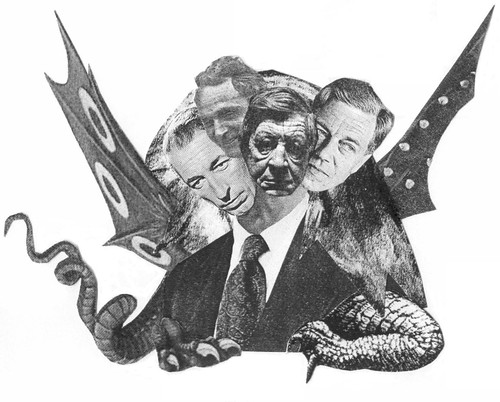
Thanks to dumbfoundry, my new favorite completely fake person (just edging out Lillian Mountweazel) is, officially, MacSpaunday: a monster made of equal parts MacNeice, Spender, Auden, and C. Day-Lewis.
1504. Ludwig, Jennifer. "Lessons of the War: Henry Reed." In vol. 2, Literature of War: Experiences, edited by Thomas Riggs. Detroit, MI: St. James Press, 2012. 359-361.
A relatively lengthy assessment of Reed's influences, position, and the impact resulting from his famous sequence of poems, Lessons of the War.
In 1995, to coincide with National Poetry Day, BBC1's television program, "The Bookworm," conducted a six-day poll of the public, seeking Britain's favorite poem (Independent (London), 13 October 1995). 7,500 votes cast narrowed down 1,000 choices to the 100 best-loved poems. Henry Reed's "Lessons of the War" was ranked at #38:
1. Rudyard Kipling, "If"
2. Alfred Lord Tennyson, "The Lady of Shalott"
3. Walter de la Mare, "The Listeners"
4. Stevie Smith, "Not Waving but Drowning"
5. William Wordsworth, "The Daffodils"
6. John Keats, "To Autumn"
7. W.B. Yeats, "The Lake Isle of Innisfree"
8. Wilfred Owen, "Dulce et Decorum Est"
9. John Keats, "Ode to a Nightingale"
10. W.B. Yeats, "He Wishes for the Cloth of Heaven"
11. Christina Rossetti, "Remember"
12. Thomas Gray, "Elegy Written in a Country Churchyard"
13. Dylan Thomas, "Fern Hill"
14. William Henry Davies, "Leisure"
15. Alfred Noyes, "The Highwayman"
16. Andrew Marvell, "To His Coy Mistress"
17. Matthew Arnold, "Dover Beach"
18. William Blake, "The Tyger"
19. W.H. Auden, "Twelve Songs"
20. Edward Thomas, "Adlestrop"
21. Rupert Brooke, "The Soldier"
22. Jenny Joseph, "Warning"
23. John Masefield, "Sea-Fever"
24. William Wordsworth, "Composed Upon Westminster Bridge"
25. Elizabeth Barrett-Browning, Sonnets From the Portuguese, XLIII ("How Do I Love Thee?...")
26. T.S. Eliot, "The Love Song of Alfred J. Prufrock"
27. John Masefield, "Cargoes"
28. Lewis Carroll, "Jabberwocky"
29. Samuel Taylor Coleridge, from "The Rime of the Ancient Mariner"
30. Percy Bysshe Shelley, "Ozymandias of Egypt"
31. Robert Frost, "Stopping by Woods on a Snowy Evening"
32. Leigh Hunt, "Abou Ben Adhem"
33. Siegfried Sassoon, "Everyone Sang"
34. Gerard Manley Hopkins, "The Windhover"
35. Dylan Thomas, "Do Not Go Gentle Into That Good Night"
36. William Shakespeare, Sonnet 18 ("Shall I Compare Thee...?")
37. W.B. Yeats, "When You Are Old"
38. Henry Reed, "Lessons of the War" (To Alan Michell)
39. Thomas Hardy, "The Darkling Thrush"
40. Allan Ahlberg, "Please Mrs. Butler"
41. Samuel Taylor Coleridge, "Kubla Khan"
42. Robert Browning, "Home Thoughts, From Abroad"
43. John Gillespie Magee, "High Flight (An Airman's Ecstasy)"
44. T.S. Eliot, "Journey of the Magi"
45. Edward Lear, "The Owl and the Pussy-Cat"
46. Rudyard Kipling, "The Glory of the Garden"
47. Robert Frost, "The Road Not Taken"
48. Rudyard Kipling, "The Way Through the Wood"
49. Wilfred Owen, "Anthem for a Doomed Youth"
50. Wendy Cope, "Bloody Men"
51. John Clare, "Emmonsail's Heath in Winter"
52. T.S. Eliot, "La Figlia Che Piange"
53. Philip Larkin, "The Whitsun Wedding"
54. Oscar Wilde, from "The Ballad of Reading Gaol"
55. Thomas Hood, "I Remember, I Remember"
56. Philip Larkin, "This Be the Verse"
57. D.H. Lawrence, "Snake"
58. Rupert Brooke, "The Great Lover"
59. Robert Burns, "A Red, Red Rose"
60. Louis MacNeice, "The Sunlight on the Garden"
61. Rupert Brooke, "The Old Vicarage, Grantchester"
62. John Betjeman, "Diary of a Church Mouse"
63. Walter de la Mare, "Silver"
64. Gerard Manley Hopkins, "Pied Beauty"
65. Louis MacNeice, "Prayer Before Birth"
66. T.S. Eliot, "Macavity: The Mystery Cat"
67. Thomas Hardy, "Afterwards"
68. G.K. Chesterton, "The Donkey"
69. Robert Browning, "My Last Duchess"
70. John Betjeman, "Christmas"
71. Ted Hughes, "The Thought-Fox"
72. T.S. Eliot, "Preludes"
73. George Herbert, "Love (III)"
74. Alfred Lord Tennyson, "The Charge of the Light Brigade"
75. John Clare, "I Am"
76. Francis Thompson, "The Hound of Heaven"
77. Christopher Marlowe, "The Passionate Shepherd to His Love"
78. W.B. Yeats, "The Song of Wandering Aengus"
79. George Gordon, Lord Byron, "She Walks in Beauty"
80. A.E. Housman, "Loveliest of Trees, the Cherry Now"
81. John Donne, "The Flea"
82. F.W. Harvey, "Ducks"
83. Philip Larkin, "An Arundel Tomb"
84. William Shakespeare, Sonnet 116 ("Let Me Not to the Marriage of True Minds")
85. Alfred, Lord Tennyson, "Ulysses"
86. Louis MacNeice, "Snow"
87. Roger McGough, "Let Me Die a Youngman's Death"
88. Thomas Hardy, "The Ruined Maid"
89. Hugo Williams, "Toilet"
90. Wilfred Owen, "Futility"
91. Edgar Allan Poe, "The Raven"
92. Robert Burns, "Tam O' Shanter"
93. Percy Bysshe Shelley, "Love's Philosophy"
94. H.W. Longfellow, from "The Song of Hiawatha" (Hiawatha's Wooing)
95. Gerard Manley Hopkins, "God's Grandeur"
96. Michael Rosen, "Chocolate Cake"
97. Leigh Hunt, "Jenny Kissed Me"
98. Seamus Heaney, "Blackberry-Picking"
99. William Wordsworth, from "The Prelude" (Childhood and School-Time)
100. Carol Ann Duffy, "Warming Her Pearls"
That puts things in perspective. Reed beats three Louis MacNeice poems by at least 22 places, is only outshone by Eliot's "Prufrock," beats John Betjeman, is only three slots below Dylan Thomas's "Do Not Go Gentle Into That Good Night," and even outranks his idol Thomas Hardy's best-known verses.
These selections were published in 1996 as The Nation's Favourite Poems (Amazon.co.uk), and spawned something of an industry in poetry anthologies. It'd be interesting to see, in the polls taken in the following years, whether Reed rose, or fell, or (God forbid) fell off, altogether.
Last month it was a new poem by Robert Frost, and today (to-day) we have an unpublished sonnet by Sylvia Plath.
The poem, "Ennui," appears in the online journal Blackbird, a collaboration of Virginia Commonwealth University's English department, and the New Virginia Review. It was discovered by Anna Journey in the Sylvia Plath Archive of juvenilia in the Lilly Library at Indiana University.
1502. Reed, Henry. Poetry Reading. The Poet Speaks. British Council recording, no. 1636. 12 March 1970. Co-sponsored by the British Council and the Woodberry Poetry Room in the Lamont Library of Harvard University. TAPE ARCHIVE PR6035.E32 A6 1970x, Woodberry Poetry Room, Houghton Library, Harvard University.
Henry Reed reads a selection of his poems for the British Council series, The Poet Speaks.
I went to every bookstore in town (both of them), and could not find a copy of the October Virginia Quarterly Review. Small matter. Da' Square Wheelman, over at Bicycle Diaries, does a little internet detective work, and turns up the full-text of Frost's lost poem, "War Thoughts at Home."
1501. Reed, Henry. Interview with Peter Orr. The Poet Speaks. British Council recording, no. 1638. 11 June 1970. Co-sponsored by the British Council and the Woodberry Poetry Room in the Lamont Library of Harvard University. TAPE ARCHIVE PR6035.E32 Z5 1970x, Woodberry Poetry Room, Houghton Library, Harvard University.
Henry Reed speaks with Peter Orr of the British Council, as part of the series The Poet Speaks.
A graduate student at the University of Virginia has uncovered a previously unknown and unpublished poem by Robert Frost.
Robert Stilling, a doctoral candidate in English, discovered mention of the poem in correspondence to Frost from his friend, editor and publisher Frederic G. Melcher. The letter refers to a poem inscribed inside Melcher's copy of Frost's second collection of poetry, North of Boston.
The university's Melcher collection also includes Melcher's book, and when Stilling investigated, there was Frost's handwritten poem from 1918, "War Thoughts at Home," right where Melcher said it would be.
1495. Reed, Henry. "Proust's Way." Reviews of Marcel Proust: A Selection from His Miscellaneous Writings translated by Gerard Hopkins, and The Two Worlds of Marcel Proust by Harold March. Observer, 16 January 1949, 4.
Reed says, 'Proust, like Shakespeare, should be read as early in life as possible, and should be read entire.'
Ages ago, when I was working at a public library circulation desk, someone checked out a set of audio tapes of James Joyce's Ulysses. Having worked at the library for some time, I hardly took notice of what people were checking out: after a while, the books become just product that barely registers, like so many blocks of wood.
These cassette recordings caught my attention, however, because I happened to notice the narrator: it was none other than Joyce, himself. Never had it occurred to me that such a thing could exist, despite the fact that the phonograph had been around since 1877, and Joyce lived until 1941. A recording of the author reading Ulysses seemed impossibly anachronistic.
Which is why this BBC article caught my eye: Andrew Motion, the UK Poet Laureate, has founded the Poetry Archive, an effort to present recordings of poets reading their own work, in order to "help make poetry accessible, relevant and enjoyable to a wide audience."
Available among the recordings are such historic poets as Kipling, Sassoon (reading "The Dug-Out"!), Tennyson ("The Charge of the Light Brigade," no less), and Yeats ("The Lake Isle of Innisfree"). The mere existence of all these tracks caused me no end of cosmic dissonance.
Although Reed himself is absent from the archive, many of his contemporaries are represented, including Louis MacNeice and Vernon Scannell.
I had opportunity today to drop into Mermaid Books, a little, hole-in-the-wall used bookstore in town. I would recommend dropping in if you are at all able. Not only do they receive a good portion of the obscure and well-read books from town, but any bookshop which advertises "Ephemera" as a category has got to be worth a poke-around.
The petals of the vagina unfold
like Christopher Columbus
taking off his shoes.
Is there anything more beautiful
than the bow of a ship
touching a new world?
I believe I was drinking a Mr. Pibb in the Food Court at the mall, at the time.
You may know Brautigan for being the progenitor of the phrase "machines of loving grace." Brautigan's poems aren't poems at all; they're more like prayers, or black and white photographs. Small pieces of time frozen long enough to get a good look at.
The Pill is dedicated to "Miss Marcia Pacaud of Montreal, Canada," who is pictured, barefoot on a pile of rubble, on the cover. No title, no author. No text whatsoever. This striking image happily led me to the Brautigan "Girls on Covers" webpage.
Weldon Kees was a man of many hats. Poet, critic, painter, composer. He wrote for the Newsreels, did a stint as a librarian, and even had aspirations of producing movies. I remember coming across Kees' series of Robinson poems in some anthology from the Forties or Fifties, and thinking to myself, "This is what T.S. Eliot would sound like, if he wrote in English." That was before I knew that Kees was the disappearing poet.
In July 1955, Weldon Kees' car was found near the Golden Gate Bridge, and no one ever saw or heard from him again.
In January of that year, Kees and one of his best friends in San Francisco, the poet Michael Grieg, conceived of putting on a theatrical poetry reading they deemed the Poets' Follies. The Follies were a sort of poetic revue, with Keyes at the piano and a jazz ensemble of poets, actors, dancers and other artists sitting in. Lawrence Ferlinghetti read. The poetry was accompanied by interpretive dance. Kees and Grieg even managed to cajole a local stripper to stop by and recite some Eliot, Elinor Wylie, and Sara Teasdale.
Whom did Weldon Kees choose to read thay night? Why, Henry Reed, of course.
Kees, costumed in military dress (he was designated 4F for World War II, described as 'psychologically unfit for service') gave an interpretation of Reed's "Unarmed Combat." Why Kees chose that particular poem is beyond me. It's the more serious of the three Lessons of the War poems published at that time, and probably the least likely to be enjoyed by a raucous Follies audience. Looking at the photograph from that session of the Follies, I realize that the book in Kees' hand is too small to be an anthology. The slim volume looks like a copy of Reed's A Map of Verona and Other Poems.
Kees was a contemporary of Reed's; in fact, they were born only two days apart. Kees certainly read a great deal of poetry: he was a book reviewer and critic for the Partisan Review, The New Republic, and Time. Kees probably felt a special affinity for Reed, whose first book arrived in the States in 1947, full of promise, and who was never heard from again.
I think that I shall never see
A sight so curious as BP,
This place called up at war's behest,
And peopled by the strangely dressed;
Yet what they do they cannot say,
Nor ever will 'til Judgement Day.
For six long years we have been there,
Subject to local scorn and stare.
We came by transport and by train,
The dull and brilliantly insane,
What shall we do, where shall we be,
When God at last redunds BP?
The Air Force types that never fly
Soldiers who neither do nor die,
Landlubber Navy, beards complete
Civilians slim, long-haired, effete;
Yet what they did they never knew,
And if they told it wasn't true.
If I should die think only this of me...
I served my country at BP.
And should my son ask: 'What did you
In the atomic World War Two?'
God only knows and he won't tell
For after all BP was hell.
—Anonymous
I stumbled upon this ditty today, while trying to track down an apparent "Ode to Colossus." There's a paragraph of rather purple prose in Good, Michie, and Timms' General Report on Tunny with Emphasis on Statistical Methods, the 1945 document describing the early computers created at Bletchley Park during World War II to break the German "Fish" codes. This particular section laments the lack of language or skill required to describe the famous Colossus computer sputtering and hacking away at a decrypt like a demented Walter Mitty machine, concluding:
Perhaps some Tunny-breaking poet could do justice to this theme; but although an ode to Colossus and various fragments appeared, all seemed to have been composed in times of distress and despondency, and consist almost wholly of imprecation or commination. (p. 327)
The internets, alas, have not confirmed the existence of the hinted-at Ode.
But I did find "Bumph Palace," on a couple's photo journal of a visit to Bletchley (which includes some excellent shots of props used in the filming of "Enigma," as well as the reconstructed Colossus and bombe machines). The caption states the poem was 'found pinned to a BP notice board during the war' (though it must have been rather near the end, since the poem mentions 'atomic' war after 'six years'). It's a delightful insight into daily life and attitude at Bletchley, and perhaps even one of the comminations mentioned in the Tunny report.
I first thought the title must be a bastardization of some German word or placename. Bumph, I was tickled to discover, is British slang for easily-disregarded official paperwork (of which the Government Code & Cypher School must have had in superabundance), dis-affectionately nicknamed bum fodder. Toilet paper.
Reviews of recent poetry mentions publication of Reed's A Map of Verona, and quotes from his poem, "Iseult la Belle."
1st lesson:
Reed, Henry
(1914-1986). Born: Birmingham, England, 22 February 1914; died: London, 8
December 1986.
Education: MA, University of Birmingham, 1936. Served: RAOC, 1941-42; Foreign Office, Bletchley Park, 1942-1945.
Freelance writer: BBC Features Department, 1945-1980.
Author of:
A Map of Verona: Poems (1946) The Novel Since 1939 (1946) Moby Dick: A Play for Radio from Herman Melville's Novel (1947) Lessons of the War (1970) Hilda Tablet and Others: Four Pieces for Radio (1971) The Streets of Pompeii and Other Plays for Radio (1971) Collected Poems (1991, 2007) The Auction Sale (2006)