About:

Documenting the quest to track down everything written by (and written about) the poet, translator, critic, and radio dramatist, Henry Reed.

An obsessive, armchair attempt to assemble a comprehensive bibliography, not just for the work of a poet, but for his entire life.

Read "Naming of Parts."

Henry Reed Henry Reed
Henry Reed, ca. 1960


Contact:


Reeding:

Watchmen: The award-winning comic book series, by Alan Moore and Dave Gibbons.
The Romantic Dogs: Forty-four poems by Roberto Bolaño.
Enclosures and Disclosures: Mercer Simpson's most recent collection of poetry.


Elsewhere:

Books

Libraries

Weblogs, etc.


«  A Small Part of a Wider Scene  »

Reeding Lessons: the Henry Reed research blog

6.1.2009


A Small Part of a Wider Scene

Weldon Kees was a man of many hats. Poet, critic, painter, composer. He wrote for the Newsreels, did a stint as a librarian, and even had aspirations of producing movies. I remember coming across Kees' series of Robinson poems in some anthology from the Forties or Fifties, and thinking to myself, "This is what T.S. Eliot would sound like, if he wrote in English." That was before I knew that Kees was the disappearing poet.

In July 1955, Weldon Kees' car was found near the Golden Gate Bridge, and no one ever saw or heard from him again.

In January of that year, Kees and one of his best friends in San Francisco, the poet Michael Grieg, conceived of putting on a theatrical poetry reading they deemed the Poets' Follies. The Follies were a sort of poetic revue, with Keyes at the piano and a jazz ensemble of poets, actors, dancers and other artists sitting in. Lawrence Ferlinghetti read. The poetry was accompanied by interpretive dance. Kees and Grieg even managed to cajole a local stripper to stop by and recite some Eliot, Elinor Wylie, and Sara Teasdale.

Whom did Weldon Kees choose to read thay night? Why, Henry Reed, of course.
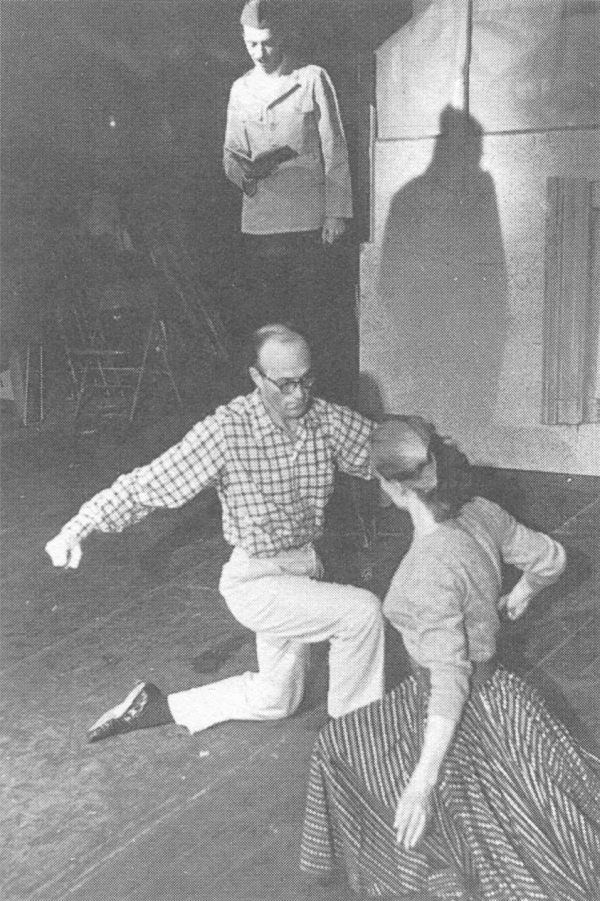
Weldon Kees
Weldon Kees (in uniform), reading "Unarmed Combat." From Vanished Act: The Life and Art of Weldon Kees, by James Reidel. Lincoln, NE: University of Nebraska Press, 2003.
Kees, costumed in military dress (he was designated 4F for World War II, described as 'psychologically unfit for service') gave an interpretation of Reed's "Unarmed Combat." Why Kees chose that particular poem is beyond me. It's the more serious of the three Lessons of the War poems published at that time, and probably the least likely to be enjoyed by a raucous Follies audience. Looking at the photograph from that session of the Follies, I realize that the book in Kees' hand is too small to be an anthology. The slim volume looks like a copy of Reed's A Map of Verona and Other Poems.

Kees was a contemporary of Reed's; in fact, they were born only two days apart. Kees certainly read a great deal of poetry: he was a book reviewer and critic for the Partisan Review, The New Republic, and Time. Kees probably felt a special affinity for Reed, whose first book arrived in the States in 1947, full of promise, and who was never heard from again.


Add Notation:

Name:
E-mail:
Webpage:

Notation for "A Small Part of a Wider Scene":
Allowed: <a> <em> <strong>
What is Henry Reed's first name?

1367. Morrison, Blake. The Movement: English Poetry and Fiction of the 1950s. Oxford: Oxford University Press, 1980. 18, 25, 34, 35.
Quotes D.J. Enright saying Reed's Lessons of the War are 'too modest, or too wise, to attempt to deal directly with War'.


1st Lesson:

Reed, Henry (1914-1986). Born: Birmingham, England, 22 February 1914; died: London, 8 December 1986.

Education: MA, University of Birmingham, 1936. Served: RAOC, 1941-42; Foreign Office, GC&CS, 1942-1945. Freelance writer: BBC Features Department, 1945-1980.

Author of: A Map of Verona: Poems (1946)
The Novel Since 1939 (1946)
Moby Dick: A Play for Radio from Herman Melville's Novel (1947)
Lessons of the War (1970)
Hilda Tablet and Others: Four Pieces for Radio (1971)
The Streets of Pompeii and Other Plays for Radio (1971)
Collected Poems (1991, 2007)
The Auction Sale (2006)


Search:


LibraryThing


Recent tags:


Posts of note:


Archives: