About:

Documenting the quest to track down everything written by (and written about) the poet, translator, critic, and radio dramatist, Henry Reed.

An obsessive, armchair attempt to assemble a comprehensive bibliography, not just for the work of a poet, but for his entire life.

Read "Naming of Parts."

Henry Reed Henry Reed
Henry Reed, ca. 1960


Contact:


Reeding:

2666: The adventures of a group of scholars dedicated to the work of a reclusive novelist.
The Quest for Corvo: A.J.A. Symon's experimental biography of Frederick Rolfe, the Baron Corvo.
High Hopes: Trans-Atlantic correspondence between aspiring poets in the 1950s.


Elsewhere:

Books

Libraries

Weblogs, etc.


All posts for "Flowers"

Reeding Lessons: the Henry Reed research blog

9.9.2010


Japonica Makes a Hardy Cameo

I thoroughly enjoyed the first half of the new BBC production of Thomas Hardy's Tess of the d'Urbervilles, which aired last night on PBS Masterpiece. This adaptation stars the enchanting Gemma Arterton as Tess, and Hans Matheson as Alec D'Urberville.

I was seriously distracted, however, at the opening of Chapter 12, when the camera pans up from a bunch of Japonica in bloom, trained along a garden wall:

Screen shot

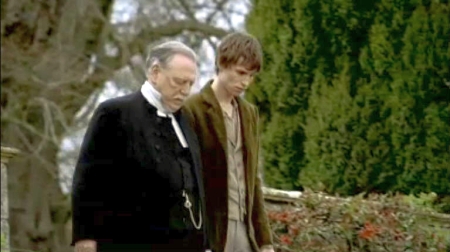
The shrub appears again, at the side of Mr. Clare (played by Kenneth Cranham) and son Angel (Eddie Redmayne), as they leave Emminster parsonage (I must be the only dude on the Internet taking screencaps which do not feature Gemma Arterton):

Screen shot

Fancy that, I thought. Henry Reed has taught me horticulture! The flower is definitely Chaenomeles, the Japanese Quince—probably Speciosa, or another ornamental variety—referred to commonly as Japonica. Filmed in early spring, March or April, at Hamswell House, South Gloucestershire.

You can catch up on the first half of Tess at PBS.org. The program concludes this Sunday evening, January 11th.

«  Hardy PBS Flowers  0  »


1464. Brownjohn, Alan. "Collected Lifelines." Reviews of Collected Poems, by Henry Reed; Selected Poems, by E.J. Scovell; and Poems, 1963-1983, by Michael Longley. Sunday Times Books (London), 20 October 1991, 14.
Brownjohn feels Reed's 'shorter lyric pieces... [are] coherent and approachable, carefully shaped, both tender and sinister in mood.'


Flowers and War

Several weekends ago I made a short excursion up to the state capital, to visit the Richmond Public Library. It was a lazy, rainy Sunday, and I needed, of all things, a 19th-century book on flowers.

The book was the Reverend Hilderic Friend's Flowers and Flower Lore (1883), and I was startled to find that it was not on the shelf. Up and down the folklore section I scanned. A word to the wise scholar: it never hurts to phone ahead.

Luckily, a librarian flew to my rescue, advising that their older texts are kept in closed stacks, downstairs in the basement. Whew! I had Friend's beautiful, leather-bound, two-volume set in my hands, momentarily. In the end, I found that they didn't even contain exactly what I was looking for. Such are the perils of blind librarying.

I consoled myself by browsing the stacks for poetry, discovering that my Dewey Decimals have become almost irreparably rusty. Poetry: 811, yes. English poetry? 821. Oh. They had several anthologies which I had indexed but never seen: notably, Dylan Thomas's Choice (Maud and Davies, eds. New York: New Directions, 1963). Deep into my Ziploc bag of dimes I dipped, to feed the ravenous Xerox machines.

The real boon was a book I had never heard of or seen: War Poetry: An Anthology, edited, and with an introduction and commentaries, by D.L. Jones (1968). This evening, I added Jones' commentary on the Lessons of the War poems to the website.

It also happened to be the last day of the Friends of the Library booksale, and from the pillaged remnants I managed to scavenge a small paperback of English translations of the poetry of Leopardi. They wanted 50¢, but I gave them a buck, and told 'em to keep the change.


1463. Short, Mick. "Style Variations in Texts." Chapter 3 in Exploring the Language of Poems, Plays, and Prose. London: Longman, 1996. 80-105 [98-101]
Examines the linguistic qualities and style variation in Reed's "Naming of Parts."


1st lesson:

Reed, Henry (1914-1986). Born: Birmingham, England, 22 February 1914; died: London, 8 December 1986.

Education: MA, University of Birmingham, 1936. Served: RAOC, 1941-42; Foreign Office, GC&CS, 1942-1945. Freelance writer: BBC Features Department, 1945-1980.

Author of: A Map of Verona: Poems (1946)
The Novel Since 1939 (1946)
Moby Dick: A Play for Radio from Herman Melville's Novel (1947)
Lessons of the War (1970)
Hilda Tablet and Others: Four Pieces for Radio (1971)
The Streets of Pompeii and Other Plays for Radio (1971)
Collected Poems (1991, 2007)
The Auction Sale (2006)


Search:


LibraryThing


Recent tags:


Posts of note:


Archives:


Marginalia: