|
|
Documenting the quest to track down everything written by
(and written about) the poet, translator, critic, and radio
dramatist, Henry Reed.
An obsessive, armchair attempt to assemble a comprehensive
bibliography, not just for the work of a poet, but for his
entire life.
Read " Naming of Parts."
|
Contact:
|
|
|
|
Reeding:
|
 |
I Capture the Castle: A girl and her family struggle to make ends meet in an old English castle.
|
 |
Dusty Answer: Young, privileged, earnest Judith falls in love with the family next door.
|
 |
The Heat of the Day: In wartime London, a woman finds herself caught between two men.
|
|
|
|
Elsewhere:
|
|
All posts for "Anthologies"
|
|
|
27.7.2024
|
In the introduction to her 1986 book, English Poetry of the Second World War: A Biobibliography, Catherine W. Reilly ranks the number of appearances various poets make in the 87 anthologies of World War II poetry she inventories:
Roy Fuller (25)
Alun Lewis (24)
Sidney Keyes (21)
Stephen Spender (19)
Keith Douglas (18)
John Pudney (18)
Alan Rook (17)
Louis MacNeice (15)
Henry Reed (15)
W.H. Auden (14)
G.S Fraser (14)
Dylan Thomas (14)
John Waller (14)
Emanuel Litvinoff (13)
Henry Treece (13)
Cecil Day Lewis (12)
Herbert Corby (11)
Nicolas Moore (11)[p. xiii] Reilly's bibliography doesn't dispel the idea that Henry Reed's Lessons of the War are the most-anthologized poems from the Second World War, just that Reed doesn't necessarily appear in the majority of anthologies of Second World War poetry.
The fifteen anthologies on Reilly's list that Reed appears in are:
An Anthology of Modern Verse, 1940-1960, chosen by Elizabeth Jennings (London: Methuen, 1961)
Components of the Scene: Stories, Poems, and Essays of the Second World War, edited by Ronald Blythe (Harmondsworth, Middlesex: Penguin, 1966)
English Poetry, Book 5: Modern Verse, edited by W.M. Smyth (London: Edward Arnold, 1971)
I Burn For England: An Anthology of the Poetry of World War II, selected by Charles Hamblet (London: Leslie Frewin, 1966)
The Martial Muse: Seven Centuries of War Poetry, edited by Alan Bold (London: Wheaton, 1976)
More Poems from the Forces: A Collection of Verses by Serving Members of the Navy, Army, and Air Force, edited by Keidrych Rhys (London: Routledge, 1943)
New Poems, 1944: An Anthology of American and British Verse, with a Selection of Poems from the Armed Forces, edited by Oscar Williams (New York: Howell, Soskin, 1944)
Poetry of the Forties, edited by Robin Skelton (Harmondsworth, Middlesex: Penguin, 1968)
Poetry of the 1940s: An Anthology, edited by Howard Sergeant (London: Longman, 1970)
The Poetry of War, 1939-45, edited by Ian Hamilton (London: Alan Ross, 1965)
The Terrible Rain: The War Poets 1939-1945, selected by Brian Gardner (London: Eyre Metheun, 1978)
These Years: An Anthology of Contemporary Poetry, edited by Howard Sergeant (Leeds: E.J. Arnold & Sons, 1950)
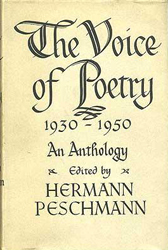
The Voice of Poetry, 1930-1950: An Anthology, edited by Hermann Peschmann (London: Evans Bros., 1950)
War Poetry: An Anthology, edited by D.L. Jones (London: Pergamon, 1968)
Where Steel Winds Blow, edited by Robert Cromie (New York: David McKay, 1968) Also, someone needs to make poor Herbert Corby ( Hampdens Going Over [1945]) a Wikipedia page.
|
1537. Radio Times, "Full Frontal Pioneer," Radio Times People, 20 April 1972, 5.
A brief article before a new production of Reed's translation of Montherlant, mentioning a possible second collection of poems.
|
Covering and recovering some old ground today, when up pops a short but pithy bio in this rare anthology: The Voice of Poetry, 1930-1950, edited by Hermann Peschmann (London: Evans Bros., 1950). The book includes Reed's "Naming of Parts," but Peschmann seems to have taken the time to personally poll his contributors for personal information:
Reed, Henry. Born 1914 in Birmingham and educated there, inc. Birmingham Univ. Called up 1941, went to Foreign Office 1942—6. Since then whole-time writer—but says he is a slow worker. Broadcasts on books and films and enjoys writing radioscripts on extended themes, e.g. Moby Dick. Fond of films, theatre and opera, and of playing the piano badly and for long stretches of time. One verse book: A Map of Verona (1946). [p. 239]
Peschmann was, for a time in the 1940s, a lecturer in English literature for the Adult Education Department of Goldsmith College, University of London, known as a critic and for his correspondence with Dylan Thomas and others.
This anthology was published in 1950, so Reed's BBC radio adaptation of Moby Dick (January, 1947), Pytheas: A Dramatic Speculation (May, 1947), and The Unblest: A Study of the Italian Poet Giacomo Leopardi (May, 1949) would have been his only features thus far. Reed's love of theatre (and actors), opera, and film are well-documented in his letters and book reviews, and he often lamented his meticulous, plodding writing process, but the fact that he played the piano, however poorly, is actually news to me.
This tiny tidbit is so heartbreakingly personal—paraphrased from a letter or questionnaire or phone call to Reed—it's tempting to try and track down a copy of the book.
|
1536. L.E. Sissman, "Late Empire." Halcyon 1, no. 2 (Spring 1948), 54.
Sissman reviews William Jay Smith, Karl Shapiro, Richard Eberhart, Thomas Merton, Henry Reed, and Stephen Spender.
|
I've just discovered that Carcanet included Reed's underappreciated longer poem, "The Auction Sale," in a 2010 anthology of work originally published as Greville Press pamphlets: A Field of Large Desires.
Edited by Anthony Astbury, who opened the Greville Press (officially) in 1979 in the hopes that poetry in England " will happen again," the new collection is "both a treasure trove and a celebration of a remarkable venture."
The title comes from a sonnet by Fulke Greville, Lord Brook:Man's youth it is a field of large desires,
Which pleas'd within, doth all without them please;
For in this love of men live those sweet fires,
That kindle worth and kindness unto praise;
And where self-love most from her selfness gives,
Man greatest in himself, and others lives. The anthology includes pieces by Robert Bridges, Hart Crane, Elizabeth Daryush, Lawrence Durrell, Kate Ellis, David Gascoyne, W.S. Graham, Robert Graves, Ian Hamilton, John Heath-Stubbs, George Herbert, John Masefield, Edna O'Brien, Harold Pinter, Anne Ridler, Alan Ross, Martin Seymour-Smith, C.H. Sisson, Stevie Smith, and Arseny Tarkovsky, among others.
Henry Reed's "The Auction Sale" was printed as a Greville Press pamphlet in 2006.
|
1535. Reed, Henry. "Talks to India," Men and Books. Time & Tide 25, no. 3 (15 January 1944): 54-55.
Reed's review of Talking to India, edited by George Orwell (London: Allen & Unwin, 1943).
|
A few odds and ends relating to Henry Reed can be found in the Internet Archive's digital library, the Open-Access Text Archive. They don't have as many titles for the second-half of the 20th century as they do for pre-1920 material that is in the public domain, but they have a bit.
Reed is mentioned in a 1961 special number of the Times Literary Supplement, The British Imagination: A Critical Survey, in a section devoted to radio: "In what other form of drama could one mirror the life of an era through one man's mind and reactions, as in Mr. Reed's Return to Naples, or through a many-layered pattern of experience, from that of the professor to that of a lizard on a hot stone, as in his The Streets of Pompeii?" (p. 94).
The Streets of Pompeii also appears in two program schedules for WBAI radio, New York, NY. The play was broadcast on Saturday, April 8, 1961, and again on Monday, February 4, 1963.
A real treasure is an electronic copy of Oscar Williams' 1951 anthology, A Little Treasury of British Poetry (1951). Williams compiled not only the original three Lessons of the War poems, but also Reed's lesser-known verses, "The Wall" (p. 843) and "Lives" (p. 844). The book is a little unwieldy at almost 900 scanned pages, so I took the liberty of lifting Reed's section and putting it in a separate, much smaller, file, including Williams' introduction.
|
1534. Reed, Henry. "Radio Drama," Men and Books. Time & Tide 25, no. 17 (22 April 1944): 350-358 (354).
Reed's review of Louis MacNeice's Christopher Columbus: A Radio Play (London: Faber, 1944).
|
Publishers Bedford/St. Martin's have revamped their LitLinks database, which contains brief biographies and links to resources on the web for more than 700 authors. One of the enhancements is the ability to display lists of Bedford/St. Martin's titles in which a particular author's work appears. Handy!
Here's their page for Henry Reed (small factual error: Reed received an MA from the University of Birmingham in 1936, not a BA in 1937. See his Who's Who entry). And here's the list of their anthologies in which "Naming of Parts" is included.
Unfortunately, although the site is slick-looking and a large improvement over the previous, static version, the new design relies heavily on JavaScript and frames to serve from the database, which makes linking to a particular author difficult, if not impossible, and functionality is lost if you do. Frames are a big accessibility no-no! Pages can take an eternity to load, if at all (which may indicate database or server problems), so let us hope Bedford/St. Martin's are still working out all the LitLinks kinks.
|
1533. Friend-Periera, F.J. "Four Poets," Some Recent Books, New Review 23, no. 128 (June 1946), 482-484 [482].
A short review calls A Map of Verona more pretentious than C.C. Abbott's The Sand Castle; influenced by Eliot, Auden, MacNeice, and Day Lewis.
|
The Annual Register, a "Review of Public Events at Home and Abroad," is a serial survey of history, politics, and the humanities, published in the U.K. since 1758. My campus library has nearly a complete run, parceled between print volumes and short stretches on microfilm. The trick, apparently, is to pay attention to the record in the online catalog, before realizing in the third floor stacks that the year you're looking for is actually on film in the basement, nine flights below.
The Register volume for 1946 delivers a quick criticism of Reed's first volume of poetry: 'In The Map of Verona [sic] (Cape), Henry Reed, one of the younger poets, develops a meditative romanticism not as yet sure of its own direction.'
The fact that his collection received notice at all speaks for Reed's promise as a poet, despite any reservations the editor may have had. The chapter surveying the literature of 1946 mentions several publications which also contain poems written by Reed: John Lehmann's Poems from New Writing , 1936-1946, which collects "Chrysothemis," and "The Wall"; and the journal Orion, which published Reed's "King Mark." Special attention is also paid to Edith Sitwell's The Song of the Cold (which Reed reviewed for the New Statesman in January, 1946), Richard Church's The Lamp, John Pudney's Selected Poems, Theseus and the Minotaur and Poems by Patric Dickinson, Poems from the North by Sir Shane Leslie, Vivian Locke Ellis' Collected Lyrical Poems, C.C. Abbott's The Sand Castle, Laurence Durrell's Plains and People, and Talking Bronco by Roy Campbell, among others.
Also noted is an anthology called For Those Who Are Alive (London: Fortune, 1946), an anthology of fifty of the 'youngest poets,' compiled by Howard Sergeant, editor of the journal Outposts. I wonder if, perhaps, something of Reed's is also collected there?
|
1532. Vallette, Jacques. "Grand-Bretagne," Mercure de France, no. 1001 (1 January 1947): 157-158.
A contemporary French language review of Reed's A Map of Verona.
|
I think every staff member working at the main library noticed I was there late this afternoon, and not at work. I snuck out an hour early to pick up a couple of books waiting for me from offsite storage. Everybody said hi, even the head of Access Services, whom I was disturbed to discover could recognize me even hunched over a table, pouring over a book, from behind.
I had a couple of leads to run down, tangential, but leads nonetheless. An article in an old British Museum Quarterly on the papers of Sydney Carlyle Cockerell, bibliophile and former director of the Fitzwilliam Museum, Cambridge, from 1908 to 1937. Reed wrote a letter to Cockerell in 1955, but I haven't found any mention of its contents anywhere in his collected letters. The article in the BMQ shed no light.
I also had an obscure reference to something the poet John Ciardi calls the fulcrum of a poem, the point of balance where a change in attitude or tone takes place, which, Ciardi argues, is always accompanied by a change in structure or technical handling. (Oh, terrific: Poets.org changed their site organization again, and all my links now point to a big, fat 404.)
"Point of balance" is an interesting phrase, since it also refers to the point on a rifle where the weight of the weapon is evenly distributed between the butt and muzzle. In a shooting stance, the point of balance should ideally fall midway between the shooter's hands, making aiming and firing easier and more accurate. The point of balance is mentioned in "Naming of Parts," and I wondered if Ciardi may have taken the phrase from Reed's poem.
After reading the chapter in How Does a Poem Mean? on "The Poem in Countermotion," it would appear, however, that Ciardi was just taking the metaphor of a fulcrum to its logical end, and he was genuinely attempting to describe a poem's silent tipping point, something like the volta or "turn" in a sonnet, after which a realization or resolution is reached. The point between the fourth and fifth stanzas of "Naming of Parts" is a good example of this, where the two, duelling voices of Army and Spring finally merge.
Reading How Does a Poem Mean? (or any scholarly work on the study of poetry) makes me feel a little like Agent Starling visiting Dr. Hannibal Lecter, and I'm a bit out of my depth and on my guard.
"What does it do, this pome you seek?"
"Uh, well. See, it's about mending a stone wall...."
"No. That is in-cidental. First principles..." and Ciardi (or whoever) launches into a rail on Marcus Aurelius, leaving me behind, standing in a cloud of my own ignorance.
And apparently, John Frederick Nims makes a similar point about an "emotional fulcrum." What need does this poem serve by turning? What is its nature?
|
1531. Henderson, Philip. "English Poetry Since 1946." British Book News 117 (May 1950), 295.
Reed's A Map of Verona is mentioned in a survey of the previous five years of English poetry.
|
|
|
|
1st lesson:
Reed, Henry
(1914-1986). Born: Birmingham, England, 22 February 1914; died: London, 8
December 1986.
Education: MA, University of Birmingham, 1936. Served: RAOC, 1941-42; Foreign Office, Bletchley Park, 1942-1945.
Freelance writer: BBC Features Department, 1945-1980.
Author of:
A Map of Verona: Poems (1946)
The Novel Since 1939 (1946)
Moby Dick: A Play for Radio from Herman Melville's Novel (1947)
Lessons of the War (1970)
Hilda Tablet and Others: Four Pieces for Radio (1971)
The Streets of Pompeii and Other Plays for Radio (1971)
Collected Poems (1991, 2007)
The Auction Sale (2006)
|
Search:
|
|
|
Recent tags:
|
Posts of note:
|
Archives:
|
Marginalia:
|
|