|
|
Documenting the quest to track down everything written by
(and written about) the poet, translator, critic, and radio
dramatist, Henry Reed.
An obsessive, armchair attempt to assemble a comprehensive
bibliography, not just for the work of a poet, but for his
entire life.
Read " Naming of Parts."
|
Contact:
|
|
|
|
Reeding:
|
 |
I Capture the Castle: A girl and her family struggle to make ends meet in an old English castle.
|
 |
Dusty Answer: Young, privileged, earnest Judith falls in love with the family next door.
|
 |
The Heat of the Day: In wartime London, a woman finds herself caught between two men.
|
|
|
|
Elsewhere:
|
|
All posts for "Painting"
|
|
|
22.10.2024
|
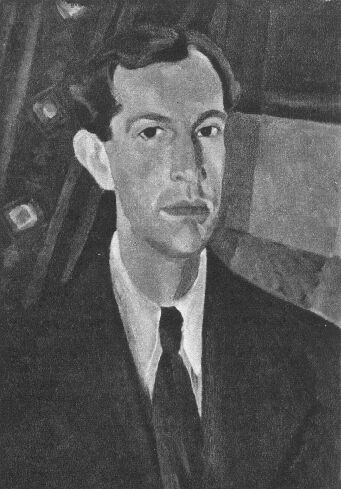
I am looking for a painting. Specifically, I am looking for "Portrait of Henry Reed," painted by John Melville (1902-1986), the English surrealist associated with The Birmingham Group. A photograuvre reproduction of the painting appeared in the Penguin New Writing, vol. 27, in 1946. I'm keenly interested to know where this portrait currently resides:
Logically, the portrait was created prior to 1946. A potential clue to its genesis appears in Reed's 1954 radio play, The Private Life of Hilda Tablet. During the course of the play, the renowned composeress Hilda Tablet directs the narrator, "Herbert Reeve" (wink, wink), to interview a friend and artist, affectionately called "Bunny":
Hilda: R. Egerton Bunningfield, ARA. He painted a damn good portrait of me in 1943.
( fade chords behind Mr Bunningfield. He seems rather weighed
down by unsuccess)
Bunningfield: Well, yes, the picture has been much admired, and it was very good of Miss Tablet to sit for it. I asked her to, you know. It was meant to be one of a series of great women of the time, their part in the war effort. Naturally, I wasn't quite prepared for quite all the conditions Miss Tablet imposed. I wanted her to be playing an instrument, of course, but what I had in mind was a clavichord or the like, with highlights on a brocade dress and so on. I never imagined she would insist on the instrument being a bugle, though I agree it was appropriate to a picture illustrating the war effort and that. And she also insisted on it being an open-air composition; that's the whole of the Pennine Chain in the background... And quite frankly, Mr Reeve, she's the kind of figure I really would have preferred to have painted draped... but no, she insisted...
( fade last words behind chords)
Hilda Tablet and Others: Four Plays for Radio (1971), p. 70
Is the character Bunningfield an homage to Reed's Birmingham chum? Did Melville ask Reed to sit for him in 1943, as part of series of wartime portraits of Birmingham notables? It's difficult to know for sure which details of the radio plays are lifted entirely from Reed's life. The mention of the Pennines is intriguing as well, since it places the fictional painter in northern England (not terribly far north of Birmingham). All this is speculation, of course, and I could be wrong as wrong.
I got to thinking about Reed's misplaced portrait this evening, after learning that the BBC announced today a commitment to digitize all 200,000 of Britain's oil paintings in public ownership, and have them available online by 2012. More information on the effort, and the BBC's "deeper commitment to arts and music," at the Guardian.
|
1537. Radio Times, "Full Frontal Pioneer," Radio Times People, 20 April 1972, 5.
A brief article before a new production of Reed's translation of Montherlant, mentioning a possible second collection of poems.
|
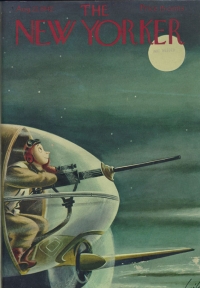
Here's a New Yorker cover from World War II which bears comparison with " Naming of Parts." It depicts a daydreaming nose gunner in (what looks like) a stylized B-24.
From American Studies at the University of Virginia's Covering the War section of Urban and Urbane: The New Yorker Magazine in the 1930s:
[E]ven preoccupied with the thoughts of death, honor, and heroism that doubtless passed through the heads of millions of American soldiers on the eve of battle, the young man cannot resist the natural beauty of the full moon on a clear night. The image also plays with the sharp contrast between the plane, the latest in American technology, and the vast emptiness of the sky. It makes a subtle yet present commentary on the just how much technology has still yet to do.
The depiction also stands in stark contrast to that other famous poem of the war, Jarrell's " The Death of the Ball Turret Gunner." The illustration appears on the cover of August 22nd, 1942 issue of The New Yorker ( full size), and is by the Russian-American artist, Constantin Alajalov.
A print of Alajalov's cover is available from The Cartoon Bank. (Via Kottke.)
|
1536. L.E. Sissman, "Late Empire." Halcyon 1, no. 2 (Spring 1948), 54.
Sissman reviews William Jay Smith, Karl Shapiro, Richard Eberhart, Thomas Merton, Henry Reed, and Stephen Spender.
|
Carcanet Press is readying the release of a paperback edition of Reed's Collected Poems, scheduled for July, 2007. Until recently, information on their website has been scarce, but details are finally emerging.
Now featured is a tantalizing thumbnail of the book cover. I must admit, at first glance I was disappointed, but then I dug a little deeper, and I have to say, I heartily approve of Carcanet's choice! The copyright note on the page reads, "Cover image 'Troops Resting' (detail) by Edward Ardizzone. Crown copyright, reproduced by permission of the Imperial War Museum."
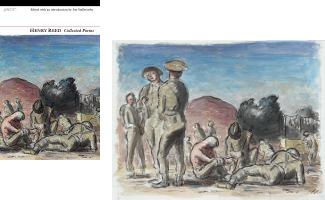
Reed's Collected Poems (left), and "Troops
Resting," by Edward Ardizzone. (1900-1979) was born in Haiphong, in French Indo-China. Educated in England, he took evening classes at the Westminster School of Art while working as a clerk with the Eastern Extension Telegraph Company, eventually becoming a freelance artist and illustrator. He earned recognition through solo exhibitions, and by illustrating for books and popular periodicals.
In 1940, Ardizzone was serving as a Second Lieutenant in an anti-aircraft battery in London when he was appointed an official War Artist by the War Artists Advisory Committee. He tagged along with the British Expeditionary Force through France and Belgium, and served in North Africa. In 1943, he put joined up with the troops invading Sicily, and within a week of the D-Day landings he was in Normandy.
The Imperial War Museum's record for Ardizzone's painting has a modest description which reads like a stanza from Reed's "Judging Distances":
A group of soldiers sit on the ground. One is slumped forward the other is cleaning his rifle. A third has his back to the viewer and is lying stretched out on the ground. To the left of this group some other solders stand around chatting. In the background there is a truck near some trees.
You can view a larger version of " Troops Resting" on the Imperial War Museum's website. (Or, you can query their art collection for "Ardizzone" to see their extensive holdings.) The Museum also has a special exhibition of his sketchbook and war diary. And here's an image search for Ardizzone's work.
|
1535. Reed, Henry. "Talks to India," Men and Books. Time & Tide 25, no. 3 (15 January 1944): 54-55.
Reed's review of Talking to India, edited by George Orwell (London: Allen & Unwin, 1943).
|
The artist Conroy Maddox ( Guardian obituary) discovered Surrealism in 1935, when he was twenty-two, browsing through a book on European painting in the Birmingham City Library: Wilenski's The Modern Movement in Art (1927, rev. ed. 1935). Maddox had been born in Ledbury, Herefordshire in 1912, but his family settled in Erdington in 1933.
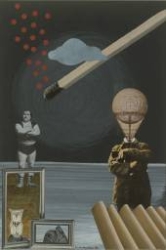 The Strange Country
, by Conroy Maddox (1940)
Although he eventually outgrew the city, Maddox was inspired by urban Birmingham—with its libraries, theatres, and art galleries—after a youth spent in the countryside. In his (impeccably illustrated) biography of Maddox, The Scandalous Eye, Silvano Levy quotes generously from conversations and correspondence with the artist. These insights from Maddox provide a context for Henry Reed's social life in Birmingham before the war:
During that time, I began to explore the possibilities I discovered in collage which questioned the innocence of all images and the allusiveness of reality. Evenings were spent with in talk with Robert and John Melville, the poet Henry Reed, and Dorothy Baker. On Sundays, we would go to the Film Society and saw for the first time the works of Eisenstein, Cocteau, Pudovkin, Fritz Lang and others. Afterwards, we would talk either about the film or more imaginatively. (p. 45)
Reed, of course, was raised in Erdington, and from 1932-1936 he was studying at the University of Birmingham. Robert Melville would later become the art critic for the New Statesman. His brother, John Melville, was an artist also interested in Surrealism, who had occasion to paint a rather more traditional portrait of Reed (popup window). Along with Emmy Bridgwater, William Gear, and Stuart Gilbert, this circle of artists became the Birmingham Group. But Maddox's group of friends and followers was not not limited to painters:
The entourage included George Painter, Harry Browne and Philip Troutman, who were literary scholars; Cornelius Russell, an art historian at the university; his wife Jane; Dorothie Hewlett; Edward Lowbry [sic], a microbiologist and poet; Roy Knight, a modern languages academic who had unsuccessfully tried to teach Maddox some French; Dorothy Baker, a writer; and the poet Henry Reed, who, whenever the opportunity arose, would introduce his 'heterosexual friend Conroy Maddox'. (p. 98)
Reed's openness (and humor) about his sexuality never ceases to surprise me.
This litany of Birmingham's intellectual A-list will keep me busy for weeks, hunting the library stacks for biographies and collected letters, sliding my digitus secundus down the "R" pages of indexes, looking for references to Reed (is that why it's called the "index" finger?).
George Painter, the Proust biographer, had attended secondary school with Reed (see previous post). My Granger's Index lists five poems of Edward Lowbury which appear in various anthologies. His poem on the Hiroshima bombing, " August 10th, 1945—The Day After," appears on the Salamander Oasis Trust website. Lowbury's Collected Poems was published in 1993 ( Contemporary Review 263, no. 1535 (December 1993): 329-330).
The two mentions of Dorothy Baker are especially intriguing, as she appears to have been a native of Missoula, Montana. What she was doing in England at that time, I haven't the faintest idea. Baker's debut jazz novel, The Young Man with the Horn (1938) was adapted into a film starring Kirk Douglas, Lauren Bacall, and Doris Day, in 1950. She was the wife of the American poet and novelist Howard Baker, whom she had married in Paris in 1930. (I think I have entirely the wrong Dorothy Baker! This is the right Dorothy Baker.)
A severely limited preview of Levy's The Scandalous Eye: The Surrealism of Conroy Maddox is available from Google Books (the copyrighted images appear to be restricted). I have a library copy here beside me, and it's a beautiful, glossy-paged book. I'm astute enough (but only just) to detect the influence of Picasso, Magritte, and Dali in Maddox's work, but I fear I have been forever spoiled for his googly-eyed collages by the Spongmonkeys (Flash, audio, weird).
|
1534. Reed, Henry. "Radio Drama," Men and Books. Time & Tide 25, no. 17 (22 April 1944): 350-358 (354).
Reed's review of Louis MacNeice's Christopher Columbus: A Radio Play (London: Faber, 1944).
|
|
|
|
1st lesson:
Reed, Henry
(1914-1986). Born: Birmingham, England, 22 February 1914; died: London, 8
December 1986.
Education: MA, University of Birmingham, 1936. Served: RAOC, 1941-42; Foreign Office, Bletchley Park, 1942-1945.
Freelance writer: BBC Features Department, 1945-1980.
Author of:
A Map of Verona: Poems (1946)
The Novel Since 1939 (1946)
Moby Dick: A Play for Radio from Herman Melville's Novel (1947)
Lessons of the War (1970)
Hilda Tablet and Others: Four Pieces for Radio (1971)
The Streets of Pompeii and Other Plays for Radio (1971)
Collected Poems (1991, 2007)
The Auction Sale (2006)
|
Search:
|
|
|
Recent tags:
|
Posts of note:
|
Archives:
|
Marginalia:
|
|