|
|
Documenting the quest to track down everything written by
(and written about) the poet, translator, critic, and radio
dramatist, Henry Reed.
An obsessive, armchair attempt to assemble a comprehensive
bibliography, not just for the work of a poet, but for his
entire life.
Read " Naming of Parts."
|
Contact:
|
|
|
|
Reeding:
|
 |
I Capture the Castle: A girl and her family struggle to make ends meet in an old English castle.
|
 |
Dusty Answer: Young, privileged, earnest Judith falls in love with the family next door.
|
 |
The Heat of the Day: In wartime London, a woman finds herself caught between two men.
|
|
|
|
Elsewhere:
|
|
All posts for "Illustration"
|
|
|
22.10.2024
|
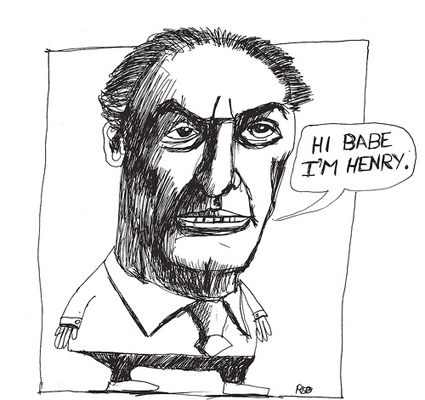
I'm happy to be able to share this excellent caricature of Henry Reed drawn by the artist Rod MacGregor, a self-described "mover of pens":
Rod's other work can be found on The Pen Mover Flickr and Instagram pages, including these great renderings of Robert Frost and William Burroughs.
|
1537. Radio Times, "Full Frontal Pioneer," Radio Times People, 20 April 1972, 5.
A brief article before a new production of Reed's translation of Montherlant, mentioning a possible second collection of poems.
|
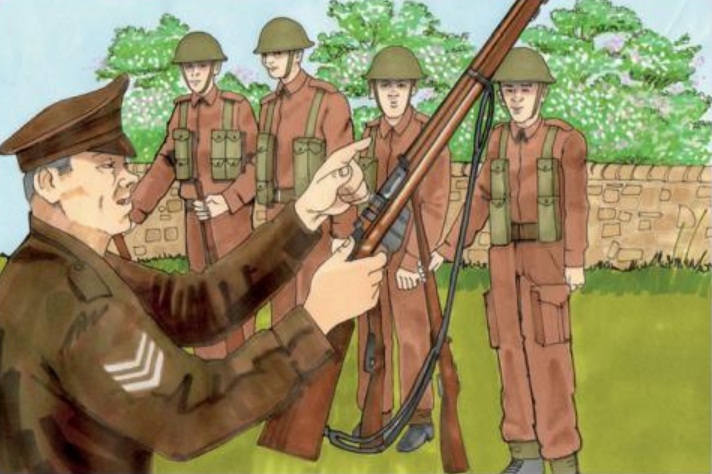
Illustration by 'Oxford Designers and Illustrators,' accompanying Henry Reed's "Naming of Parts" and "Judging Distances," in Cambridge Checkpoint English 3, by John Reynolds (London: Hodder Education, 2011), pp. 24-25.
(Looking closely, I notice the details that the recruits have not yet been given their rifle slings, and the almond blossom seems particularly silent.)
|
1536. L.E. Sissman, "Late Empire." Halcyon 1, no. 2 (Spring 1948), 54.
Sissman reviews William Jay Smith, Karl Shapiro, Richard Eberhart, Thomas Merton, Henry Reed, and Stephen Spender.
|
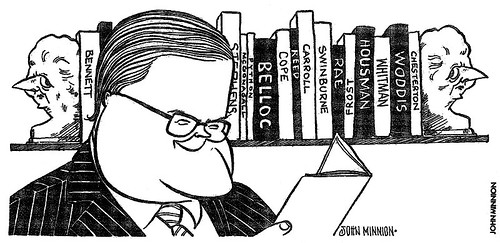
Here's an excellent caricature of Lord Kenneth Baker, drawn by the famed illustrator John Minnion. It appeared in the Listener on September 6, 1990, accompanying a review of Baker's anthology, Unauthorised Versions: Poems and Their Parodies. The review quotes Henry Reed's 'portmanteau' parody of T.S. Eliot, "Chard Whitlow."
If you look closely at the books propped up on the shelf between the twin Thatchers, you'll see REED on one of the spines (right between COPE and CARROLL).
|
1535. Reed, Henry. "Talks to India," Men and Books. Time & Tide 25, no. 3 (15 January 1944): 54-55.
Reed's review of Talking to India, edited by George Orwell (London: Allen & Unwin, 1943).
|
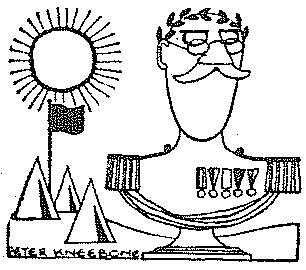
Owing to some lovely winter weather this morning, I've got a brief reprieve from work: a half-day snow day. It seems unlikely that the journal volumes which I requested from library storage last week will show up today, so instead I'll post two items I've been sitting on for some time: illustrations for billings of Reed's radio plays from the Radio Times:
This illustration is by Peter Kneebone, and is from the Radio Times for May 1, 1959. It accompanied the billing for the sixth play in Reed's Hilda Tablet series: Not a Drum Was Heard: The War Memoirs of General Gland, first broadcast on the BBC Third Programme on May 6, 1959. The General looks distinguished, but he's quite mad.
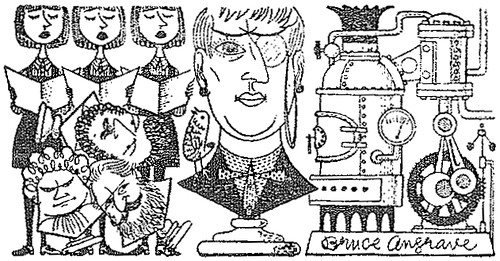
This drawing is by Bruce Angrave, from the Radio Times for October 23, 1959, illustrating the seventh and final play in Reed's sequence, Musique Discrète: A Request Programme of Music by Dame Hilda Tablet. The play premiered on October 27, 1959, with musique concrète renforcée provided by Donald Swann. Isn't Hilda's monocle a gas?
(I'm not embarrassed to admit that I could only recognize Beethoven's bust [bottom left] getting tumbled in Angrave's picture. Our friend the Webrarian came to my rescue: that's Wagner turned sideways, with Brahms just below.)
|
1534. Reed, Henry. "Radio Drama," Men and Books. Time & Tide 25, no. 17 (22 April 1944): 350-358 (354).
Reed's review of Louis MacNeice's Christopher Columbus: A Radio Play (London: Faber, 1944).
|
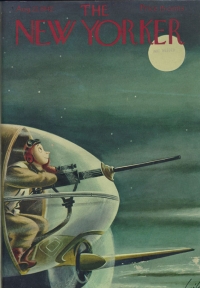
Here's a New Yorker cover from World War II which bears comparison with " Naming of Parts." It depicts a daydreaming nose gunner in (what looks like) a stylized B-24.
From American Studies at the University of Virginia's Covering the War section of Urban and Urbane: The New Yorker Magazine in the 1930s:
[E]ven preoccupied with the thoughts of death, honor, and heroism that doubtless passed through the heads of millions of American soldiers on the eve of battle, the young man cannot resist the natural beauty of the full moon on a clear night. The image also plays with the sharp contrast between the plane, the latest in American technology, and the vast emptiness of the sky. It makes a subtle yet present commentary on the just how much technology has still yet to do.
The depiction also stands in stark contrast to that other famous poem of the war, Jarrell's " The Death of the Ball Turret Gunner." The illustration appears on the cover of August 22nd, 1942 issue of The New Yorker ( full size), and is by the Russian-American artist, Constantin Alajalov.
A print of Alajalov's cover is available from The Cartoon Bank. (Via Kottke.)
|
1533. Friend-Periera, F.J. "Four Poets," Some Recent Books, New Review 23, no. 128 (June 1946), 482-484 [482].
A short review calls A Map of Verona more pretentious than C.C. Abbott's The Sand Castle; influenced by Eliot, Auden, MacNeice, and Day Lewis.
|
|
|
|
1st lesson:
Reed, Henry
(1914-1986). Born: Birmingham, England, 22 February 1914; died: London, 8
December 1986.
Education: MA, University of Birmingham, 1936. Served: RAOC, 1941-42; Foreign Office, Bletchley Park, 1942-1945.
Freelance writer: BBC Features Department, 1945-1980.
Author of:
A Map of Verona: Poems (1946)
The Novel Since 1939 (1946)
Moby Dick: A Play for Radio from Herman Melville's Novel (1947)
Lessons of the War (1970)
Hilda Tablet and Others: Four Pieces for Radio (1971)
The Streets of Pompeii and Other Plays for Radio (1971)
Collected Poems (1991, 2007)
The Auction Sale (2006)
|
Search:
|
|
|
Recent tags:
|
Posts of note:
|
Archives:
|
Marginalia:
|
|