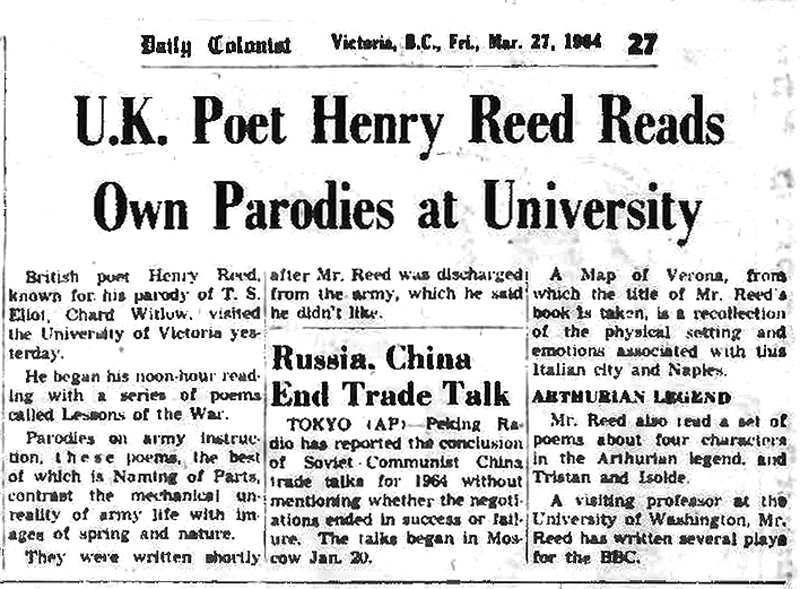
What a treat to be able to add another country to the list of places Henry Reed visited! The Daily Colonist of Victoria, British Columbia reports that Reed gave a noontime poetry reading at the University of Victoria on Thursday, March 26, 1964. Reed may have gone at the invitation of Robin Skelton.
Reed was a Visiting Professor of English at the University of Washington, Seattle at the time, a guest position opened up by the untimely death of Theodore Roethke. So he just popped over to Canada for a reading:
U.K. Poet Henry Reed Reads Own Parodies at University
British poet Henry Reed, known for his parody of T. S. Eliot, Chard Witlow [sic], visited the University of Victoria yesterday.
He began his noon-hour reading with a series of poems called Lessons of the War.
Parodies on army instruction, these poems, the best of which is Naming of Parts, contrast the mechanical unreality of army life with images of spring and nature.
They were written shortly after Mr. Reed was discharged from the army, which he said he didn't like.
A Map of Verona, from which the title of Mr. Reed's book is taken, is a recollection lot the physical setting and emotions associated with this Italian city and Naples.
ARTHURIAN LEGEND
Mr. Reed also read a set of poems about four characters in the Arthurian legend, and Tristan and Isolde.
A visiting professor at the University of Washington, Mr. Reed has written several plays for the BBC.
"Several" plays for the BBC. By my count, Reed wrote or translated 36 radio plays before 1964.
Spiegelman uses "Naming of Parts" as an example of "irony as dialectic", and brilliantly even spends a minute to explain Reed's switch of "duellis" (battles) for "puellis" (girls) in the poem's epigraph from Horace.
I tweeted this a while back, but never posted it here. A reading and re-enactment of Reed's "Naming of Parts," from the Channel 4 series, Arrows of Desire, produced by Optic Nerve, circa 2004. The episode this clip is from is described as:
A selection of well-known poets read and discuss two classic poems—"The Flea" by John Donne and "A sight in camp in the daybreak gray and dim" by Walt Whitman—as well as two modern ones: a letter from Marie Curie" by Lavinia Greenlaw and "Naming of Parts" by Henry Reed.
The videocassette label lists:
...interpretations and discussions by W.N. Herbert, John Kinsella, Clare Pollard, Owen Sheers, Michael Donaghy, Patience Agbabi, Greta Stoddart, Paul Muldoon, John Stammers, Andrew Motion, Rod Mengham, Tom Paulin, Jamie McKendrick, Roger McGough, Sophie Hannah, Jean Binta Breeze, Matthew Sweeney, Kenneth Koch, Matthew Hollis, Jerome Rothenberg, Jane Hirschfield, Wendy Cope, P.J. Kavanagh, Imtiaz Dharker, Iain Sinclair, Lavinia Greenlaw, and Charles Bainbridge.
I'm curious if anyone recognizes the reader/narrator in this clip? I'm dying to know who it may be!
Ben Mellor is a Manchester-based, award-winning slam poet. His first full-length spoken word show, Anthropoetry (with music by Dan Steele), is a linguistic road trip through the human body, and includes this spin on Henry Reed's classic "Naming of Parts":
This audio clip is part of "Other Ranks," an installation by sound artist Amie Slavin at the Royal Armouries Museum in Leeds, England (extended until July!). It features the actor Jim Broadbent reading Henry Reed's poem "Naming of Parts" over the sounds of soldiers drilling:
You can listen to other works by Ms. Slavin — including an introduction to "Other Ranks" — on her SoundCloud stream.
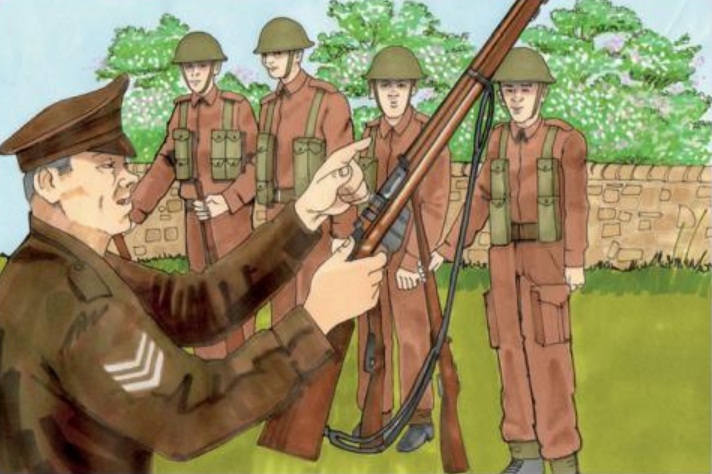
Illustration by 'Oxford Designers and Illustrators,' accompanying Henry Reed's "Naming of Parts" and "Judging Distances," in Cambridge Checkpoint English 3, by John Reynolds (London: Hodder Education, 2011), pp. 24-25.
(Looking closely, I notice the details that the recruits have not yet been given their rifle slings, and the almond blossom seems particularly silent.)
An American contemporary of Henry Reed's, Hecht saw combat in World War II, and was particularly affected by his experience liberating Flossenbürg concentration camp in April of 1945. With few exceptions, he finds little good to say about the Touchstones anthology, and takes a particular exception (Google Books preview) to Marvin Bell's piece on Reed's "Naming of Parts":
December 19, 1995 Washington DC
[To J.D. McClatchy]
Dear Sandy,
I imagine you're away now, either in England or California (I can't keep your travels straight in my memory) but I have just read your excellent little essay on Pope's "Epistle to Miss Blount," and read it not only with delight but with greatly moved feelings. Your essay, brief as it is, seems to me the best thing in the whole book called Touchstones. It is in many ways an odd book. I haven't read it all, and don't think I ever will; but I feel I must surely have covered both the best and worst of it. And these "best" and "worst" fall with astonishing neatness into two distinct camps that are easy to characterize. Let me say right away that I think the "best" are, after you, Wilbur, Justice, Nims (and there may be one or two others as yet unread). The other category is more numerous, and, as I was composing it I began to think I was, as I have long been accused of being, a misogynist, male-chauvinist pig. For my list includes (in no preferential order) Linda Pastan, Maxine Kumin, Erica Jong, Clara Yu, Rosellen Brown, Nancy Willard, Chase Twichell, and (saved by the bell) Marvin Bell.
...All of them, in any case, begin auto-biographically, with a sickening narcissism [and seem] to come to the poem they are ostensibly writing about with some reluctance. They feel all cuddly or martyred about their past, and this is what truly moves them...[.]
But in some ways Bell deserves a special trophy for incomprehension. It's not just that he begins with his own trifling army experience in writing about Henry Reed's "Naming of Parts." It's that there is so much about the poem he fails to grasp, not the least of which being the very clear and touching class distinction between the conscript and the staff sergeant who is lecturing. The difference would be ironically amusing (or mildly offensive) under normal circumstances: the intellectually inferior lecturing his better. But in war time, such roles are either irrelevant or reversed. And the recruit must put up with them not merely because army regulations require his obedience but because his life may depend on knowing what this well-meaning oaf is trying to impart. And all the grounds for resentment are thereby cancelled, and a new, not entirely desirable, basis for existence is established. The wistfulness of the recruit for the pastoral world of harmless nature, and the recollected world of lovers, is juxtaposed, as it was in Hardy's "In a Time of Breaking of Nations," with the familiar irony of war-time brutality.
Anyway, the book is, but for your piece, and one or two others, a silly book, eliciting the worst, the most hopelessly self-absorbed from writers who are far too self-absorbed...[.]
...With warmest and most affectionate wishes for the holiday season and the coming year,
Tony
[pp. 274-275]
It's obvious that Hecht holds Reed's poem with special regard—no doubt from the familiar experience of basic military training—and the comparison with Hardy is both apt and doting. Hecht does not appear to be one to suffer fools lightly, but Bell served as a lieutenant in the U.S. Army during the Vietnam War, so perhaps the criticisms regarding the other contributors' narcissism and self-absorption are heavy-handed. As a matter of fact, if you have read the entire letter, it sounds suspiciously as though Hecht may have misunderstood the editors' intentions for the collection.
"The Naming of Parts" (2003), acrylic on wood and found objects, by P J Crook, in the collections of the Imperial War Museum:
This piece refers to Henry Reed's poem of the same name, drawing on his experiences in the Second World War. It was made during the recent war with Iraq in 2003, in reaction to another of the artist's pieces in the Museum's Art collection, 'Other Mothers' Sons.'
Team Impression, a printing house based in Leeds, are celebrating their tenth anniversary with a year-long project called Ten, featuring ten 'articles and accompanying posters which are the result of collaborations between some of the world's most prestigious names in graphic design.'
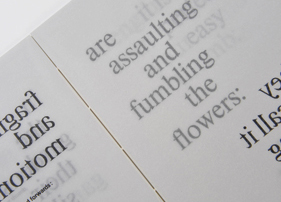
The third collaboration for the Ten project is based on a setting of Henry Reed's "Naming of Parts" by the graphic artist and typographer Pamela Bowman, who co-founded the design studio dust in 2000. What began as a student project at Leeds Metropolitan University in 1995 was eventually published by Simon King Press in 1999 as Lessons of the War: An Artist's Book. In Bowman's design, the text of Reed's poem is presented on see-through stock, illustrating the dream-like, backward-and-forward qualities of the soldier's internalization of his lesson:
The renowned graphic designer and author Ken Garland calls Bowman's book 'a most sensitive and suitable use of translucent paper to convey the idea of parallel spoken and internal text.' Garland and Bowman discuss the work on Team Impression's Ten webpages, where you will see the poster that resulted from their collaboration. Links to purchase a limited, numbered edition of the A2 poster at the bottom of the page!
1529. Sackville-West, Vita. "Seething Brain." Observer (London), 5 May 1946, 3.
Vita Sackville-West speaks admirably of Reed's poetry, and was personally 'taken with the poem called "Lives," which seemed to express so admirably Mr. Reed's sense of the elusiveness as well as the continuity of life.'
Carol Muske-Dukes, the poet laureate of California, has been holding an extended conversation over the past five months with Lieutenant Colonel Edward Ledford, U.S. Army, and posting the exchanges over at The Huffington Post. Colonel Ledford is stationed in Kabul, Afghanistan, and has been taking the time to share his thoughts on war, poetry, and the poetry of war.
In the first part, "Soldier to Poet: An Exchange," we meet Lt Col Ed Ledford (photo), and learn that in addition to flying helicopters and jumping out of airplanes, he has taught English at the University of Alabama and the United States Military Academy at West Point. Prompted by Muske-Dukes, Ledford talks about the romanticism of war, cowardice and conscience, and by turns, Hamlet.
In Part II, they cover Wilfred Owen and the old lie, "Dulce et decorum est pro patria mori."
The latest exchange, Part III, finds the pair going over "Naming of Parts." Ledford considers April, and spring in Afghanistan, and says:
The first lines point me back to the creation myth and allegorical Eden. Adam 'gave names to all cattle, and to the fowl of the air, and to every beast of the field.' He was on the verge of something: shortly after — the temptation, the fall, the migration to a world of pain, suffering, and death.
And those first lines do put us on the verge of something — today we name; tomorrow is 'what to do after firing.' Between today and tomorrow, we're firing the weapons, and that means one thing — engagement, combat, casualties. These are apparently new troops in training, one could argue that the firing will be at a rifle range, harmless.
But let's not fool ourselves: the firing at the range is a cold rehearsal of killing, firing at paper or plastic silhouettes of the human form — flat, faceless, nameless, anonymous representations of the innumerable and unnameable casualties, very many of whom will suffer agonizing deaths or agonizing lives.
Ledford procedes to uncover the language of "Naming of Parts," camouflaged in a Q&A which took place between Donald Rumsfeld and American soldiers on the eve of the Iraq War, turning the hollow-sounding responses into a found poem:
As you know, you go
to war
with the Army you have.
They're not the Army
you might want
or wish to have
at a later time.
If you think
about it,
you can have
all the armor
in the world
on a tank
and a tank
can be blown
up.
It is something
you prefer not to have to use,
obviously,
in
a perfect world.
It's been used
as little as possible.
Lt Col Ledford is contributing to "Crossing State Lines, an American Renga," a conversation-poem between 54 poets, part of the America: Now + Here project—a mobile, cross-country exhibition of artists, writers, and musicians—scheduled for spring, 2011.
Over on Yahoo! Music, I was shocked to find available, free for listening, all 118 poems from the album Best of Second World War Poetry (CSA Word Recording, 2007). Read by Rosalind Ayres, Phil Collins, Barry Humphries, Martin Jarvis, and Richard Todd, the anthology includes poems by Roy Campbell, Keith Douglas, Gavin Ewart, Sidney Keyes, and Terrence Tiller.
Individual tracks, or the entire album, are available for purchase from Rhapsody, and the Commemorative Special Edition CD set (shown above) is on the CSA Word website.
I'm not in the habit of buying Reed ephemera online, though I've occasionally done so in the past. I bought a couple of old Listener issues which are rather difficult to find in libraries in the States, and if I were a richer man, I might consider buying a whole forest's worth of Radio Times back issues. So I was rather torn when I found this short article in The Bookseller for March 3, 1951:
Poetry Sold in Cambridge Streets
Some enterprising Cambridge undergraduates have been trying the effect of offering modern poetry for sale in the streets. The first experiment took place on a Saturday—a market day in Cambridge—and out of 2,000 copies printed, about 1,100 were sold. A further 200 copies were disposed of afterwards.
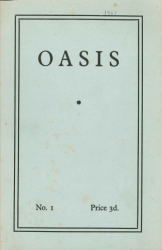
The publication offered was the first issue of a series of pamphlets of poetry, entitled Oasis. The selling price is 3d. The first issue contained poems by W.B. Yeats, T.S. Eliot, W.H. Auden, Stephen Spender, C. Day Lewis, Louis MacNeice, Robert Graves, Dylan Thomas, and Henry Reed. In the next issue, work of lesser-known poets will be printed; and for May Week the organisers hope to bring out a Cambridge Poetry for the previous year.
The aim of the scheme is to overcome present-day apathy to poetry. 'All the authors and publishers allowed us to reprint these poems without fee,' writes Mr. David Stone, of Queens' College. 'Without this help it would have been very difficult to sell the pamphlet at a price attractive to everyone. There has been some disapproval of the street-selling, but most seemed to think it was a good idea.' The pamphlet carried an invitation: 'If you enjoy this selection and are interested in modern poetry come and hear these and other poems read and ask questions to-morrow evening at the Union.' The reader, on the Sunday evening, was Mr. Hamish Henderson.
(p. 344)
At first I was a bit confused by the title, since Reed also makes an appearance in the Salamander Oasis Trust'sFrom Oasis into Italy: War Poems and Diaries from Africa and Italy, 1940-1946 (Victor Selwyn, et al., eds., 1983), but this was evidently an entirely different oasis of poems, a student-published pamphlet from Trinity College, University of Cambridge. According to A Literary History of Cambridge (rev. ed., 1995),
Oasis [was] founded in 1950 by John Mander of Trinity and David Stone of Queens' in conjunction with a series of readings at the Union, was sold directly on the streets by what Gunn called 'a kind of suicide squad' of enthusiasts. It was bought in remarkable numbers (up to three thousand per issue), giving it the largest circulation of any poetry magazine in England. The first issues were devoted to major poets like Yeats and Eliot, later ones to undergraduate work. Fifteen hundred poems were submitted for the Oasis poetry competition. One of the winners was Thom Gunn (who was also on the editorial board).
(p. 275-76)
Gunn would later write of the students' experience hawking poetry in the streets of Cambridge for The Bookseller: "Oasis: An Experiment in Selling Poetry" (March 15, 1952, p. 782).
My curiosity got the better of me, finally, and I went poking around online until I found a bookstore in the UK which was offering copy of Oasis, no. 1 (1951). A short wait for trans-Atlantic airmail later, and I was sitting under the yellow lamp in my living room, magazine in hand. From the editors' foreword:
'Oasis' is the first in a series of pamphlets of poetry. Our aim is to show by a representative selection of good contemporary poetry just what sort of poem has been written in the last decades. In this selection there are many styles and many moods. Poets write about everyday subjects—see if you agree with the last two lines of Louis MacNeice's poem: they write about newsreels, love, religion, the futility of war; Henry Reed makes a poem out of naming the parts of a rifle.
We should like to devote future numbers of 'Oasis' to the works of other poets: and perhaps we might find enough good undergraduate poetry here to fill an issue with Cambridge writers.
Modern poetry is always said to be obscure: we hope you will read these poems and judge for yourselves.
This is followed by the epigraph: "When I hear the word culture I reach for my revolver," a popular paraphrase of Hanns Johst, from his pro-Nazi play, Schlageter (1933): "Wenn ich Kultur höre... entsichere ich meinen Browning!"
I guess I had been hoping to discover an obscure, perhaps unknown poem from Henry Reed, but the issue was, as advertised, devoted to well-known, previously-published poems from established poets. A slim volume at only 12 pages, it contains "For Anne Gregory," by W.B. Yeats; "Journey of the Magi," by T.S. Eliot; "Culture," by W.H. Auden; "Regum Ultima Ratio," by Stephen Spender; "Newsreel," by C. Day Lewis; "Bagpipe Music," by Louis MacNeice; "No More Ghosts," by Robert Graves; "Among Those Killed in the Dawn Raid Was a Man Aged a Hundred," by Dylan Thomas; and, of course, Reed's "Naming of Parts."
Edmund Blunden says Reed's Lessons of the War poems 'have captured something of the time-spirit and ambiguity of the recent war in a style of wit and deep feeling united.'
Jim Clark has been "reincarnating" long-dead poets by animating old photographs to make it seem as if their subjects were reading out loud. The effect is sometimes wonderful, especially if the audio is a recording of the actual poet reading his or her own work. Sometimes, however, the animations are haunted by the uncanny valley effect, which can make the more exaggerated movements of lips and eyebrows seem less real (and even a little creepy). Here's the video for Henry Reed's "Naming of Parts":
(You might recognize that recording from from Reed's 1959 appearance on Oscar Williams' Album of Modern Poetry, and the photograph from Reed's time at the University of Washington, Seattle, circa 1965.)
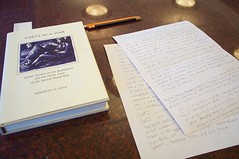
As afforded me by my time spent working a half-day on Easter Sunday, I was able to sneak out of the last couple of hours of work today, and managed to do something resembling genuine scholarship. There was a book on campus, in the library's Special Collections, which I had discovered hiding in plain sight on Professor Goethal's "Poetry & WW2" page: Poets in a War, by Kenneth A. Lohf (New York: Grolier Club, 1995). The book is a detailed catalog of an exhibition curated by Mr. Lohf, which was displayed at the Grolier Club of New York from December, 1995 through mid-February, 1996.
The Grolier Club is 'America's oldest and largest society for bibliophiles and enthusiasts in the graphic arts' (they are currently showing an autograph manuscript of Robert Burns' "Auld Lang Syne"). From the Club's webpage for Poets in a War:
In observance of the 50th anniversary of the end of World War II, the Grolier Club in December 1995 presented an exhibition featuring manuscripts, first editions, drawings and portraits of 130 British poets of the 1940s who served on the battlefronts and home front.
The book is lavishly illustrated with photographs and reproductions, and I was hopeful that it might contain a picture of Reed. Alas, no such luck, though there is a reproduction of the title page of Reed's 1970 collection, Lessons of the War (New York: Chilmark Press). The text does contains detailed bibliographic information on the Lessons and A Map of Verona (London: Jonathan Cape, 1946), as well as several appraisals of Reed's poetry:
Of the poets who produced one or more memorable poems, F.T. Prince's 'Soldier's Bathing' and Henry Reed's 'Naming of Parts' (the first part of his series of poems, 'Lessons of the War'), stand out because of the ways in which they treated their specific subjects...[.] Like Prince, Reed, who after a year in the Army worked at the Foreign Office for the remainder of the war, had written only one volume of poetry, A Map of Verona (1946), by the time the war ended...[.] Though his participation in the army was brief, his series of poems 'The Lessons of War,' [sic] collected in A Map of Verona, is among the best-known group of poems of the Second World War. Like 'Soldier's Bathing,' 'Naming of Parts,' the first poem in the series, is a meditative poem in which the central conflict is between a recruit's wandering thoughts and an army officer's emotionless voice of instruction in the use of a rifle, a voice with a decided sexual dimension which is lost on the recruit who thinks solely of the beauty and sensuousness of nature. It is the human scale of these poems—both of their speakers are soldiers—that facilitates our understanding of the meaning of war to the men caught in its turmoil. (p. 26)
The library's copy appeared to be in pristine condition, or at least it had been previously handled with the greatest care. I was loathe to ask for photocopies since it would involve putting pressure on the books' virgin spine, so I settled for copying out the relevant passages in longhand, and taking pictures of everything, in case I made any mistakes (more pics on the Reeding Lessons Flickr page). An hour well spent!
1524. Reed, Henry. Letters to Graham Greene, 1947-1948. Graham Greene Papers,
1807-1999. Boston College, John J. Burns Library, Archives and Manuscripts Department, MS.1995.003. Chestnut Hill, MA.
Letters from Reed to Graham Greene, including one from December, 1947 Reed included in an inscribed copy of A Map of Verona (1947).
1523. Reed, Henry. "Simenon's Saga." Review of Pedigree by Georges Simenon, translated by Robert Baldick. Sunday Telegraph (London), 12 August 1962, 7.
Reed calls Pedigree a work for the "very serious Simenon student only," and disagrees with the translator's choice to put the novel into the past tense.
Reed's poem "Naming of Parts" makes use of a time-honored rhetorical device called amplification, in particular the use of eutrepismus: the numbering and ordering of parts under consideration. From the Greek, eutrepes, meaning "well-turning." Here's "Naming of Parts" used as an example of this locution, in a 2003 dictionary of poetic terms (Google Book Search).
[I]n latine called Bonus ordo, and Ordinatio, it is a forme of speech, which doth not only number the partes before they be said, but also doth also order those partes, and maketh them plaine by a kind of definition, or declaration.
Peacham also adds the following "Caution": 'It is verie behouefull to take heed that when the parte be numbred in generall, they be not forgotten in the particular prosecution: as he that promised to expound the twelve articles of the Creed, and after could remember but nine.'
So it would seem "Naming of Parts," or at least the sergeant-instructor's lesson, is also an example of a how-not-to.
1522. Reed, Henry. "Hardy's Secret Self-Portrait." Review of The Life of Thomas Hardy, by Florence Emily Hardy. Sunday Telegraph (London), 25 March 1962, 6.
Reed says this disguised autobiography is a "ramshackle work," but is still "packed with a miscellany of information not available elsewhere, and readers who care for Hardy will find it everywhere endearing, engaging, and full of his characteristic humour."
Last Sunday, BBC Radio Three's Words and Music featured an episode with the theme of "Authority," including the "authority of armies and the law":
'The March to The Scaffold from Berlioz' 'Symphony Fantastique' is played in Liszt's piano transcription, over a reading from George Luis Borges amazing short story of a man, on the point of being executed, given the gift of a year of frozen time from God. Armies feature next, starting with Benjamin Britten's imperious War Requiem where the quiet, cruel words of Wilfred Owen are set against a grand and deliberately overbearing setting of the Latin Mass. Henry Reed's Second World War poem, 'Naming of Parts' follows, and we hear the final movement of Respighi's 'Pines of Rome', the Apennine Way, where scores of Roman Legions can be heard marching back to the Eternal City. From Joseph Heller's Catch 22 we move on to political power, with 'poems' by Donald Rumsfeld, and satire from Swift. Margaret Thatcher is the narrator in Copland's Lincoln Portrait, and we witness JS Bach encountering Frederick The Great of Prussia, offering a fawning dedication to him at the start of his 'Musical Offering' but slyly presenting the Emperor with fiendishly difficult music.
"Naming of Parts" is read enthusiastically by the actor Henry Goodman, and appears at about 19:54 (as I listen: YMMV. The playlist has it at 22:46). If you should care to Listen Again (RealPlayer), the August 19th, 2007 program should be available through next weekend.
1521. Reed, Henry. "Leading a Dance." Review of Fokine: Memoirs of a Ballet Master, translated by Vitale Fokine. Sunday Telegraph (London), 26 November 1961, 6.
Reed finds Fokine's memoirs "very absorbing and intelligent."
Here's a linguistic experiment conceived by our friend and counterpart, the Webrarian. It's Reed's "Naming of Parts" being read as a duet of sorts. The parts in the voice of the Sergeant-Instructor have been re-recorded in an Essex accent, while the voice of the Private is the original recording, read by Reed himself:
1520. Reed, Henry. "Shocked into Life." Review of The Empty Canvas, by Alberto Moravia, translated by Angus Davidson. Sunday Telegraph (London), 19 November 1961, 7.
Of Moravia's most recent novel, Reed says "there is something unquestionably heroic about the whole enterprise."
Last September, I mentioned discovering a letter to Henry Reed in the collection of Oscar Williams' correspondence at the Lilly Library in Indiana. The letter was from Henry J. Dubester, and was among a group of letters addressed to British and American poets, including Auden, William Empson, Frost, Roy Fuller, Archibald MacLeish, Roethke, and Stephen Spender (amidst many others). I wondered, at the time, what Mr. Dubester was doing, writing to so many prominent poets?
Not long after, I received an e-mail from none other than Henry Dubester, himself, which answered my question. Mr. Dubester informed me:
I was promoted and served as Assistant and then Chief of the General Reference and Bibliography Divisions of the Library of Congress. The Poetry Office was one of the sections of the Division. The Library also had a recording laboratory where recordings were made and preserved of many individuals, including poets. I had the opportunity of compiling a set of records with a selection from those recordings. Oscar Williams was my consultant who advised me on the selection. Following his advice, I contacted the poets and solicited their permission to include the text of their recorded poems with the (3) record album.
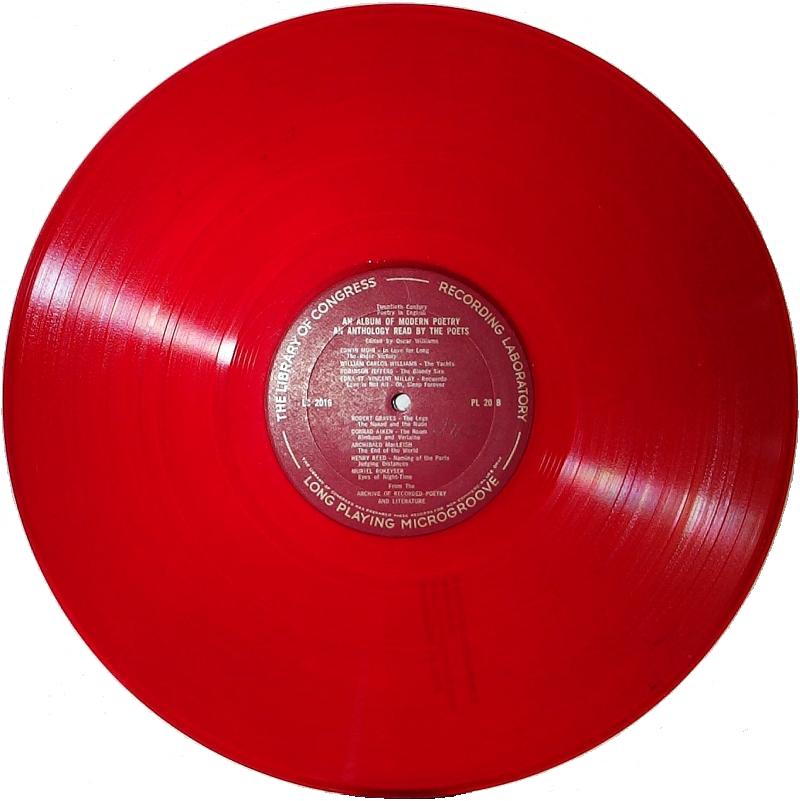
Mr. Dubester is referring to the Library of Congress Recording Laboratory's An Album of Modern Poetry: An Anthology Read by the Poets (1959), a set of recordings of the best 20th-century poets reading from their own work, edited by Williams.
My library actually owns these records, although I had to request them from the storage facility where they cache the more outdated or under-utilized materials. The library also possesses a spectacular media lab of its own, replete with soundproofed recording booths stuffed with just the right gear for analog-to-digital conversion. Which is? An ancient turntable plugged into a Mac.
So I snuck away for an hour today, and lifted the tracks of "Naming of Parts" and "Judging Distances" from Williams' Album of Modern Poetry. The boxed set is three 12", 33 1/3 microgroove LPs, pressed into a vinyl the color of which there is no word for in English ("vermillion" does not adequately convey the records' ethereal translucence).
As Mr. Dubester promised, the set includes a wonderful, 41-page printed anthology of the poems being presented by their authors, as well as an introduction from Oscar Williams on the box. And, I did enjoy a wonderfully surreal moment, when I heard Conrad Aiken's voice booming from the lab's speakers, repeatedly referring to Rambo, Rambo, Rambo, before I realized he was talking about Rimbaud. But, enough.
'This is Henry Reed, reading selections from his poems':
1519. Reed, Henry. "What the Master Kept Back." Review of Picasso's Picassos, photographed and introduced by David Douglas Duncan. Sunday Telegraph (London), 29 October 1961, 6.
Reed calls this book "much more than a retrospective" of unseen works by a master: this collection is "infinitely more touching, and possibly more absorbing."
1518. Reed, Henry. "Ageing Passions." Review of The Complete Poems of Michelangelo, translated by Joseph Tusiana. Sunday Telegraph (London), 11 June 1961, 7.
Reed feels that Professor Tusiani's translations have "merely produced page after page of lifeless verse, often unscannable, and stuffed with many images and fantasies of his own."
Pinckney Benedict, author and professor of English at Southern Illinois University, Carbondale, has created what can only be described as a fan video for "Naming of Parts":
You can read Professor Benedict's "naming of parts" and other writing exercises over on his blog.
That's "Rafe," not "Ralf." Rrrrafe. Roll your "r": R-r-r-r-r-rafe.
On a fansite for Ralph Fiennes, there's a "Poetry Corner" page, which collects recordings of the actor reading all sorts of verse, from Shakespeare to Kipling to Pablo Neruda. This, in itself, is not surprising.
But I was left completely nonplussed to discover Ralph Fiennes reading "Naming of Parts" (.mp3). He does the two voices, and everything! Just when you thought the Internet wasn't, y'know: good for stuff.
The poem appears under a section for BBC Radio 4's program, "Poetry Please," so I have to assume this to be the recording's origin. The section also includes Fiennes's interpretations of Keith Douglas's "Vergissmeinnicht," and John Gillespie Magee's "High Flight."
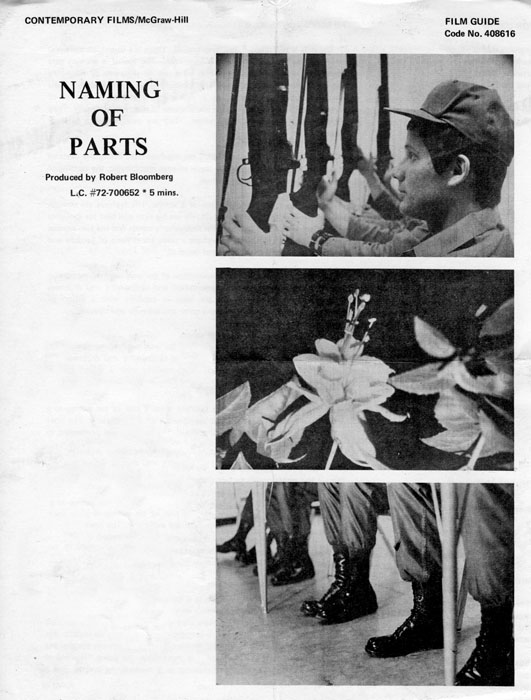
Reeding Lessons is proud to present "Naming of Parts," a film by Robert Bloomberg, based on the poem by Henry Reed. Click to go to video:
Produced in 1971 as a student film at San Francisco State University, Bloomberg's "Naming of Parts" won the Student Peace Prize at the 13th annual American Film Festival. Subsequently, it was picked up for distribution as an educational film. From "Poetry and Film for the Classroom" (English Journal, January 1977), a "highly selected checklist of some of the best films made from poems":
Naming of Parts (Contemporary/McGraw-Hill, 5 min., black and white, 1972). Henry Reid's [sic] poem about a soldier daydreaming during a demonstration/lecture on the naming of the parts of his rifle is presented visually through the eyes of the man. The officer conducting the lesson talks about the weapon and death, but the soldier's thoughts are on nature, sex, and life.
If you prefer a direct, non-Flash link, here's the full version (50MB MPEG file, lengthy download).
Back when Ted Hughes' Birthday Letters came out, there was a lot of renewed tumult over his troubled marriage to Sylvia Plath, and how he had handled (or mishandled) her legacy. I remember not knowing much about Hughes, nor being familiar with his poetry, and I went right out and picked up a copy of his collection, Crow, as a means of introduction.
A young poet friend of mine soon caught me reading Hughes, and she nearly plotzed: How can you be reading that bear, that monster, that beast? Don't you know he killed Sylvia Plath? I felt ashamed. Ignorant, and ashamed for not possessing the same, boldly personal conviction. But at least I was willing to give Hughes a chance to tell his side of the story. When I was sufficiently caught up through Crow, I turned to the library's copy of Birthday Letters, which to my surprise, I found both haunting and moving.
Today, however, for all my purported open-mindedness, I came across a newspaper article which quickly started shifting my opinion. Explication:
Just after Hughes' death, the London Times editor Peter Stothard wrote a recollection of the poet's last public poetry reading, in April of 1997 ("The Poet Laureate's Last Reading," 30 October 1998, 24). Hughes was promoting the School Bag anthology of poetry for students (Magma review), alongside his co-editor, Seamus Heaney. Hughes read a selection from Whitman's "Song of Myself" which captivated the audience, while Heaney chose Wilde's "The Ballad of Reading Gaol."
Following the reading, during an awkward photo-op with the two editors and their collection, Stothard reports he found himself holding the text in front of the photographers. In order to "add fake versimilitude of the sort that publicity pictures require," he began to read aloud the first stanza of the first poem he found inside: Reed's "Naming of Parts."
Heaney and I mumbled about Reed and about how this particular poem was 'one of the most extraordinary works of the war'. Hughes became agitated. 'I hate this poem,' he said, as though shovelling rocks into the vacuum around us. 'I once crashed my car listening to it.' [....] Hughes, the man of hawks and crows and earth, the man who gave animals ideas with his eyes, hates this poem.
Stothard, obviously a stronger man than I, was not to be swayed. He finished reading the entire poem. 'I had always much preferred the public, car-crashing Reed, who looked at the gun and the gardens through the same cold eye and placed them side by side in the same stanza frame.'
As for myself, so easily turned, if I should catch you with a copy of Birthday Letters, it might be me hurling accusations next time. How can you be reading that bear, that monster, that beast? Don't you know he hated "Naming of Parts"?
Did you know that the first publication of Reed's "Naming of Parts" was the same day as the UK premiere of Disney's Bambi? The poem appears directly below a panning review in the August 8th, 1942 New Statesman and Nation (link to .pdf document).
There aren't nearly enough laughs in Bambi, and when we stop laughing at a Disney creation it begins to look commonplace [....] The voices are all straight; Bambi's Ma is a bore with fairy-tale intonations; the Great Stag of the Forest is a terrible bore; and heavenly choirs chant interminably, without a tune one remembers.
My photocopy was a particularly poor one, as it was taken from a bound volume of New Statesmans, and I spent several hours washing out the shadows in the page-well to make that .pdf legible. There it is: Bambi, followed by "Naming of Parts."
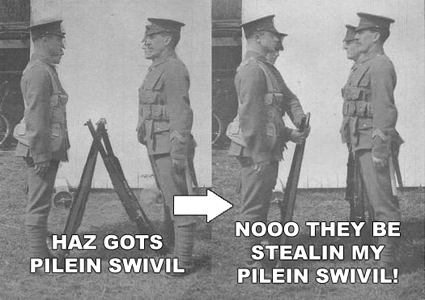
I fixed my kitchen sink tonight. The faucet stem was leaking from the swivel that allows it to move back and forth over the two split sinks, and it was dripping in the cupboard underneath, wreaking wet havoc on my collection of plastic grocery bags.
I am not the handiest of men. Still, I have a few rudimentary tools—a wrench, pliers, screwdrivers, a claw hammer—and just enough confidence to believe I can reassemble a faucet, leaving it (at least) no worse off than it was before I took it apart. I know that turning a water cutoff valve to the right should turn it off (righty-tighty, lefty-loosey), and I religiously watch "This Old House".
So, a little Teflon plumbing thread tape and an hour later, I have a decidedly undripping, non-leaky kitchen sink.
A truly handy gentleman to have around would be someone like David G. Kendall, Professor of Mathematics and Fellow of the Royal Society of London. He has published his theories on such diverse topics as queueing ("Some Problems in the Theory of Queues." J. Roy. Statist. Soc. Ser. B 13 [1951] 151-185), comets ("The Distribution of Energy Perturbations for Halley's and Some Other Comets." Proc. Fourth Berkeley Symp. Math. Statist. Probab. 3 [1961] 87-98), and bird migration ("Pole-Seeking Brownian Motion and Bird Navigation." J. Roy. Statist. Soc. Ser. B [1974] 36 365-470).
In a paper on seriation (a common archeological tool used to date objects by arranging them in a chronological series), I discovered a reference to, of all things, Reed's "Naming of Parts": 'The arable fields are not shown, and a large-scale pre-enclosure map of Whixley is one of those things, which, in our case, we have not got (Reed, 1946)' ("Recovery of Structure From Fragmentary Information." Philos. Trans. Roy. Soc. Ser. A 279 [1975] 562. Italics mine).
After scanning the paper (and understanding about one paragraph in four), I was more surprised that "Judging Distances" was not the poem quoted from A Map of Verona. I imagine Professor Kendall would have taken special delight in the duelling lines "Maps are of place, not time," and "maps are of time, not place...".
A contemporary of Reed's, Kendall was posted to the PDE (Projectile Development Establishment, "Please Don't Enquire!") in the west of Wales during World War II, where he helped develop rocket technology as a statistician. In 1946, he returned to academic life, teaching mathematics first at Magdelan College, Oxford, followed by an appointment to the University of Cambridge in 1962 (picture).
A truly absorbing interview with Professor Kendall (contains link to .pdf file) was printed in the journal Statistical Science in 1996. Astronomy. Rocketry. Mountaineering. Everything but the kitchen sink.
1512. Reed, Henry. "The Case for Maigret." Reviews of Maigret Hesitates and The Man on the Bench in the Barn, by Georges Simenon. Sunday Times (London), 2 August 1970: 22.
Reed reviews two translations of George Simenon's fiction.
An interesting article came to my attention this week: "'Naming of Parts,' 'Judging Distances,' Literary Snobbery and Careless Reading in the Analysis of Henry Reed's 'Lessons of the War'," by Joseph Petite, Ph.D., published in The Journal of Evolutionary Psychology 26, nos. 1-2 (March 2005). Essentially, Petite argues that past critics of "Naming of Parts" and the other "Lessons of the War" poems have relied too heavily on the supposition that there are two, separate voices, or tones, in the poems.
Traditional interpretations point to polar changes in Reed's tone, language, and diction, and argue that these opposites can be explained in one of two ways: either there are two voices in the poems, and we are hearing both the instructor and the recruit; or there is only one point of view — that of the recruit's — and we are listening through him, and are privvy to his inner thoughts.
Petite posits that this is so much literary trickery, and that too much reliance has been made on Freudian interpretations. Essentially, he believes the possibility has been ignored that there is just one speaker in the poems: the instructor.
‘Critics do not credit Reed with a more profound insight—the instructors are victims of war, grappling with how to be human in inhuman circumstances. Psychologically, language is their last line of self-defense, a way to survive the dehumanizing acts war requires. There is no need to "explain" the presence of such language. War-weary, instructors long for beauty, finding it in nature undisturbed by war and expressing themselves in a second register.’
It's a provocative thesis, but I find it hard to agree with a lot of what Petite puts forth, although I do concur that lengthy discussions of stylistics are tiresome, and often include more magical thinking and sleight-of-hand than proofs. But the idea that 'Sometimes a cigar is just a cigar,' and there are no sexual connotations in "Naming of Parts" is patently ridiculous, and attempts to remove all the fun and playfulness from the poem. It's like arguing that all the women on Monty Python's Flying Circus were actually women.
By minding the evidence in biographies of Reed, it's obvious that the "Lessons of the War" are mocking in tone, and more or less autobiographic. Not the least of which is Scannell's assertion that Reed entertained his fellows in basic training by imitating their instructors. Most revealing, however, is the fact that when Reed adapted "Naming of Parts" (.mp3 file) for BBC radio, he split the poem into two speaking parts, and took the part of the recruit, himself.
A longer excerpt of "Literary Snobbery" can be found on the Questia website, and the entire article is available from Amazon.com as a digital download for $5.95.
Stumbled across an interesting lead today, poking and prodding around Google Print. Using Google Print is very much like browsing the index cards in an old-fashioned library card catalog's Subject drawers, except instead of only seeing the phonebook subject headings created by catalogers, there's an index card for every single word and phrase in the English language.
I was looking for information relating to Reed's training in the British army during World War II; specifically, the infamous "lessons" given by non-commissioned officers, on subjects like weapons training, fieldcraft, and self-defense.
Among the complaints of these teachers turned soldiers? 'Too much material crowded into a given period.' 'Inadequate use of visual aids.' 'Lack of learning by doing.' 'Mechanical, parrot-like teaching' (emphasis mine), and an 'unnecessary enumeration of parts' (emphasis also mine).
Does that sound like anyone we know? Just a coincidence, of course. Perhaps the allusion is only in Crang's word choice. I'm sure the all servicemen Valentine surveyed made similar protests.
Valentine, however, just happened to be Professor of Education at the University of Birmingham, as well as the director of the university's Department for the Training of Teachers.
The University of Birmingham is, of course, Reed's Alma Mater, and Reed did teach for a year between graduating and getting called up for military service. Interesting.
Google is, of course, making news this week because they're being sued by publishers McGraw-Hill, Pearson Education, Penguin, Simon & Schuster, and John Wiley for violating copyright by scanning the contents of library collections for their Google Library Project. The Association of American Publishers claims Google is 'seeking to make millions of dollars by freeloading on the talent and property of authors and publishers.'
As near as I can figure, Google Print includes, or will include, Google Library Project scans, but also includes books scanned at the express request of publishers. The reference I discovered today makes an excellent argument in favor of these projects. After a simple keyword search, I was able to check the book out from the college's library, and I have it right here, sitting on my coffee table as I write this.
1510. Birmingham Post, "The Merchant of Venice," 5 March 1937.
Photograph of Henry Reed with members of the Birmingham University Dramatic Society's (BUDS) production of The Merchant of Venice. Shylock played by Ian Alexander.
When I started the "Reeding Lessons" weblog, one of the things I thought it would allow me to do was extoll and expound on Reed's poems myself, something which I have been hesitant to do on the main site (with one notable exception).
Having seen several folks searching for the phrase "easing the spring" this week, it seems a logical place to begin.
In Reed's poem, "Naming of Parts," the play on the phrase "Easing the Spring" appears three times: twice in the fourth stanza, and once in the fifth and final stanza.
In the fourth stanza, the word "spring" is printed both in lowercase and capitalized. The first reference to "spring" is mechanical and literal: this is the metal spring in the rifle's magazine which forces the cartridges up into the breech to be fired. The second and third appearances of the word are in uppercase, "Spring," referring to the season.
The stanzas of the poem are divided into two parts: the first three lines of each are of the recruit listening to the lesson on the parts of his rifle; the fourth line is a blending of the actual lesson and the recruit's interpretation; and the fifth and sixth lines complete the inner monologue of the recruit trying to make sense of what he is being taught. Thus, in stanza four:
Voice of the instructor
1 And this you can see is the bolt. The purpose of this
Is to open the breech, as you see. We can slide it
Rapidly backwards and forwards: we call this
Easing the spring.
Thoughts of the recruit
And rapidly backwards and forwards
5 The early bees are assaulting and fumbling the flowers:
They call it easing the Spring.
The contrast between the mechanized, military spring and natural, bee-filled Spring is obvious. No matter how hard the young soldier concentrates on his arms lesson, his thoughts always revert to Spring, love, and the mechanics of sex.
Reed lifted the phrase "Easing the spring" directly from his basic training. Chapter IV, Section 52 of the Manual of Elementary Drill (All Arms), 1935, contains instructions for the inspection of arms. Part of this procedure is the order "Ease—Springs." The object of a soldier easing the spring is to remove all tension from the mechanical parts of the rifle. Literally, the easing of the rifle's spring requires ejecting any and all cartridges from the magazine, thus rendering it safe for inspection by an officer.
4. To ease springs, or charge magazines and come to the order. Ease—Springs.
From the position described above, work the bolt rapidly backwards and forwards until all cartridges are removed from the magazine and chamber* allowing them to fall to the ground, then close the cut-off (except with S.M.L.E. Mark III* rifles, which have no cut-off) by placing the right hand over the bolt and pressing the cut-off inwards, then close the breech, press the trigger, turn the safety catch over to the rear with the first finger of the right hand, and return the hand to the small.* This precaution will also be adopted when magazines are not charged, and at drill it should be presumed that five rounds are in the magazine and chamber.
I find it particularly interesting that the word "easing," because of the line breaks, is capitalized in line four, and in lowercase at the close of the stanza. Note also the phrase 'rapidly backwards and forwards,' which Reed also utilizes in "Naming of Parts."
The British Lee-Enfield rifle Henry Reed would have been trained on held two clips of five cartridges apiece. The "cut-off" mentioned in the drill instruction was a plate which could be slid into place to cut the magazine off from the breech, allowing the rifle to be fired as a single-loader, with the contents of the magazine held in reserve for heavy combat, thus saving ammunition. However, the inclusion of a magazine cut-off was retired after World War I, the tactics of warfare having shifted in favor of expending more ammunition against an enemy or target.
Reed may have a made a conscious choice to exclude the cut-off from his lesson on naming of parts, or possibly the cut-off was just another something which he "had not got."
1509. Reed, Henry, "'Tatty': The Year's New Word," Birmingham Post, 13 October 1937.
Discusses the history and usage of the word 'tatty'.
1st lesson:
Reed, Henry
(1914-1986). Born: Birmingham, England, 22 February 1914; died: London, 8
December 1986.
Education: MA, University of Birmingham, 1936. Served: RAOC, 1941-42; Foreign Office, Bletchley Park, 1942-1945.
Freelance writer: BBC Features Department, 1945-1980.
Author of:
A Map of Verona: Poems (1946) The Novel Since 1939 (1946) Moby Dick: A Play for Radio from Herman Melville's Novel (1947) Lessons of the War (1970) Hilda Tablet and Others: Four Pieces for Radio (1971) The Streets of Pompeii and Other Plays for Radio (1971) Collected Poems (1991, 2007) The Auction Sale (2006)