|
|
Documenting the quest to track down everything written by
(and written about) the poet, translator, critic, and radio
dramatist, Henry Reed.
An obsessive, armchair attempt to assemble a comprehensive
bibliography, not just for the work of a poet, but for his
entire life.
Read " Naming of Parts."
|
Contact:
|
|
|
|
Reeding:
|
 |
I Capture the Castle: A girl and her family struggle to make ends meet in an old English castle.
|
 |
Dusty Answer: Young, privileged, earnest Judith falls in love with the family next door.
|
 |
The Heat of the Day: In wartime London, a woman finds herself caught between two men.
|
|
|
|
Elsewhere:
|
|
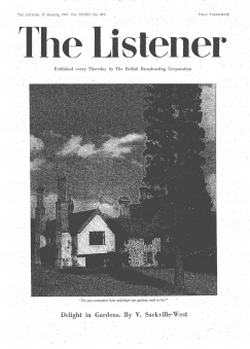
All posts for "Listener"
|
|
|
27.4.2024
|
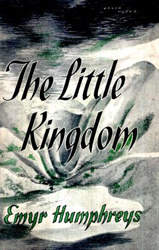
For the centennial of his birth on April 15, here is a book review of Emyr Humphreys' first novel, The Little Kingdom (London: Eyre & Spottiswoode, 1946). Written by Henry Reed, it appeared in The Listener's "New Novels" column for January 6, 1947. Reed expresses a familiarity with Humphreys' poetry, stating that the author certainly "knows how to write, and you feel as you read him that he knows that apprehension and diction must, in prose and verse alike, be clasped as earnestly as two hands in prayer."
It appears the two corresponded for a while, in 1947-1949 (Emyr Humphreys Papers, National Library of Wales), and Reed discussed Humphreys' next book, The Voice of a Stranger, for a B.B.C. radio talk in 1949.
Reed also reviews here an English translation of C.F. Ramuz' The Triumph of Death, and The Becker Wives, stories by Mary Lavin.
New Novels
The Little Kingdom. By Emyr Humphreys. Eyre and Spottiswoode. 9s.
The Triumph of Death. By C. F. Ramuz. Routledge. 8s. 6d.
The Becker Wives. By Mary Lavin. Michael Joseph. 9s. 6d.
WHAT is the most positive quality we have to recognise in a new novelist in order to feel that his work contains promise as well as immediate success or in spite of immediate failure? It is, I suspect, his style: whether it is already individual or assured, or whether it merely indicates a preoccupation with the act of writing.
A war plays hell with prose. There is always the influx of new technical terms and clichés, there is always the politicians' jargon; these are small in themselves, perhaps, but if they pervade our speech, as they are likely to do when our ideas are confused, they will shortly afterwards pervade our writing also. The most depressing thing that confronts a novel reviewer at the moment is the general beastliness—I have pondered this word before using it—of the various ways in which most novels are written. The mediocre novelists of thirty and forty years ago at least believed that they should try to write well. They believed, if not that a good writer must always appear en grande tenue, that the disorder in his dress must be a sweet one. They believed it mattered how a book was written. Of Mr. Emyr Humphreys, a new novelist not unknown as a poet, one can use many nice and conventional expressions: he is worth watching, he is a novelist of whom we shall hear more, he has something to say and he knows how to say it. I think this last thing is the most interesting thing about him. He knows how to write, and you feel as you read him that he knows that apprehension and diction must, in prose and verse alike, be clasped as earnestly as two hands in prayer. I think that the strength of a young writer's religious, political and psychological perceptions are usually less important than his sense of style. Here is a passage from The Little Kingdom: it is, as may be guessed, a mere 'bridge-passage' in the action; but it is clearly the work of a very able writer: The little bell over the door giggled as the minister went in, and echoed the giggle as he closed the door carefully behind him. He screwed up his eyes. After the soft twilight outside, the harsh naked electric light in the barber's shop was painful to him. He said 'Good evening, everybody', but all he could make out at first was the white blur of the barber bending over someone indistinct in the chair. Otherwise the shop was empty; this was the last customer for the night. The barber was too tired to talk to the man, who slumped helpless in the chair. He nodded.
'Evening, minister'.
The man in the chair stirred with curiosity, but the barber held him firm, the fingers of his left hand spread over his ruffled hair like a vice.
'Go through'.
The barber pointed to the swing door with his gleaming razor, which flashed as it caught the light.
'You'll be coming up later, Dan?'
The smiling, perfect male, advertising hair cream, swung back and fore, smile out, smile in. The last sentence will at once indicate that the 'middle' Joyce has contributed something to the formation of Mr. Humphreys' style. There are few better models for a serious young writer, and an ability to learn something from the first half of Ulysses will probably imply a kindred sensitiveness to the coalescence of sight, sound and thought in the human consciousness. The feelings which attend on being alive do not escape Mr. Humphreys, any more than they escaped Joyce.
The action of The Little Kingdom concerns the last months in the life of a dominating and imperious young Welsh nationalist who, to further his ambitions, murders a wealthy uncle, and later sets fire to an English-built aerodrome. He is shot and killed by a night watchman. I take it that one of the main ideas behind the book is the common running aside of an idealistic political movement, first into 'irresponsible' acts, and then into Fuehrerprinzip. This is a respectable theme, though not a very distinctive or profound one; but it has the advantage common to all well-tried themes that it shifts the reader's interest to the writer's talents as a particular interpreter and executant. One is curious to see how he will use his gifts. And to have emphasised Mr. Humphreys' ability to write is not to diminish his other powers. There is a touching reality about his characters—almost all of whom are muddled and pathetic. I believe that the hero-villain Owen, who is neither muddled nor pathetic, is slightly under-emphasised; though the author's avoidance of an opposite effect is doubtless intentional; Owen's first appearance is admirable. The major scenes of the book are ably got through; though for some reason it is the semi-marginal scenes that one remembers best—the opening chapter describing a morning tour made by Owen's uncle Richard, or the waiting scene on the night of the fire. It is a most remarkable intuition that makes the author delay our first and only glimpse of Richard's beloved daughter, Nest, till the moment after her death: a most curious and effective piece of understatement, for Nest is the figure on whom the subsequent action turns.
Mr. Humphreys holds our attention by the way he gets from one point of his story to the next, by certain felicitous interior echoes, by his movements from one contributory stream of activity to another. I think that a greater tragedy is needed for a writer to be able successfully to use a village lunatic—a Mayor of Casterbridge, for example—but Mr. Humphreys obviously conceives of an art serious enough to include such a dangerous piece of machinery.
It is curious that the Swiss novelist C. F. Ramuz should be so little known in this country; he is obviously a very remarkable and original writer, and one is inclined to believe the extensive claims made for him by M. Denis de Rougemont in his admirable introduction to The Triumph of Death. This is a translation, by Allan Ross MacDougall and Alex Comfort, of a book called Présence de la Mort, a better and more accurate title which it is strange to find rejected. It is a fable about the end of life on earth: disaster comes as the earth steadily and rapidly approaches the sun. The scene is set mainly on a lakeside in the Vaud country of Switzerland. It is perhaps with some misgiving that one embarks on reading such a story. It is written fancifully, and at first promises to be little more than im over-long prose-poem. I remembered, and expected to prefer, H. G. Wells's story ' The Star'. But Ramuz' book surprises and excites by its peculiar mounting intensity; one succumbs, and consents to the author's apparently arbitrary ordering of his material. Many of his scenes have great beauty; and he keeps one agog to know the end, which turns out to be both tender and wonderful. His scenes of anarchy, demoralisation and criminality are very moving, and they are never indulged in for the private delight of their author. There are many moments when the book shows signs of having offered to its translators some of the difficulties that works like Rimbaud's Les Illuminations offer; but on the whole the book comes over vividly and well. It is doubtless a point of preciosity in the original that present and past tenses are pointlessly mingled; but English seems particularly odd when such a mannerism is grafted on to it. It is to be hoped that Mr. Macdougall and Mr. Comfort will soon address themselves to the task of translating the sequel, Joie dans le Ciel. These books, incidentally, are not allegories about our recent disasters; the date of Présence de la Mort is 1925.
Miss Mary Lavin is a most prolific and varied writer. She is, so far, at her best in comedy. Her serious writing is often commonplace, and it is noticeable that when the first story in her new book, after an excellent beginning, takes a turn into. the pathological, it is a turn for the worse. But there are few writers now writing in English capable of more sustained comic scenes—scenes where the comedy depends not on conversation so much as on large-scale conception of a theme. The high spot in Miss Lavin's prodigiously long novel, The House in Clewe Street, was the brilliant scene where two funeral corteges attempted to race each other to the cemetery; there is a similar vis comica pervading two stories in the new book: 'Magenta' and 'The Joy-ride', both about surreptitious outings made by servants. Intermittently throughout the book there is to be found Miss Lavin's particular talent for startlingly transfixing a scene: the moment in 'The Becker Wives' where Flora makes the stolidly respectable family involuntarily pose for an imaginary photograph, for example, or the vision of the upstart kitchen-vestal Magenta crossing the park in her borrowed finery. It is with regret that one adds that Miss Lavin's grammar is so bad that from time to time one gazes at it in surprise.
HENRY REED
|
1537. Radio Times, "Full Frontal Pioneer," Radio Times People, 20 April 1972, 5.
A brief article before a new production of Reed's translation of Montherlant, mentioning a possible second collection of poems.
|
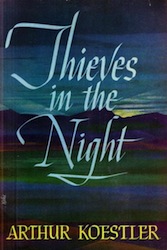
Today I am dredging up a review from The Listener from November 28, 1946. In the "New Novels" column, Henry Reed considers two books which are distinctly post-war: Arthur Koestler's Thieves in the Night, based on Koestler's experiences setting up a kibbutz in British-ruled Palestine; and Henry Green's Back, regarding a wounded British soldier returning from a German POW camp. Reed also has a few favorable words for Tom Hopkinson's Mist in the Tagus, "a story of two heterosexual girls in love with two non-heterosexual young men."
Reed is disappointed in both Koestler and Green (though he gives Green's prose high marks), whose preceding works were so much more enjoyable and filled with promise, but surprisingly his biggest complaint about Hopkinson's novel is that it is too brief:
New Novels
Thieves in the Night. By Arthur Koestler. Macmillan. 10s. 6d.
Back. By Henry Green. Hogarth Press. 8s. 6d.
Mist in the Tagus. By Tom Hopkinson. Hogarth Press. 7s. 6d.In almost every way, Mr. Arthur Koestler's new novel is profoundly depressing. It depresses one on his behalf because he has suffered what he describes; on behalf of the Jews he writes about because a solution to their problems seems almost unimaginable; and on behalf of the readers who normally admire his work because Thieves in the Night is a poor book. Mr. Koestler seems indeed to be not very interested in making it any better, and I felt while reading it that the contempt he appears to feel for most groups of people had somehow invaded his attitude towards novel-writing, and — less pardonably — his attitude towards his readers.
Thieves in the Night could doubtless have been a worthy successor to Darkness at Noon; one could forgive it for being less objective, since Mr. Koestler has himself been more deeply involved in what he describes. It is a story about a group of Jewish immigrants to Palestine. They arrive on a night in 1937; the book tells about their building of a settlement; it carries us through their days of achievement, setback, and hardship, up to the time of the 1939 White Paper. It ends with another small batch of immigrants arriving in Palestine in the same year. Threaded through this chronicle of events is the personal story of Joseph, a half-Jew who has joined the Zionists; the girl he loves is murdered by Arabs, and this turns the scale for him so that he throws in his lot with the terrorists. I do no think we are to assume an identity between Joseph's views and Mr. Koestler's, though I see that this has been promptly taken for granted in some quarters. What he shows us is an example of how 'those to whom evil is done do evil in return'; and he convinces us that a sober and dignified effort towards a good life has become transformed by frustration and betrayal into lawless violence. The plight of the Jews is described thus:
We are homesick for a Canaan which was never truly ours. . . . Defeated and bruised, we turn back towards the point in space from which the hunt started. It is the return from delirium to normality and its limitations. A country is the shadow which a nation throws, and for two thousand years we were a nation without a shadow. Mr. Koestler has summed up the tragedy in that unforgettable last image; and it is obvious that his subject is a great one. It is here that one's cause for depression rises: rarely can such a subject have been so dully and so mechanically treated. We are given many illuminating facts; but during scarcely more than a dozen pages does the book come alive as an original story; these are page after page of discussion, of would-be satirical portraiture which I feel any novelist anxious to do a good job would have seen to be commonplace and flat. No readers enjoy more than do English readers satire about themselves abroad; but A Passage to India, to say nothing of other books, has set a standard in this sort of writing which one cannot ignore.
And, alas, Mr. Koestler tends more and more to become a publicist. He is perhaps not to be blamed. It is an easy line, and doubtless it is justifiable. I can imagine that tolling in his ears is the death-knell of civilisation. Art seems increasingly crowded on to a narrowing littoral and facing an incoming sea. I think a critic is called upon to understand and sympathise with this point of view; he is also called upon to say that straight polemical writing is more readable than the casual dramatisation found in Thieves in the Night. It seems idle to suggest that, with his gifts, Mr. Koestler could have developed his characters to a point where they become interesting, and cease to be merely a set of wooden objects asking the reader for pity. We know that if Mr. Koestler cared to try, he could force the pity from us. We know that he could also make us laugh, but here, as in his play, 'Twilight Bar', he prefers facetiousness. The solemn importance of the subject prevents one from ignoring the book; but it is a great disappointment.
So many intelligent novelists in recent years have eschewed the use of plot and substituted what may be charitably called 'theme' that the sight of sort of plot emerging from a novel goes to a reviewer's head. The position is much the same with wines. Years of tormenting abstinence deaden one's judgment. Plots and wines return, and at first it seems in both cases that any blessed thing will do. The excitement of wanting to know what will happen next leads one to murmur preliminary words of extravagant praise. Then the plot falters, the wine doesn't turn out as well as you expect, and your words of praise have to be withdrawn. Thus with Mr. Henry Green's new novel, Back. It starts an attractive story about a man named Charles Summers returning with a peg leg from a prison camp; Rose, his former mistress, the wife of a friend, has died. By a curious contrivance Charley is introduced to her illegitimate half-sister, Nancy; he cannot believe she is not Rose herself with her hair dyed. It is part of the nightmare quality of being 'back'. I do not object to an improbable plot. But Mr. Green's plot totters; it too is peg-legged and has to have a long rest in the middle. Its end is convincing and beautiful, but by the time it comes we have slightly lost interest.
If you know Mr. Green's other novels, its curt title will suggest to you at once that he has chosen a good 'theme' for himself; there is the intensity of feeling found in Caught and Loving. The ideas that he implies in his titles are for him poetic ideas, as summer or winter might be to a poet. It is this that makes Mr. Green one of the most striking and original of modern novelists. To me he seems also one of the best. He does something new and good. I can see that his curious style may be an irritation to some readers; me it normally charms. Adaptations of highly mannered authors are always dangerous; but Mr. Green seems to find genuine kinship with the sad, wistful mood of the earlier Bloom chapters in Ulysses. His echoing poetic images, recurring and transformed like musical phrases, are to him a natural and not an artificial way of seeing and feeling; and they reproduce something real in our own sensitivity. His new novel contains ay fine passages; its comedy is excellent. If it is less of a success than its two immediate predecessors, it is nevertheless something one will keep with Mr. Green's other books and take down from time to time.
Mr. Tom Hopkinson's second novel, Mist in the Tagus, has a fault staggeringly unusual in contemporary novels: it ought to have been longer. The people and emotion he deals with demand greater space for their proper emergence than he has allotted them, so that relationships which should have been dramatised are often merely described: there is a felling that some of them have been unduly potted. It is a story of two heterosexual girls in love with two non-heterosexual young men. It occupies the week or fortnight of an English girl's holiday intrusion into a leisured small group of people who have drifted down from Europe into Portugal. The feeling of rapidly shortening time as the girls attempt to accomplish their desires is excellently achieved; so is the sense of inevitable failure which pervades their efforts. Everything in the book is well conceived and well ordered; the actual succession of events and disclosures shows a most intelligent and perceptive writer at work. But the final feeling one is left with is that one has seen it all through the wrong end of a telescope. Today this seems like being given an ounce of best butter in place of a pound of common marge. One hardly knows whether to be grateful or not; it is another aspect on the plot and wine situation referred to above.
Henry Reed
[p. 766] You can read the original New York Times review for Thieves in the Night on their website.
|
1536. L.E. Sissman, "Late Empire." Halcyon 1, no. 2 (Spring 1948), 54.
Sissman reviews William Jay Smith, Karl Shapiro, Richard Eberhart, Thomas Merton, Henry Reed, and Stephen Spender.
|
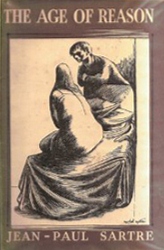
For this edition of "Reed Reviews" we dig up Henry Reed's "New Novels" column from The Listener for February 6, 1947. Reed reads for us a short story collection by Sid Chaplin, a translation of Camilo José Cela's La Familia de Pascual Duarte, and the first English publication of Jean-Paul Sartre's The Age of Reason ( L'âge de raison), the first volume of his existentialist trilogy, The Roads to Freedom:
 New Novels
The Age of Reason. By Jean-Paul Sartre.
Translated by Eric Sutton. Hamish Hamilton. 10s.
Pascual Duarte's Family. By Camilo J. Cela.
Eyre and Spottiswoode. 7s. 6d.
The Leaping Lad. By Sid Chaplin.
Phoenix House. 8s. 6d.M. SARTRE is primarily a brilliant artist. He is secondarily a philosopher, one of the leaders of a more or less new school of thought. It is therefore a great pity that in England we should have read so much about his philosophical ideas before we have had much chance of reading his stories and plays; and it is probably a further pity that his ideas should for the most part have been first expounded by antagonistic critics. His plays, 'Les Mouches', 'Huis-Clos' and 'La Putain: Respectueuse', need nothing in the way of exposition; they make their points unaided, and their points are clear ones. With The Age of Reason I feel far less sure; it is the first volume of a trilogy called 'Les Chemins de la Liberté', and though it is a book of quite extraordinary power it cannot be thought of very easily as a work by itself, since at the end of volume one, the reader is likely to be left still baffled by M. Sartre's theme, and by his terminology. The semantic of abstract nouns is almost always so eroded (as Professor Hogben would say) that they need continual re-definition. And I am far from certain what M. Sartre means either by freedom or by reason. I have uneasily assumed from the story itself, and from things I have picked up here and there, that Mathieu, the hero of the book, who is questing for freedom, is out to attain a state of mind and a condition of will where he will be free to act without being influenced by the image he creates in the minds of others. As a child he has vowed to himself: 'I will be free'. At the end of the first volume we find him saying to himself that he has attained the age of reason, and the meaning of this is, so far, even less clear; he means in one sense that his adolescence is over; but one is perplexed by the fact that his attainment of the age of reason, whatever it be, is principally caused by an act performed by someone else. This is brought about as follows.
Mathieu, a lecturer in philosophy and the central figure of a small group of people in Paris, is told by Marcelle, his mistress, that she is pregnant. He assumes that an abortion is necessary, and he sets out to get the money for it. His efforts to raise four thousand francs are the principal strand in the book. There are other things going on at the same time: they mainly concern two young friends of Mathieu, his pupil Boris Seguine, and Ivich, who is Boris's sister. There is a no longer young cabaret singer called Lola, who is feverishly in love with Boris. Mathieu himself, rather to his own surprise, at a particular point during the forty-eight hours covered by the book, falls suddenly and fruitlessly in love with Ivich, whose own sexual appetites are, up to now, uncertainly directed. Mathieu continues his quest for money; within forty hours or so, having exhausted all possible sources, he steals from Lola. She thinks the theft has been committed by Boris, whom she knows to practise theft in a small way from bookshops and the like. By this time we have already seen a good deal of another character, Daniel, a homosexual, and a friend of Marcelle. Marcelle, discovering that Mathieu is no longer in love with her, has told him to go. He has by now discovered that she wants the baby and has offered to marry her. Just as Lola is telling Mathieu that she is charging Boris with theft, Daniel enters Mathieu's apartment and announces that he is going to marry Marcelle. We are left at this point to await the second volume, and, if our curiosity has been aroused, to wonder what will now happen to Lola and Boris, to Ivich, who has failed in her examinations and must return to her hated home in Laon, to the unpromising marriage of Marcelle and Daniel, and to Mathieu and his reasoning, reasoned or reasonable age.
The story may be called sordid, morbid,) and 'unrepresentative', though M. Sartre does not, I think, make it these things. Extended comment on it can scarcely be made at this stage; but there are some things that immediately occur to one. I do not know how consequent or inconsequent M. Sartre's version of existentialism is; but it appears to provide a most potent atmosphere and background, which would, I believe, be apprehensible even to a reader who had picked up none of the relevant jargon. It is not necessary to have mugged up the subject in order to see the strange new perspectives behind M. Sartre's novel; the ominous background is there, and it is possible to be much moved by it. It reminds me of those floorboard landscapes of Chirico and some of the surrealists: those long parallel lines receding into the distance and ending, sharply at a void of empty and ominous sky. Over such a floor and oppressed by the same anguished and thundery air, the tatty characters of M. Sartre's novel move. It seems to me as acceptable and convincing a mise-en-scène as any other, if the human condition is your subject.
The early chapters of the book at once indicate a master, perhaps a great one; certainly an authoritative technician and stylist who also has his characters, and their actions, extremely well taped. That void on the horizon, towards which his characters painfully glance from time to time, is poetically 'touched in'. The climaxes and turns in the story are brilliantly timed, the folds of the narrative adroitly set. There is a wonderful feeling of suspense about the book. There is also a certain monotony, and at a first reading some of the conversations seem over-long; I wonder also if it is entirely well-judged to set so much of the book in bedrooms and nightclubs. But its monotony seems to me the acceptable monotony of an epic.
Pascual Duarte's Family is a story about a murderer, told by the murderer himself; the book would probably fail if we were not on the murderer's side, for it is superficially a story of fantastic squalor, and at times steps perilously near the point where the unbearable becomes the farcical. But the murderer is a man who strives to be good and his sister's lover and his own mother, both of whom he murders, are irremediably bad. The nets of circumstance close in on him from every side, and there is a tragic inevitability about his disastrous acts; though since the facts of his story are so violent and brutal, the general poetic quality of the story is probably incommunicable by reviewer to reader; the reader may doubt that the character of a matricide (who later, it is hinted, commits a common political murder) can evoke pity. But the priest's verdict on Pascual is true: he 'could be recognised when one probed to the depths of his soul as not other than a poor tame sheep, harassed and terrified by life itself'. Señor Cela's book is subtle and disquieting, and I do not remember that its story has ever been used before.
The Leaping Lad is a collection of short stories, all set in a mining-valley in Durham. This, forgivably but unfortunately, will put most readers off. Those whom it doesn't will find that, despite limitations of theme and setting, Mr. Chaplin's stories usually are stories with a beginning, a middle, and an end; and rarely mere sketches. There is also a vein of gaiety and exhilaration running through a good many of them, which crops up as deliciously as the outbursts of fresh, green countryside in the sombre landscape which is Mr. Chaplin's native heath. 'Rooms', 'The Pigeon-Cree', 'The Shaft' and 'The Unwanted' are particularly good stories; while the story called 'And the Third Day' promises well for the time when Mr. Chaplin sets out on a longer flight.Henry Reed The one bit of personal information we can glean from this review is the mention of Professor Lancelot Hogben. Hogben was an experimental zoologist whose varied career included two professorships at the University of Birmingham from 1941-1961. Reed must have known him, or known of him, from his time there. Hogben seems to have cut quite a figure across several fields of study, was quite well known, and the two shared Socialist leanings. Hogben's books on language and semantics—which surely would have greatly interested Reed—were not published until the 1950s and 60s, but obviously he was expounding on such topics much, much earlier.
|
1535. Reed, Henry. "Talks to India," Men and Books. Time & Tide 25, no. 3 (15 January 1944): 54-55.
Reed's review of Talking to India, edited by George Orwell (London: Allen & Unwin, 1943).
|
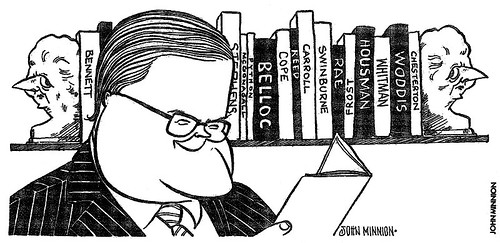
Here's an excellent caricature of Lord Kenneth Baker, drawn by the famed illustrator John Minnion. It appeared in the Listener on September 6, 1990, accompanying a review of Baker's anthology, Unauthorised Versions: Poems and Their Parodies. The review quotes Henry Reed's 'portmanteau' parody of T.S. Eliot, "Chard Whitlow."
If you look closely at the books propped up on the shelf between the twin Thatchers, you'll see REED on one of the spines (right between COPE and CARROLL).
|
1534. Reed, Henry. "Radio Drama," Men and Books. Time & Tide 25, no. 17 (22 April 1944): 350-358 (354).
Reed's review of Louis MacNeice's Christopher Columbus: A Radio Play (London: Faber, 1944).
|
Robert Gittings was an author and poet, and from 1940 to 1963, a script writer and producer at the BBC. His award-winning book, John Keats (1968), is considered the definitive biography. Following this, he then set his sights on Thomas Hardy. From Gitting's obituary in the Times (London), of February 21, 1992:
Gittings's next project was a life of Thomas Hardy, of whom no biography had by then appeared that could be described as even adequate. His edition of Emma Hardy's Some Recollections (1961), done in collaboration with another writer, had received very rough handling from the late Henry Reed and was subsequently revised. Reed, who had known the second Mrs Hardy well, had for long been expected to write the definitive biography. But illness prevented that happening. Gittings failed to obtain Reed's co-operation in his work. This was a loss, as Michael Millgate's later biography, written with the benefit of Reed's expertise, showed.
Gittings accomplished his task in two volumes: Young Thomas Hardy (1975) and The Older Hardy (1978). These were received with respect and (especially the first volume) with gratitude for bringing hitherto unknown facts to light.
The "rough handling" of Gitting's 1961 book, Some Recollections By Emma Hardy and Some Relevant Poems By Thomas Hardy, comes from "Veteris Vestigia Flammae" ("scars of an old flame"), Reed's review in the Listener on October 26, 1961. Reed, of course, had spent decades on his own biography of Hardy, and may have taken offense that he was not consulted. He makes insinuations as to an over-reliance on what he calls "gossip," and then proceeds to call into question the editors' reliability:
It is a little surprising to see the name of Miss Evelyn Hardy [no relation] associated with the presentation of these difficult pages; her past achievements in the way of transcription have not been of a kind to beget confidence. It is to be hoped that the presence of Mr. Robert Gittings has guaranteed the general accuracy of the text; he has not, of course, been able to hold completely in check Miss Hardy's passion for irrelevant annotation: perhaps he feels that this has sometimes a wild charm of its own. Mr. Gittings has himself edited a small anthology of poems, appended to the main text, which may be considered to have a definite or possible derivation from the Recollections themselves. There is naturally room for minor disagreement about some of his choices, but most of what he has to say is very illuminating; and all of it is worth the closest attention. (p. 678)
Returning to Gitting's obituary, we note that Michael Millgate's 1982 life of Hardy, "written with the benefit of Reed's expertise" (as well as that of consummate bibliographer, Richard L. Purdy), would become the definitive Hardy biography. So how much, exactly, did Millgate benefit? Quite a bit, it turns out! Millgate inherited all of Reed's Hardy research and drafts. We can see, in the finding aids for the University of Toronto's Fisher Rare Book Library, a list of six boxes of notes, correspondence, and documents relating to Millgate's Hardy books. Among the items listed are:
Box 5, 17 folders (Howard Bliss/Henry Reed): (Folder 1) Howard Bliss/Lew Feldman correspondence
(Folder 2) Howard Bliss: inscribed, presentation or signed
(Folder 3) Henry Reed: drafted sections of projected Hardy biography
(Folder 4) Reed: misc. biographical passages re: Hardy
(Folder 5) Reed: notes and drafts re: Hardy novels
(Folder 6) Reed: Notes on conversations with Hardy’s widow, 'Important'
(Folder 7) Reed: reviews of Hardy items, article on Hardy
(Folder 8) Reed: scripts for Hardy programs
(Folders 9-10) Reed: unpublished thesis on T.H. biography
(Folder 11) Reed: misc. reviews and lectures Ms. Michael Millgate
(Folder 12) Reed: misc. biographical items (clippings)
(Folder 13) Reed: MM correspondence, re: his papers
(Folder 14) Correspondence: Reed/Purdy, 1949-1977
(Folder 15) MM/Reed, carbons, 1969-1981
(Folders 16-17) Reed’s comments on MM’s Hardy biography Box 6, Henry Reed notebooks (5 holograph notebooks in box): (1) 1912-1913, brief intro. by Henry Reed on TH’s poems, Poems of 1912-1913
(2) HR notes on Dorchester 1851 census...
(3) HR’s outlines of a few chapters of projected biography...
(4) HR’s extensive notes (some on loose sheets) on Hardy family history
(5) HR notes on the early novels...
|
1533. Friend-Periera, F.J. "Four Poets," Some Recent Books, New Review 23, no. 128 (June 1946), 482-484 [482].
A short review calls A Map of Verona more pretentious than C.C. Abbott's The Sand Castle; influenced by Eliot, Auden, MacNeice, and Day Lewis.
|
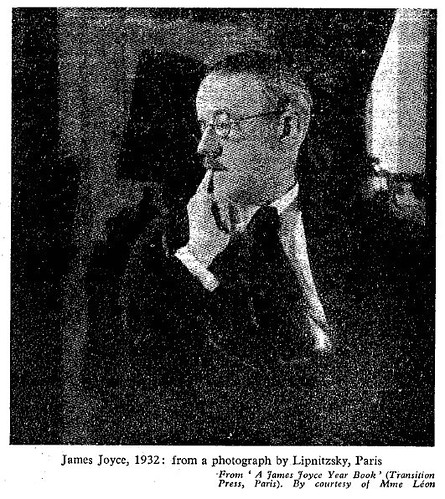
I waited and waited for Bloomsday this spring, and then suddenly, when I finally noticed, it had already blown past and summer was hotly breathing on my windowpane. Better later than never, for what it's worth, I have a couple of posts on James Joyce. From the midst of my stay-cation, I bring you a terrible picture of Joyce:
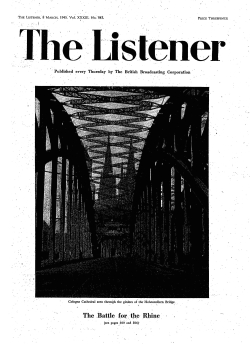
At 10:30 pm on February 28, 1950, Henry Reed gave a fifteen-minute talk on the BBC Home Service, the eighth and final part of a series on "The English Novel." This talk, " James Joyce: The Triple Exile," was published in the next Listener, on March 9. Reed has condensed some ideas he first put forth in 1947, in a long essay for the journal Orion (I'll save that for another entry). Joyce, Reed says, has written from triple exile: exile from Dublin, from the Catholic church, and from 'the banishment of the heart.' This third being from one's family; exile from our parents, and eventually from our own children.
The talk touches on Joyce's Portrait of the Artist as a Young Man, and Reed calls Finnegan's Wake Joyce's greatest work, but he lingers a long time describing Ulysses' themes, style, and influence on the English novel:
You will find much Joyce, variously sophisticated, debased or vulgarised in the work of Aldous Huxley, Graham Greene, Henry Green, Elizabeth Bowen, Joyce Cary and countless others. They have never made good use of him; good use of him can possibly not be made. They have approached the great barrier, fecklessly snatched what they can and made off back. They have made off back to the past; they have not got over into the future. And so it is that in reading so many modern novelists you get the feeling of a pathetic retrogression and the inevitable afterthought that what they do has been better done already. Modern novelists—I can only speak of England—are desperately engaged in mopping-up operations; and they are often put to ill-considered stratagems in order to ginger a little originality or life into these operations: hence, I suppose, the crude religion so often draped along the top of modern fictions; hence the sadism and the dirty sexuality; hence also perhaps the curious ruse of writing about children; and, most alarming of all, the frank, crude, comprehensive ambitions of those novelists who avoid the analytical only to attempt the synthetic: who promise us a bastardisation of Kafka, or who threaten to do for our time what Dostoevsky or Balzac did for theirs.
The photograph of Joyce accompanying the article (above) is interesting—while my scan from the photocopy is terrible—because I cannot find a copy of it online. Which, of course, I had assumed would be easy enough. The caption states it is taken from the James Joyce Yearbook (Paris, 1949), and that it was taken circa 1932, by Boris Lipnitzki (1887-1971). There's another portrait of Joyce by Lipnitzki on the Joycean.org media page, but it's not this particular photo. I'll have to see if I can make a better copy. Update: Slightly better copy!
|
1532. Vallette, Jacques. "Grand-Bretagne," Mercure de France, no. 1001 (1 January 1947): 157-158.
A contemporary French language review of Reed's A Map of Verona.
|
[This is the final letter to the editor regarding two articles appearing in the BBC's Listener in January, 1945, written by Henry Reed: " Poetry in War Time: I—The Older Poets," and " Poetry in War Time: II—The Younger Poets." Here, you may read the entire, nine-part " Points from Letters" saga. This is the last. A final reply from Mr. William Bliss.]
The Listener, 29 March, 1945. Vol. XXXIII. No. 846 (p. 353) [.pdf]
Poetry in War Time
Mr. Reed flatters us. I do not think that either I or Mr. Richards could give him points in the non sequitur handicap. And, unawed by his somewhat superior reproof, I must still maintain that he did, most clearly, say and not merely suggest, that good poets had lacked appreciation in the past. There is his letter. I have just looked at it again. He speaks of 'the perennial absurdity of the contemporary'. He says that it 'is no new thing', but that Tennyson and Wordsworth and Coleridge and Keats were belittled or 'coldly received' and he feels quite sure that Shakespeare would have been thought 'uncouth' by those brought up on Marlowe: And he clinches these statements by his 'one only' reason, viz., 'the interadicable human belief that only the dead are harmless and praiseworthy'.
There is nothing here about 'a vociferous subcurrent of criticism' (whatever strange sort of noisy silence that may be). It is perennial and universal, 'an ineradicable human belief that, only the dead are praiseworthy'. Now, the modern poets whom Mr. Richards and Major Hunter and I fail to appreciate are, I believe, still alive. Very well then—sequitur—? Now, in his last letter, Mr. Reed agrees that good poets are appreciated in their lifetimes. But it does not follow that all poets who gain applause or have a following in their lives are good poets. The age that produced Dryden also produced Shadwell, who 'never deviated into sense'. The age that produced Pope also produced Colley Cibber and the other even less admirable heroes of the Dunciad. The age that produced Keats also produced Thomas Haines Bayley. The age that produced Byron also produced 'hoarse Fitzgerald' of the 'creaking couplets'—and so on. Mr. Reed need only consider the list of Poets Laureate from Pye to Alfred Austin to see that Messrs. Eliot and Auden and Pound are not safe yet. For all these forgotten versifiers were admired during their lives. All had a following.
But it is neither the gallery nor the select few who, in each generation, applaud new things just because they are new or to show their own superior eclecticism, who are the final arbiters. It is Time—and the consensus of opinion of all lovers of poetry, that is to say all human people. And we've got to wait for that. Securus judicat orbis terrarum—and I don't want to hedge that bet.
Lane EndWilliam Bliss
|
1531. Henderson, Philip. "English Poetry Since 1946." British Book News 117 (May 1950), 295.
Reed's A Map of Verona is mentioned in a survey of the previous five years of English poetry.
|
[Here, at last, is Henry Reed's final word in these matters, though it seems nothing has been settled to anyone's satisfaction. What began as two articles on "Poetry in War-Time," written for The Listener in January 1945, resulted in a lengthy exchange of letters and a debate over the difference between traditional and modern verse. Joining the fray today is the poet and journalist, Allan M. Laing. Part 9 and the conclusion is next.]
The Listener, 22 March, 1945. Vol. XXXIII. No. 845 (p. 324) [.pdf]
Poetry in War Time
I have nothing to add to this discussion except a few words of protest at the attempts of Mr. Richards and Mr. Bliss to credit other people with as great a talent in the non sequitur as their own. I did not suggest that good poets had lacked appreciation in the past (nor do they now). What I did suggest was that there has always been a vociferous sub-current of criticism which hates the contemporary; and that that tradition is maintained by Mr. Richards, Major Hunter and Mr. Bliss. And I should be the last to suggest that such -voices infiuence public appraisal very much, even in their own time. But if they ask questions, one must attempt to answer them, even if they will not—dare I quote?—'stay for an answer'.
BletchleyHenry Reed
The passion for obscurity, which prevents so much modern verse from being poetry, is a perennial problem, and the criticism of it current today may be matched from the distant past. In 1646, François Maynard, a French poet, published an epigram addressed to a contemporary writer, which may be Englished as follows:The sense of what you write
Lies locked behind close bars:
Your language is a night
Lacking the moon and stars.
My friend, your garden weed
Of this dark mystic strain:
Your works at present need
A god to make them plain.
If you wish to conceal
The beauties of your mind,
How odd you do not feel
Silence to be more kind! Could a wiser admonition be addressed to the authors of some of the verse we are expected to understand in Horizon, New Writing, etc.?
LiverpoolAllan M. Laing
|
1530. Radio Times. Billing for "The Book of My Childhood." 19 January 1951, 32.
Scheduled on BBC Midland from 8:15-8:30, an autobiographical(?) programme from Henry Reed.
|
[This is where, in my opinion, the old guard's arguments break down. For here, Mr. William Bliss joins in—and is willing to bet money, no less—that the words of Eliot, Auden, and Pound will fade with time; Mr. Richards replies yet again, to call Dadaism, Futurism, Surrealism, atonality, and functionalism 'freakish and crazy cults' (though Reed may have sided with him). Worst of all, Richards uses in his defense my favorite poet who never existed: Ern Malley. At least Mr. Bliss, Mr. Richards, and Reed can all agree on one thing: Keats got a bum review from The Quarterly.]
The Listener, 15 March, 1945. Vol. XXXIII. No. 844 (p. 299) [.pdf]
Poetry in War Time
I do not see what 'reasons' Mr. Henry Reed can expect anyone to give who finds modern poetry to be uninspired, ungifted, shapeless, etc. If I say a pudding is heavy and has no currants in it I cannot give any 'reasons'. There is the pudding.
But when Mr. Reed gives us his 'one only' reason he simply misstates the facts. The 'perennial absurdity of the contemporary' is a figment of his imagination. Most great poets have enjoyed considerable appreciation in their lifetime. Tennyson certainly did, whatever 'Q's' grandfather may have thought. There is a great deal to show that the 'Lyrical Ballads' were not coldly received. Even Keats, though he died so young, lived to see himself acclaimed. (The Quarterly's rude remark, by the way, was only about 'Endymion';1 Blackwood's2 was much worse; but reviewers were then notoriously conservative.) And Mr. Reed's assumption about Shakespeare and Marlowe is just an assumption. Shakespeare, Milton, Dryden, Pope, Shelley, Swinburne, Tennyson, Browning—even George Meredith, all were popular in their lives. (And Mr. George Bernard Shaw isn't doing so badly!)
No. So far from its being 'only the dead who are harmless and praiseworthy', it is always the immediately dead who are forgotten or belittled and (if they be truly great) have to wait for one or two or even more generations to come finally into their own.
Neither Mr. Reed nor I therefore will know for sure which of us is right, though I would be willing to make a small bet about it and deposit the stake with the Curator of the British Museum for the benefit of my great-grandchildren. If I were Mr. Eliot or Mr. Auden or Mr. Ezra Pound I shouldn't feel very sure of immortality—or, being a modern poet, should I?
Lane EndWilliam Bliss
When Mr. Reed writes 'I believe pattern, form and finish to be only part of poetry; to put them at their highest the are only co-equal with what poetry has to say', I cannot forbear to say I agree. Not quite, however, in the way he means those last six words. Change say to convey and there perhaps is the kernel of the difference. I read Brooke's immortal five sonnets again and I realise afresh as the great lines roll on that it is not tidiness but the movement and swell in words that makes them poetry. But if the pulse and heart-beat is there, there is already that necessary fusion between logical sense and form (in this case metre) which is the miracle of poetry.
The Quarterly3 fell foul of Keats, finding no 'meaning' in 'Endymion'. This merely illustrates the complete destructive critical irresponsibility of those times. Nowadays, the irresponsibility takes the form of literally illimitable gullibility—witness the 'Angry Penguins' and 'Ern Malley' [ernmalley.com], an affair that isn't laughed off yet by any means. Then there was the gentleman who returned Keats' first collected volume to the bookseller's protesting it was 'little better than a take-in'. Where does this form of argument get you? 'They were wrong about Keats, Bizet, Wagner, Ibsen and Manet—therefore they are wrong about us'. Non sequitur. Queen Victoria, Mr. Gladstone, Ellen Terry and even Swinburne were devoted admirers of Marie Corelli [Wikipedia]. Contemporary verdicts have to be revised both upwards and downwards but in the main, surely, are confirmed.
'The Muse has withdrawn'. That, says Mr. Reed, is the perennial cry of the dyspeptic laudator temporis acti [praiser of past times] impatient with the contemporary young. For Mr. Reed there has been no climacteric, no fundamental break, whereas for me self-evidently there has. Does it really count for nothing that in our time we have seen such freakish and crazy cults as dadaism, futurism, surrealism, atonality in music and functionalism in architecture? You cannot connive at functionalism in one art and decry it in another and, functionally speaking, the Ministry of Food's weekly Food Facts [WWII Ex-RAF] are masterpieces of English prose.
PooleGeorge Richards 1, 3 John Wilson Croker. Review of Endymion: A Poetic Romance, by John Keats. The Quarterly Review 19, no. 37 (April 1818) 204-208.
2 John Gibson Lockhart. Review of Endymion: A Poetic Romance, by John Keats. Blackwood's Edinburgh Magazine 3 (August 1818) 519-524.
|
1529. Sackville-West, Vita. "Seething Brain." Observer (London), 5 May 1946, 3.
Vita Sackville-West speaks admirably of Reed's poetry, and was personally 'taken with the poem called "Lives," which seemed to express so admirably Mr. Reed's sense of the elusiveness as well as the continuity of life.'
|
[In which Henry Reed continues the defense of his criticism of Rupert Brooke's namby-pambier poems, and rails against those who blindly dismiss modern poetry, written by soldiers or not (and contemporary or not). This, the sixth part in a series of letters written to the BBC's Listener between January and March, 1945.]
The Listener, 8 March, 1945. Vol. XXXIII. No. 843 (p. 271) [.pdf]
Poetry in War Time
Rupert Brooke's romantic view of war was not the reason I gave for denying him 'any particular poetic merit'. It was the reason, I suggested, for his popularity. Mr. Richards has, however, lost sight of what he first wrote to ask. He is now, with Major Hunter, out in the open, developing a broader and more familiar theme: that modern poetry is, for the most part, uninspired, ungifted, shapeless, formless, artificial, adolescent and as often as not hysterical. The Muse has withdrawn herself. Reasons? None.
Nor indeed have Major Hunter's and Mr. Richards's predecessors in past centuries ever been able to suggest a reason for the perennial absurdity of the contemporary. For it must not be thought that it is a new situation they are deploring. 'Q's' [Arthur Quiller-Couch (Bartleby.com)] grandfather, reading a poem of Tennyson, described it as 'prolix and modern'. There is nothing to show that years earlier the Lyrical Ballads of Wordsworth and Coleridge were less coldly received. We know what the Quarterly thought of Keats. And it is inconceivable that to the conservative the later versification of Shakespeare can have seemed uncouth to those brought up on Marlowe. One cannot unconvince this point of view; one can only point out that it is immemorial. Reasons? One only: that it is an ineradicable human belief (so great is our fear of the creative) that only the dead are harmless and praiseworthy. Is it insignificant that Mr. Richards selects for a meagre praise only Keyes and Lewis from among those I wrote about; and that those two poets are the only ones who are dead?
There is only one other point I wish to refer to: when Major Hunter and Mr. Richards demand 'finish', they are not really disagreeing with me, as they will see if they can bear the to re-read the second of my articles. There are, however, different opinions as to what constitutes finish, and I am arrogant enough to believe I can usually distinguish between the bitterly-achieved artistry of the true poet (however original), and the glibness of the pasticheur; and impolite enough to doubt if, judging from their admiration for Brooke, they can. I must add that I believe 'pattern, form and finish' to be only part of poetry; to put them at their highest they are only co-equal with what poetry has to say. I do not believe, with Major Hunter, that 'to turn a commonplace sentimentality into poetry is the mark of a poet'; I believe that sentimentality and commonplace will corrupt even the brightest gifts, and that, setting aside the charm of light verse, the best poetry is the repository, not of platitude and banality, but of wisdom.
May I be allowed to add that since writing my last letter I have read the American edition of Mr. Auden's verse and prose commentary on 'The Tempest',1 and that I share almost all of Mr. Geoffrey Grigson's warm and understandable enthusiasm for it?
BletchleyHenry Reed 1 For the Time Being (New York: Random House, 1944). Reed would eventually review the London edition for The Penguin New Writing, as "W.H. Auden in America" (Vol. 31, 1947).
|
1528. Manning, Hugo. "Recent Verse." Books of the Day, Guardian (Manchester), 31 July 1946, 3.
Manning feels that 'Mr. Reed has worn thin much of his genuine talent in this direction by too much self-inflicted censorship.'
|
[A doubleheader to start off March, 1945. On the first of that month, The Listener published two letters regarding Henry Reed's "Poetry in War-Time" articles from January of that year: a vehement refutation by Mr. George Richards of Reed's response to his first letter; and in addition, a letter from the Mumbaikar novelist and poet, Fredoon Kabraji, opposing N.C. Hunter's letter from the preceding week.]
The Listener, 1 March, 1945. Vol. XXXIII. No. 842 (p. 243) [.pdf]
Poetry in War Time
Mr. Reed is of course entitled to his tastes. It is only natural that he should account for my distaste for the typical modern poet on the assumption that the fault is not in him that he is precious, esoteric and artistically embryonic but in me that I am a philistine—'and proud of it'. Indeed, after a duly appreciative reading of his succulent letter I would say I revel in the attribution from such a critic. So 'Rupert Brooke's talents were of the slightest'. His five war-sonnets 'show a defect of imagination which in a poet is serious to the point of catastrophe'. Now we know! After this, to call Mr. Reed a prig would be insipid. I prefer to say instead that I believe these and other passages in Mr. Reed's latter will survive as classics of the Higher (literary) Criticism.
But Mr. Reed is wrong. I am not a philistine, but, rather, a Finishtine. That is I believe that there is no true creation without toil and torment, that the activity indulged in by the miscalled poets of today (the fashionable ones, that is) lacks the afflatus [divine inspiration] and is essentially uncreative, that this modern poetry is by any serious artistic standards of former times a great sham, a prodigious bubble and a naive hoax. I believe, in short, in a rather old-fashioned way that art of all kinds is a matter of pattern, form and finish, not the noise made by an aggrieved and bewildered adolescent trying to get something off his chest. Even in the case of the most sincere, serious, interesting and gifted of these modern poets such as Keyes and Alun Lewis, I would say that the poets of an older day began where these leave off. It is true that many modern poets do not, superficially, lack form but it is imposed, inorganic. Specifically modern poems are of two kinds: (a) cerebral word-jugglings or acrostics, and (b) the result of a feeling in the young poet-impressionist that 'there is a poem there'. The poet of the older generation knew that he had to write it.
Most instructive of all is the reason Mr. Reed gives for denying Brooke 'any particular poetic merit', namely that he took a romantic view of war, unlike other poets who 'saw what war was really like'. One must give Mr. Reed full marks for the uncompromising honesty of his views, but could anything be more crude than this confusion of point of view with power and quality of utterance in expressing it? If to Brooke 'death in battle appeared lovely', it was perhaps from Homer, Shakespeare, Wordsworth, Burns, Campbell, Browning or Tennyson that he got the eccentric idea. In any case poets are not war correspondents but immortalisers of moods. That fine and true critic Earle Welby put the point definitively thus: 'The question with a poet must always be of what value his thought is to him, not to us. Philosophically it may be almost worthless: if it can call into vivid activity his peculiar powers, it will possess the only kind of value we can rightly attach to thought in poetry.'
PooleGeorge Richards
There is too much high falutin' talk about the responsibility of the poet to society. If, in his art, a poet is to be responsible to society at all, he must be wholly himself, i.e., completely irresponsible: with something of the spirit and moods of Pan, St. Paul, J. M. Barrie and Charlie Chaplin allowed free play to be juxtaposed—to blow as the spirit listeth, i.e., exactly as he may be inspired. The only condition on that society must make is that its poet sings: not necessarily in metres and rhymes, but in cadences and rhythms; that his meaning or message is magic not logic, politics or metaphysics; that it is a thing of beauty and abandon like 'Kubla Khan' or 'The Ancient Mariner', nor a pundit's dissertation or a doctor's prescription. Edwin Muir, Vernon Watkins, Norman Nicholson, Henry Treece, Clifford Dyment, Lieutenant Popham have some of this music and magic: and the vogue is all for a return to metrical and even rhymed forms, contrary to Mr. Hunter's impression.
HampsteadFredoon Kabraji
|
1527. Rosenthal, M.L. "Experience and Poetry." Herald Tribune Weekly Book Review (New York), 17 October 1948, 28.
Rosenthal says Reed shares with Laurie Lee 'that unhappy vice of young intellectuals—a certain blandness of which the ever-simple irony is a symptom.'
|
[In this, the fourth installment in an exchange of letters to The Listener, Mr. N.C. Hunter attempts to intercede as the voice of reason in an argument about modern poetry which has been rapidly descending into name-calling and thinly-veiled insults. I suspect this may be the playwright N.C. Hunter (1908-1971), known as 'the English Chekhov' of his day, among whose credits are Waters of the Moon, A Touch of the Sun, The Tulip Tree, and (ironically) the film, Poison Pen.]
The Listener, 22 February, 1945. Vol. XXXIII. No. 841 (p. 213) [.pdf]
Poetry in War Time
In his interesting reply to Mr. Richards, Mr. Henry Reed claims that the 'homme moyen esthétique' approaches modern poetry with tolerance, patience and curiosity. Mr. Richards who, says Mr. Reed, does not, is therefore to be numbered among the Philistines.
It seems to me that this sad relegation gives us a good clue to the nature of modern poetry. We must have tolerance; we must not fling the book aside because it lacks rhyme and metre, or because its meaning is not clear. We must have patience in unravelling its mysteries, and curiosity in seeking out its allusions. In other words, modern poetry must be studied seriously, almost scientifically, and not read as if it existed simply to please and charm and excite.
I wonder if Mr. Henry Reed has put his finger on something that separates modern poetry from a great many of its potential readers? In poetry, alas, cleverness, sensitiveness erudition, honesty—and nobody would deny these qualities to the moderns—are not enough. Mr. Reed claims that Rupert Brooke owed his popularity to his ability to 'falsify the nature of war in a way that the public found palatable'. Is this the whole, or even half the truth? Was it not rather that he happened also to be possessed of that gift for poetic expression which so many of the moderns, however right-thinking, serious and industrious, lack? One might charge Shakespeare with 'falsifying the nature of war' in 'Henry the Fifth', but would that make him less of a poet? And, after all, does Rupert Brooke's popularity rest on his war poetry?
'He wrote in enthusiastic ignorance', says Mr. Reed. Perhaps. I cannot avoid the unworthy reflection that it would be no bad thing to have a little more enthusiastic ignorance in our poetry today—and a little more poetry. Surely it is a mistake to suppose that a poet must necessarily be clever and honest, and that his ideas on war (or anything else) must be sound or profound. What matters is that he should be a poet, and this, whether one likes it or not, Rupert Brooke undoubtedly was. Mr. Reed says that 'there is no fundamental difference between his war poetry and the modern song beginning "There'll always be an England"'. Exactly. To turn a commonplace sentimentality into poetry is the mark of a poet, and English poets from Chaucer to Housman have done it successfully. The brutal fact is that Providence is all too shy about bestowing the gift of poetic genius, and that is why there are so very many modern poets—all sincere, thoughtful, clever and industrious to a man—and so very little poetry.
WorthingN.C. Hunter
|
1526. Blunden, Edmund. "Poets and Poetry." Bookman, n.s., 1, no. 4 (July 1946): 14-15.
Edmund Blunden says Reed's Lessons of the War poems 'have captured something of the time-spirit and ambiguity of the recent war in a style of wit and deep feeling united.'
|
[This letter to the editor, by the poet and critic Henry Reed, is part of an exchange between readers of The Listener from early 1945, in response to a series of articles Reed had written on contemporary war poets. It's interesting to note that Reed's address is given as "Bletchley", Milton Keynes, since at this time he was still stationed at the Bletchley Park estate, working for the codebreaking effort as a translator of Italian and Japanese.]
The Listener, 15 February, 1945. Vol. XXXIII. No. 840 (p. 185) [.pdf]
Poetry in War Time
The literary critic must concern himself more with the achievement of poets than with their renown, and the popularity or otherwise of the poets I wrote about is not my business. It is always deplorable that poets who are gifted, sincere and hard-working should be ignored or disparaged merely because their work is not always easy to grasp; but it will, I think, be a long time before one can hope for a disappearance of that traditional attitude which finds expression in the satirical second paragraph of Mr. Richards' letter: 'If we admit that people, however they may respect contemporary poets, do not quote them, then what Mr. Reed means by poetry and what it means to the homme moyen esthétique are two entirely different and distinct things'. Between the protasis and the apodosis of this statement there is no obvious connection; but I sense from the tone what Mr. Richards believes: that modern poetry—probably all of it—is obscure, impenetrable, esoteric, and unlovely. I do not agree with him: we can merely state our tastes. But if by the homme moyen esthétique he means the average man who takes an interest in art—the man who, for example, takes the trouble to go to W.E.A. classes, or to read regularly and seriously by himself—then I know that he very much underestimates that man's tolerance, patience and curiosity. Mr. Richards lacks these qualities, and is wrong to put himself beside the homme moyen esthétique. He is the homme moyen philistin; and he is proud of it.
It is more profitable to discuss Mr. Richards' first paragraph. He is right in assuming that Rupert Brooke achieved far greater popularity than any poet of today. This was not, however, due to any particular poetic merit; Brooke's talents were, in fact, of the slightest. He achieved his unparalleled popularity, I believe, simply because he contrived at an appropriate moment to falsify the nature of war in a way that the public found palatable. He himself is not to be blamed for this; had he lived, he might have regretted his five war-sonnets (and had he lived, he would probably never have been so famous). For they show a defect of imagination which in a poet is serious to the point of catastrophe. And Brooke saw very little of the war itself, and nothing at all of the long-term horror which might have filled the gap his imagination failed to fill. He wrote in enthusiastic ignorance; death in battle appeared lovely; there was no suggestion that war might be a tragedy. This was all highly consolatory to those whose task it was to keep the home fires burning. He was a poet for the thoughtless; and there is no fundamental difference between his war-poetry and the present-day song beginning 'There'll always be an England'.
The poets who saw what war was really like, who saw it for a long time, and who unflinchingly described it—Owen and Sassoon, for example—did not fare so well, either during or after the war. It is alongside them that I would put the best war-poets of today: such poets as Lewis and Keyes. And though they may not be widely quoted—whatever that is worth (and it may be remembered that Housman is easier to quote than Milton)—their success with the general public is a hopeful sign that people are able to 'take' a little more in the way of honesty than they used to be. It is worth while adding that Lewis's Raiders' Dawn sold well, even before Lewis's death. But neither of them has had the freakish success of Rupert Brooke or Julian Grenfell; nor would they have hoped for it.
Mr. Grigson is right in assuming that I have not read Mr. Auden's new book, which has not yet been published over here. No one could look forward to it with more eagerness than I do: I hope it is as good as Mr. Grigson says; if it is, it will survive Mr. Grigson's praise.
BletchleyHenry Reed
|
1525. "Reed, Henry," Publishers Weekly, 152, no. 15 (11 October 1947), 1945.
A note on the publication of the American edition of Reed's A Map of Verona.
|
[The following is a response to two articles written by Henry Reed, " Poetry in War Time: I—The Older Poets," and " Poetry in War Time: II—The Younger Poets," which appeared in The Listener in January, 1945. This letter to the editor, by George Richards, is mentioned in Spirit Above Wars, by Dr. Amitava Banerjee.]
The Listener, 1 February, 1945. Vol. XXXIII. No. 838 (p. 129) [.pdf]
Poetry in War Time
Mr. Grigson challenges Mr. Henry Reed's ideas about war-time poetry because he does not find his own pet Auden anointed pope among contemporary poets by Mr. Reed in his first article. With your permission I would like to challenge 'Poetry in War Time' in a much more fundamental way. In the last war we had young poets writing, notably Rupert Brooke, quotations from whose poems were on everybody's lips. To have gained fame then as a poet was to be a national symbol. Now I would like to ask, in a purely scientific-objective spirit, whether there is a single four-line sequence (leave alone an entire short poem) to the credit of any of these poets mentioned by Mr. Reed which has in the same way struck the popular imagination and become common property, as did, say, several of the poems of Rupert Brooke on publication? In other words, can either Mr. Reed or Mr. Grigson quote anything written by any of the poets here complimented on their gifts which has won renown outside the literary periodicals?
I am neither so foolish as to lay it down absolutely that public (mis)quotation is a test of poetic merit nor sufficiently arrogant to assert, in the light of the results of such a test, that Mr. Reed's poets have no merit and that therefore the titles of his articles should have been 'Rubbish in War Time'. But what I do assert unhesitatingly is that if we admit that people, however they may respect contemporary poets, do not quote them, then what Mr. Reed means by poetry and what it means to the homine moyen esthétique [aesthetic of the common man] are two entirely different and distinct things. Counting myself among the latter, the more present-day poetry and poetic criticism I read the more I realise that I only deluded myself in ever thinking I understood or appreciated poetry. What I got was merely the potent but cheap thrill at the sound of mysterious but unobscure words.
PooleGeorge Richards
|
1524. Reed, Henry. Letters to Graham Greene, 1947-1948. Graham Greene Papers,
1807-1999. Boston College, John J. Burns Library, Archives and Manuscripts Department, MS.1995.003. Chestnut Hill, MA.
Letters from Reed to Graham Greene, including one from December, 1947 Reed included in an inscribed copy of A Map of Verona (1947).
|
[The following is a letter to the editor, in response to Henry Reed's article, " Poetry in War Time: The Older Poets," which appeared in The Listener on January 18, 1945. Reed's two-part series on the poets working during the period 1939-1944 led to a lively exchange of letters debating the merits of modern poetry, with particular regard to a comparison of the poets of the Second World War and those of the first, Great War. Over the next week, we will reproduce the exchange of letters, here. We begin with the poet and editor, Geoffrey Grigson.]
The Listener, 25 January, 1945. Vol. XXXIII, No. 837. (p. 104) [.pdf]
Poetry in War Time
Writing of 'Poetry in War Time' Mr. Henry Reed says, and says only of Mr. W.H. Auden, that 'Two volumes by Auden have appeared, but they consist mainly of pre-war work'.
In America, in 1944, Mr. Auden's book For the Time Being was published. I daresay few copies have arrived over here; but when Mr. Reed does get hold of one, and does digest Mr. Auden's long commentary on 'The Tempest' which is called 'The Sea and the Mirror', he may overhaul his opinion about who 'has made the greatest contribution to poetry in the last five years'. In my judgment 'The Sea and the Mirror' secures Mr. Auden in the place many of us know him to occupy—as the most inquisitive, moving, serious, the best and most diversely equipped poet now writing in English.
KeynshamGeoffrey Grigson
|
1523. Reed, Henry. "Simenon's Saga." Review of Pedigree by Georges Simenon, translated by Robert Baldick. Sunday Telegraph (London), 12 August 1962, 7.
Reed calls Pedigree a work for the "very serious Simenon student only," and disagrees with the translator's choice to put the novel into the past tense.
|
I've been trying to tidy up around here: index cards have begat unsorted piles out-of-boxes; Xeroxes are backing up into heaps the cat perches upon, unstapled and unread; and I've been neglectful in answering Reed-mail. One of these days I gotta get myself organizized.
Long, cathartic hike to the library today, which paid off in several citations to track down. The university library is about three miles' worth of sidewalk away, on the other side of a good-sized hollow, down and up again. My path crosses the edge of a small lake, and there are herons, ducks, and sometimes even a bald eagle. Bonus points today for taking a side-trip to the bookstore for coffee, an extra two miles. (I'm working at getting over my irrational fear of ordering frou-frou espresso drinks from cafe baristas.)
Today's agenda was to read a bit on British poetry movements from the first half of the twentieth-century. Reed defies classification, and doesn't usually get grouped with anyone except "Poets of the Second World War." Browsing, I found a book on war poetry called Spirit Above Wars (Macmillan Company of India, 1975), by A. Banerjee. The title is taken from a 1917 letter Robert Graves wrote to Wilfred Owen:
For God's sake cheer up and write more optimistically—The war's not ended yet but a poet should have a spirit above wars.
A general chapter on the poetry of World War II brings up, once again, the question which was asked many times from 1939 to 1945: "Where are the war poets?" (see " A Call to Arms", previously). Cited are several articles: "Where Are Our War Poets?" ( Horizon, January 1941), "War and the Poet," by W.D. Thomas ( Listener, 1 May 1941), and Stephen Spender's and Robert Graves' thoughts on "War Poetry in this War" ( Listener, 16 and 23 October 1941). Reed is referenced as having attempted to answer the question before the war's end, in a set of two articles written for The Listener: "Poetry in Wartime: The Older Poets," and "Poetry in Wartime: The Younger Poets" (18 and 25 January 1945).
The Horizon, Spender, and Graves are articles are exciting, but the best part is a quote from a letter to the editor in response to Reed's "Poetry in Wartime" essays, which highlights the contention about the differences between the poems of the First and Second World Wars:
When Henry Reed [....] picked out men like Vernon Watkins, Alun Lewis and Sidney Keyes as the significant poets who had emerged since the start of the Second World War, one correspondent asked, in earnest solemnity:
Now I would like to ask, in a purely scientific-objective spirit, whether there is a single four-line sequence (leave alone an entire short poem) to the credit of any of the poets mentioned by Mr. Reed which has in the same way struck the popular imagination and become property, as did, say, several poems of Rupert Brooke on publication? To this Henry Reed made the blunt rejoinder that Rupert Brooke 'was a poet for the thoughtless; and there is no fundamental difference between his war poetry and the present-day song beginning " There'll always be an England"'.
Oh, schnap! The correct answer to the correspondent's question is, of course: "Today we have naming of parts...." The letter to the editor appears in the February 1, 1945 Listener, and Reed's retort is in the issue of February 15. Two more index cards for the pile, another batch of Xeroxes for the cat to perch on.
|
1522. Reed, Henry. "Hardy's Secret Self-Portrait." Review of The Life of Thomas Hardy, by Florence Emily Hardy. Sunday Telegraph (London), 25 March 1962, 6.
Reed says this disguised autobiography is a "ramshackle work," but is still "packed with a miscellany of information not available elsewhere, and readers who care for Hardy will find it everywhere endearing, engaging, and full of his characteristic humour."
|
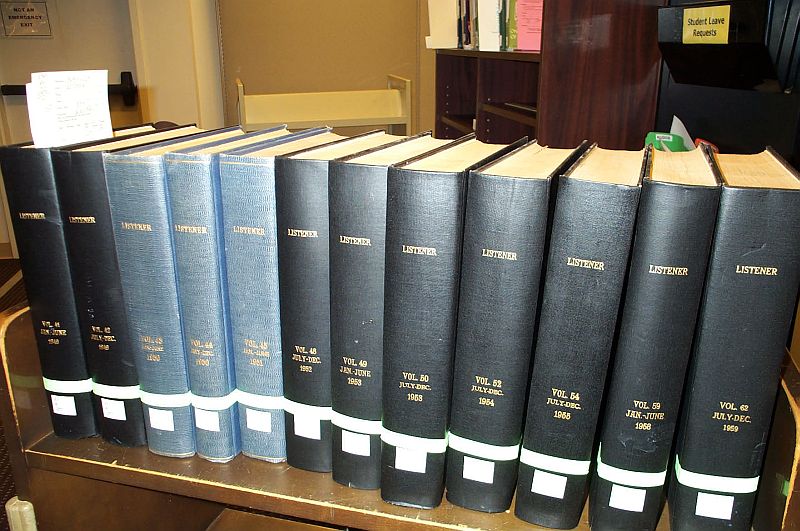
Four days and a fistful of dollars in photocopier fees later, my little collection is heavier by a grand total of 20 articles: no fewer than 16, primary source, Reed-written book reviews and talks; one Reed poem as it originally appeared at publication; and three reviews of his radio work by secondary authors. All culled from 12 volumes of the BBC's Listener, spanning just nine years, 1949-1958:
I also managed to eliminate several duplicate records in the bibliography owing to innaccurate or incorrect citations, and deleted a couple of leads which turned out to be dead ends (more mistaken references to Sir Herbert Read. Damn poseur).
The haul includes several essential and long sought-after items, including Reed's two-part radio essay on the problems of dramatic writing ("Towards 'The Cocktail Party'"); Reed's take on Joyce's effect on the English novel ("The Triple Exile"); and "'If and Perhaps and But'," a look at Eliot's critical prose.
The last two days, when I sidled up to the library copier, I discovered the previous user had left the machine set to the scanner, instead of for simply making copies. I didn't think much of it, but then I had a sudden epiphany: the library copiers are set up to scan straight to email! We have this luxury on the staff copy machines, of course. But it wasn't until this evening that I even dared to imagine that the public machines have this marvelous capability. I do dream in a dream.
Next up: "Reeding Lessons" tackles The New Statesman and Nation!
|
1521. Reed, Henry. "Leading a Dance." Review of Fokine: Memoirs of a Ballet Master, translated by Vitale Fokine. Sunday Telegraph (London), 26 November 1961, 6.
Reed finds Fokine's memoirs "very absorbing and intelligent."
|
I recently purchased an old, six drawer library card catalog on eBay. It's missing a couple of finger-pulls, but other than that it's in pretty decent shape. Still had the metal followers in all the drawers. This produced a remarkably vivid sense-memory: the feeling of tabbing through a drawer full of cards with my fingertips. I don't think I've actually used a physical card catalog since around 1990.
One thing about starting to re-organizize, notes and cites I had written ages ago floated to the top. The database is too large to browse properly, even broken down into subjects, and it needs more sorting options (like by date).
I came across a reference to a book review of Reed's A Map of Verona, from a 1946 Listener that I had never followed up. All I had was a date and a page number. No volume, no issue number. No title. I didn't even bother to write down where I had originally found the review cited. (Not noting sources and cross-references is a bad habit I cannot seem to break.)
It was so easy, I don't know why I hadn't tried to look it up before: Listener v. 35, no. 906 (23 May 1946): 690. "Book Chronicle." And in I put for a photocopy through interlibrary loan. We'll see, but that may be the last review from the Forties that I didn't already have. Which may be why I was putting it off: there can only be so many secondary sources left, and everything else is just third-order.
|
1520. Reed, Henry. "Shocked into Life." Review of The Empty Canvas, by Alberto Moravia, translated by Angus Davidson. Sunday Telegraph (London), 19 November 1961, 7.
Of Moravia's most recent novel, Reed says "there is something unquestionably heroic about the whole enterprise."
|
|
|
|
1st lesson:
Reed, Henry
(1914-1986). Born: Birmingham, England, 22 February 1914; died: London, 8
December 1986.
Education: MA, University of Birmingham, 1936. Served: RAOC, 1941-42; Foreign Office, Bletchley Park, 1942-1945.
Freelance writer: BBC Features Department, 1945-1980.
Author of:
A Map of Verona: Poems (1946)
The Novel Since 1939 (1946)
Moby Dick: A Play for Radio from Herman Melville's Novel (1947)
Lessons of the War (1970)
Hilda Tablet and Others: Four Pieces for Radio (1971)
The Streets of Pompeii and Other Plays for Radio (1971)
Collected Poems (1991, 2007)
The Auction Sale (2006)
|
Search:
|
|
|
Recent tags:
|
Posts of note:
|
Archives:
|
Marginalia:
|
|