|
|
Documenting the quest to track down everything written by
(and written about) the poet, translator, critic, and radio
dramatist, Henry Reed.
An obsessive, armchair attempt to assemble a comprehensive
bibliography, not just for the work of a poet, but for his
entire life.
Read " Naming of Parts."
|
Contact:
|
|
|
|
Reeding:
|
 |
I Capture the Castle: A girl and her family struggle to make ends meet in an old English castle.
|
 |
Dusty Answer: Young, privileged, earnest Judith falls in love with the family next door.
|
 |
The Heat of the Day: In wartime London, a woman finds herself caught between two men.
|
|
|
|
Elsewhere:
|
|
All posts for "Eliot"
|
|
|
28.4.2024
|
Ages ago, back in 2007, I had a post about the critic and Eliot scholar, Dame Helen Gardner. Henry Reed had been a student of Gardner's at the University of Birmingham in the 1930s, and had introduced her to Eliot's poetry when he sent her a copy of "East Coker" in 1940. Gardner had credited Henry Reed in an article she wrote for the Summer, 1942 New Writing & Daylight on "The Recent Poetry of T.S. Eliot," saying that Reed had pointed out to her that some of the sea imagery in Eliot's "The Dry Salvages" may have come from the works of Herman Melville, and that 'the voice of Mr. Eliot's seabell is certainly like the sound of the Liverpool bell-buoy which Redburn heard as he sailed in to the Mersey.'
This last is, of course, entirely incorrect.
How do we know it's not true? Because Eliot tells us so. In her book, The Composition of Four Quartets (Oxford University Press, 1978), Gardner states:
After the publication of Little Gidding I wrote to Eliot, wishing to let him know how much these poems had meant to me, and told him that Mr. Lehmann had passed on his remarks. He replied saying my article had given him 'great pleasure' and went on Only two very small points occur to me. The first is that I have no such connection as you suggest with the house at Burnt Norton. It would not be worth while mentioning this except that it seemed to me to make a difference to the feeling that it should be merely a deserted house and garden wandered into without knowing anything whatsoever about the history of the house or who had lived in it. ... The other point is that I have never read or even heard of the book by Herman Melville.24 American critics and professors have been so excited about Melville in the last ten years or so that they naturally take for granted that everybody has read all of his books, but I imagine that bell buoys sound very much the same the world over. 24 I had suggested, with acknowledgement to Henry Reed, that a passage from Redburn lay behind the close of Part I of The Dry Salvages, Eliot mistakenly assumed Henry Reed was an American Professor of that name. [p. 37]
Silly Helen, foolhardy Henry. What did Eliot expatriate for, if not to avoid reading American literature? "Little Gidding" was published in December 1942, so Eliot's reply to Gardner must be circa 1943. The implied professor is Henry Reed (1808-54), Wordsworth's American editor.
Still, there is a tiny bit of redemption from Gardner's footnotes in The Composition of Four Quartets. Just a few pages further, attempting to attribute the sources for "Burnt Norton," she relays the following from Eliot:
In a letter to John Hayward, 5 August 1941, quoted in the heading to this chapter, Eliot mentioned three other sources: his own poem ' New Hampshire'; Kipling's story ' They', which he only recognized as having contributed to his poem when, five years later, he was re-reading Kipling for his anthology A Choice of Kipling's Verse; and a 'quotation from E.B. Browning'. Many years ago I suggested that 'the image of laughing hidden children may have been caught from Rudyard Kipling's story "They", since the children in that story are both "what might have been and what has been", appearing to those who have lost their children in the house of a blind woman who has never borne a child'. 28
28 The Art of T.S. Eliot (1949), 160. The suggestion was made to me by Henry Reed. [p. 39]
So we shall comfort ourselves with one Reed footnote to Eliot scholarship, instead of two.
|
1537. Radio Times, "Full Frontal Pioneer," Radio Times People, 20 April 1972, 5.
A brief article before a new production of Reed's translation of Montherlant, mentioning a possible second collection of poems.
|
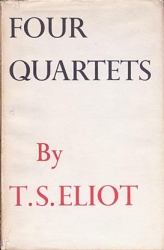
Today we have something truly special: Henry Reed's review of Eliot's Four Quartets, from the December 9, 1944 issue of Time & Tide. The article is unsigned, but Reed is identified as the author the following month, in Notes & Queries ("Memorablia," 13 January 1945, p. 1).
Reed draws his title from the dedication of The Wasteland, in which Eliot calls Ezra Pound il migglio fabbro, "the better craftsman". Eliot lifted the phrase from Canto 26 of Dante's Purgatorio, wherein the Provençal troubadour Arnaut Daniel is named the best craftsman of the mother tongue.
Such high regard for Eliot's craftsmanship could almost be considered ironic, given that Reed won a 1941 New Statesman contest with "Chard Whitlow: Mr. Eliot's Sunday Evening Postscript," a parody which manages to blend the styles and mock the sentiment of both Burnt Norton and East Coker. (When East Coker was published in 1940, the first thing Reed did was post a copy to his former professor, Helen Gardner.) But Reed's skill for imitation only belies a deeper admiration, even worship. In fact, many of the reviewers of Reed's first volume of poetry, in 1946, would accuse him of being too indebted to Eliot.
Il Miglior Fabbro Four Quartets: T.S. Eliot. Faber. 6s.
it does not disquiet me that there are passages in these four poems that I still do not understand, for whenever I read them, as I do often, the wonderful varied power of the language they employ holds me completely a victim, and I do not mind the uncertainties. Nor does it distress me that the particular religious inflection which their author intends the poems to have comes from a religion which I no longer find myself trying to believe in; for even if the things which Eliot says were not also "true in a different sense", I think that the alternating gentleness and forcefulness of the voice that is speaking would completely suspend my disbelief. Perhaps it is the gentleness of the voice that is the real magic; the agonized gentleness which we do not hear since Tennyson, whom Eliot calls the saddest of English poets:
Calm is the morn without a sound,
Calm as to suit a calmer grief;
And only through the faded leaf
The chestnut pattering to the ground. That, somehow, is a voice one can trust. So is this voice:
The brief sun flames the ice on pond and ditches,
In windless cold that is the heart's heat,
Reflecting in a watery mirror
A glare that is blindness in the early afternoon.
And glow more intense than blaze of branch, or
brazier,
Stirs the dumb spirit. After the exquisite language of these poems, whatever one tries to say by way of criticism or analysis sounds uncouth. One has also the feeling that one is slightly off the point, because they are poems which can be communicated only in their own words. But since they are difficult and elusive, it is necessary for a critic to say what he thinks they are about. Time is their theme. (That is not quite true, but it is as near as one will get.) They aim at discovering a means of facing time; at discovering an attitude towards time which shall be something different from a subservience to the passing of the years; at discovering a capacity for thinking of the present moment not as a bridge between past and future, but as a point in an eternal pattern. To conquer time we have only one weapon given us—time. And at this point one wonders if one would not do better to say the poems are about life rather than about time.
Eliot's examination, or quest, begins simply (so far as he is ever simple) and hesitantly in Burnt Norton with one particular "aspect" of time; the highest complexity and difficulty are reached in the second and third movements of The Dry Salvages; the problem is solved in Little Gidding. The over-all drama of the quest is stressed by the sequence of the four symbols, air, earth, water and fire, which the four poems suggest. The intensity of the poem increases from the quiet of Burnt Norton, through the disturbances of East Coker to the tumult of The Dry Salvages, and relaxes to a final tranquillity at the end of Little Gidding. In each of the separate poems (which all follow the same structural design) there is a separate drama of crescendo and diminuendo.
In Burnt Norton we are given a fairly easy exercise in perception: Eliot recalls to us that not uncommon moment when the common sequence of minute after minute seems suspended, when two kinds of consciousness seem to cross. This may happen in a variety of ways; perhaps Proust encountered the same thing when he tasted the madeleine; for Eliot, in this first poem, it is the coincidence of a vision of what is, and a vision of what might have been. What is, is a deserted garden and a drained pool; what might have been, is the shrubberies full of children's voices, and the pool filled with water. Both moments seem equally actual: the double moment of "actuality" is reality, a state we cannot bear for long; it is a moment quickly to be seized and quickly gone, a "hint" of a greater experience. That experience, we are told later, is the intersection of eternity and time at the Incarnation.
The opening of this first poem presents a way into the problem of time; the core of the rest of it is the effort to break free from—
the enchainment of and future
Woven in the weakness of the changing body. East Coker is a study of the onset of age, and of the discovery that age, contrary to all the promises, brings neither wisdom nor the solution to our tragedies:
We are only undeceived
Of that which, deceiving, could no longer harm
. . . .
The only wisdom we can hope to acquire
Is the wisdom of humility: humility is endless. In this poem the pattern as distinct from the sequence of life is once more emphasized; and in this pattern the dead also are involved. This is an advance from the moment in the garden in Burnt Norton. The poet desires:
Not the intense moment
Isolated, with no before and after,
But a lifetime burning in every moment
And not the lifetime of one man only
But of old stones that cannot be deciphered. In The Dry Salvages, the themes of eternity and death are announced. The climax of this poem is an echo, one gathers, of Krishna's words to Arjuna in the Gita; but it reminds us also of "Make perfect your will", and of "Take no thought for the harvest, but only of proper sowing." It is an admonishment—significant only to the religious man, perhaps, but not beyond the appreciation of others—to live each moment, regardless of past and future, as if it were the moment before death.
O voyagers, O seamen,
You who come to port, and you whom bodies
Will suffer the trial and judgement of the sea,
Or whatever event, this is your real destination. The movement towards the faith of Christianity is already clear; and it becomes clearer still in Little Gidding. At the end of The Dry Salvages, we are told where our duty lies: in "prayer, observance, discipline, thought, and action." In Little Gidding we go to a place where "prayer has been valid", where the Holy Ghost has once descended to flame in men's hearts. In this poem the themes of the earlier poems are resumed and rounded off. We are left with the Christian choice: to be redeemed from the fire of hell by the flame of Pentecost. The fifth movement of this poem is a masterpiece of concentration; in it the poet reminds us, in a way that usually only the allusions of music can, of all he has had to say. Above all, he tells us that what he has to say is not anything new. He has already said in East Coker that all he can do in his poetry is to rediscover what has been found and lost before. That is all one will do in life itself, however, one goes about it.
|
1536. L.E. Sissman, "Late Empire." Halcyon 1, no. 2 (Spring 1948), 54.
Sissman reviews William Jay Smith, Karl Shapiro, Richard Eberhart, Thomas Merton, Henry Reed, and Stephen Spender.
|
Dr. William Turner Levy, who died this past January, was an author, professor, and an ordained Episcopal priest ( LA Times obituary), who called among his friends First Lady Eleanor Roosevelt, the director Frank Capra, and T.S. Eliot. Levy chronicled his friendship with the poet in Affectionately, T.S. Eliot, The Story of a Friendship: 1947-1965 (.pdf).
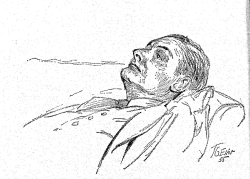 T.S. Eliot, Pencil and Chalk Drawing
 from life,
by his sister-in-law Theresa G. Eliot, 1955.
A strange convergence took place on Sunday, April 27, 1958, when Eliot was returning from appearing at an exhibition of his first editions and personal papers at the University of Texas at Austin. He and his second wife, Valerie Fletcher, stopped in New York to pay Levy a visit. Eliot arrived wearing a ten-gallon hat, having been made an honorary sheriff (I'm not making this up). After attending church with Levy's parents, the group retired to Levy's study for a martini brunch. Levy proudly showed off some books and papers he had purchased:
I next showed Tom another new acquisition, two pages in Dylan Thomas's handwriting, from a notebook which he had used during his poetry readings. The pages contained the poem " Chard Witlow" [ sic] by Henry Reed, a facetious take-off on Tom's " Burnt Norton." Tom gave it a close scrutiny, and remarked, "You know, I've been chairman of the British group that has been raising funds for Dylan Thomas's family. Caitlin, his wife, asked me to—a very sad business." Thomas's death in New York had left his family almost penniless.
Tom removed his fountain pen from inside his breast pocket and wrote on the bottom of the second of the two pages. When he finished, he handed it to my parents, who read it and passed it to Valerie. When it reached my hands, Tom said, "You know, William, this is the only piece of paper in existence that has both Dylan's writing on it and mine."
I read what he had written: "Not bad. But I think I could write a better parody myself. T.S. Eliot, 27.iv.58."
Somewhere, out there in the world, in a drawer or filed away in some box, is a page from Dylan Thomas' notebooks, with a wry, handwritten note by T.S. Eliot. Not to mention the possibility of photographs of T.S. Eliot in a cowboy hat.
|
1535. Reed, Henry. "Talks to India," Men and Books. Time & Tide 25, no. 3 (15 January 1944): 54-55.
Reed's review of Talking to India, edited by George Orwell (London: Allen & Unwin, 1943).
|
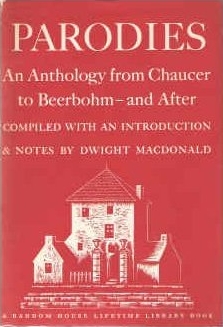
Last September, I complained of not being able to find the source of an oft-quoted comment by T.S. Eliot, who remarked that Reed's poem, " Chard Whitlow," was the only parody deserving of its success. Realizing that I have been less than devoted to updating here, and that I have been stockpiling items worthy of posting, let us begin at the top of the pile: Dwight Macdonald's (Wikipedia) Parodies: An Anthology from Chaucer to Beerbohm—and After (WorldCat).
Here, it seems, is the original source (.pdf) of Eliot's comment:
This famous parody was originally an entry in a New Statesman contest. 'Most parodies of one's own work strike one as very poor,' Mr. Eliot writes. 'In fact one is apt to think one could parody oneself much better. (As a matter of fact some critics have said that I have done so.) But there is one which deserves the success it has had, Henry Reed's Chard Whitlow.' Broadness is the sin of most Eliot parodies; Mr. Reed's alone seems to me to escape it. The one following, by 'Myra Buttle,' who is a Cambridge don, does not. I have included it because it is funny and because I thought some sample of The Sweeniad should be given.
(I apologize for the lousy scan from Parodies. I need to report that misbehaving copier to the library staff.)
Alas, Mr. Macdonald does not credit or cite the source of his 'Mr. Eliot writes'. As an editor of The Partisan Review, he did have reason to correspond with Eliot, and letters from Eliot in Macdonald's papers do appear from the right time period: 1959-1960 (see the " Guide to the Dwight Macdonald Papers," 230 page .pdf, from the Manuscripts and Archives department at Yale University Library).
Macdonald is careful to include permissions for using other quoted material in his text, but none is provided for Eliot. Did he write Eliot and ask the poet's opinion of his parodists? Is Eliot's letter residing in some box at Yale?
|
1534. Reed, Henry. "Radio Drama," Men and Books. Time & Tide 25, no. 17 (22 April 1944): 350-358 (354).
Reed's review of Louis MacNeice's Christopher Columbus: A Radio Play (London: Faber, 1944).
|
The Rt Hon. Kenneth Baker, in his excellent anthology Unauthorized Versions: Poems and Their Parodies (OCLC WorldCat), assiduously includes this explanatory note with Henry Reed's famous send-up of Eliot's Four Quartets:
This parody by a poet celebrated in his own right won a competition in the New Statesman. Eliot himself commented: 'In fact one is apt to think one could parody oneself much better. (As a matter of fact some critics have said that I have done so.) But there is one which deserves the success it has had, Henry Reed's "Chard Whitlow".' There is no single poem to put beside Reed's parody, which cleverly manages to summon echoes from almost all Eliot's work, but a few examples are given here.
Lord Baker places "Chard Whitlow" side-by-side with lines from Eliot's "Little Gidding," "Gerontion," "Ash Wednesday," and "Choruses from 'The Rock'."
It seems unlikely (if not impossible) that Reed was parodying "Little Gidding," since that poem was written in 1942, after the publication of " Chard Whitlow" (.pdf). It's more likely Reed had in mind the earlier verse of Eliot's Four Quartets, such as "Burnt Norton" (1935). The possibility exists, therefore, that Reed's poem actually influenced Eliot's. Stephen Spender, however, in his book T.S. Eliot (New York: Viking, 1975), says that Eliot, in fact, 'relished' the parody, but that he was not seeking to 'emulate' it (p. 177).
Regardless of who influenced whom, the real mystery is the source of Eliot's admiration of "Chard Whitlow," quoted above. Baker's anthology includes acknowledgments for the poems he has compiled, but I'm fairly certain there is no attribution for Eliot's words, and no footnotes accompany the explanatory notes. Does anyone have a copy they can double-check for me?
The quote appears in numerous places on the web (including Robert Pinsky's article for Slate magazine), but always lifted from Baker's anthology, it would seem.
Where did Baker take Eliot's quote from? What is the original source?
Incidentally, for his winning poem in the New Statesman's parody contest, Reed was awarded "the usual prize" of two Guineas (42 shillings).
|
1533. Friend-Periera, F.J. "Four Poets," Some Recent Books, New Review 23, no. 128 (June 1946), 482-484 [482].
A short review calls A Map of Verona more pretentious than C.C. Abbott's The Sand Castle; influenced by Eliot, Auden, MacNeice, and Day Lewis.
|
Dame Helen Louise Gardner (1908-1986) was a professor, critic, and editor, but above all, she was a scholar. Her work on Shakespeare, Milton, Donne, Eliot, and religious verse is still greatly respected, and earned her honorary doctorates from London, Harvard, Yale, and Cambridge Universities, among others. She took an M.A. at St. Hilda's College, Oxford in 1935, and returned to the school in 1941, teaching at Oxford until 1975. She was made a DBE in 1967.
Helen Gardner began her career as an assistant lecturer at the University of Birmingham in 1930. She took a position at the University of London in 1931, but returned to Birmingham as a lecturer in English from 1934-41. In her book, In Defense of the Imagination (Harvard University Press, 1982), Gardner recalls receiving a packet in the mail in the spring of 1940, in the midst of the "phoney war." Inside was the Easter Number of the New English Weekly, which contained a new poem by T.S. Eliot. 'I found myself reading a poem that offered no easy comfort, but only the true comfort of hearing a voice speaking out of the darkness without cynicism and without despair.' The poem would inspire her to recommend Eliot as wartime reading during a series of public lectures that summer. The poem was "East Coker," the second of his Four Quartets, and it had been sent to Gardner by none other than Henry Reed, who had been a graduate student at the University of Birmingham from 1934-36.
I came across a small homage to Reed today, in an article Gardner wrote called "The Recent Poetry of T.S. Eliot" ( New Writing and Daylight, Summer 1942). A note to her discussion of "The Dry Salvages" expresses her gratitude:
Mr. Henry Reed, to whom I am indebted for much sympathetic and illuminating criticism, and without whose encouragement this article would not have been written, has pointed out to me a passage in Herman Melville's 'Redburn,' from which some of the sea imagery of 'The Dry Salvages' may derive. The voice of Mr. Eliot's seabell is certainly very like the sound of the Liverpool bell-buoy which Redburn heard as he sailed into the Mersey.
Here is the relevant section from Melville's sea-faring novel Redburn: His First Voyage (1849), concerning the bell-buoy:
After running till about midnight, we "hove-to" near the mouth of the Mersey; and next morning, before day-break, took the first of the flood; and with a fair wind, stood into the river; which, at its mouth, is quite an arm of the sea. Presently, in the misty twilight, we passed immense buoys, and caught sight of distant objects on shore, vague and shadowy shapes, like Ossian's ghosts.
As I stood leaning over the side, and trying to summon up some image of Liverpool, to see how the reality would answer to my conceit; and while the fog, and mist, and gray dawn were investing every thing with a mysterious interest, I was startled by the doleful, dismal sound of a great bell, whose slow intermitting tolling seemed in unison with the solemn roll of the billows. I thought I had never heard so boding a sound; a sound that seemed to speak of judgment and the resurrection, like belfry-mouthed Paul of Tarsus.
It was not in the direction of the shore; but seemed to come out of the vaults of the sea, and out of the mist and fog.
Who was dead, and what could it be?
I soon learned from my shipmates, that this was the famous Bett-Buoy, which is precisely what its name implies; and tolls fast or slow, according to the agitation of the waves. In a calm, it is dumb; in a moderate breeze, it tolls gently; but in a gale, it is an alarum like the tocsin, warning all mariners to flee. But it seemed fuller of dirges for the past, than of monitions for the future; and no one can give ear to it, without thinking of the sailors who sleep far beneath it at the bottom of the deep. Melville's "Bett" is a variant of "beat," a rhythm or measure. Compare this with Eliot's sea-bell in " The Dry Salvages" (1941):
The sea howl
And the sea yelp, are different voices
Often together heard: the whine in the rigging,
The menace and caress of wave that breaks on water,
The distant rote in the granite teeth,
And the wailing warning from the approaching headland
Are all sea voices, and the heaving groaner
Rounded homewards, and the seagull:
The tolling bell
Measures time not our time, rung by the unhurried
Ground swell, a time
Older than the time of chronometers, older
Than time counted by anxious worried women
Lying awake, calculating the future,
Trying to unweave, unwind, unravel
And piece together the past and the future,
Between midnight and dawn, when the past is all deception,
The future futureless, before the morning watch
When time stops and time is never ending;
And the ground swell, that is and was from the beginning,
Clangs
The bell. Reed's suggestion makes for a strong argument, and Gardner says in her article that "The Dry Salvages" 'marries most absolutely metaphor and idea. The sea imagery runs through it with a freedom and a power hardly equalled in Mr. Eliot's other poetry.'
|
1532. Vallette, Jacques. "Grand-Bretagne," Mercure de France, no. 1001 (1 January 1947): 157-158.
A contemporary French language review of Reed's A Map of Verona.
|
Will this labor ever be finished? Complete? Will there ever come a day when, thumbing through the index of some quaint volume or plying the depths of some obscure database, I will suddenly discover that there is simply nothing left to discover? Not today. I am constantly amazed when I turn up Reed references which have so far managed to escape the irresistible gravity of the bibliography.
I found today's escapee as I was strolling (virtually) through the searchable database of back issues of journals at Oxford University Press, specifically Notes & Queries. Great stuff, that. (Incidentally, the 19th century stuff is online, full-text.)
Undeterred by innumerable references to Wordsworth's American editor, whose name also happened to be Henry Reed, I found this in a page of search results: 'The pages under our eye did not reveal his name, and we were content to go on guessing. (It proved to be a name new to us—Henry Reed.)'
Now, you have to have a special subscription to the Oxford University Press Journals to view articles prior to 1996. However, if you browse instead of search, the "Front matter" (table of contents) is thoughtfully provided. The article in question, " Memorabilia," happens to be on page 1 of volume 188, no. 1 (13 January 1945), and is included with the scan!
It's an unsigned article reacting to a review of Eliot's "new book," Four Quartets, which appeared in the December 9th, 1944 Time & Tide. Here's the rest of the quote:
'It does not disquiet me that there are passages in these four poems that I still do not understand, for whenever I read them, as I do often, the wonderful varied power of the language they employ holds me completely a victim, and I do not mind the uncertainties.'
When we had read as far as that, in the Time and Tide review (9 December) of Mr. Eliot's new book, we knew that here was a mind we must respect. The pages under our eye did not reveal his name, and we were content to go on guessing. (It proved to be a name new to us—Henry Reed.)
The author (whose name I may try to guess), then goes on to compare Reed's review in favor of one by E.J. Stormon, from the Winter, 1944 Meanjin Papers.
Now, I'm familiar with the journal Time & Tide, having taken an extended traipse to pursue a volume at Duke's libraries in order to obtain Walter Allen's review of Reed's A Map of Verona. At the time, I had scanned Duke's volumes looking for more of Reed's work, but this review must have slipped by. It may have been unsigned as well, as "Memorabilia"'s author suggests. And if I had to take a guess at the name of this author? Mr. Walter Allen, I presume?
|
1531. Henderson, Philip. "English Poetry Since 1946." British Book News 117 (May 1950), 295.
Reed's A Map of Verona is mentioned in a survey of the previous five years of English poetry.
|
In 1953, Reed wrote a critique of Eliot's prose as it relates to his verse, called "If and Perhaps and But" ( Listener, 18 June 1953, 1017-18). I hadn't realized until today that the title is actually a quote from a self-deprecating poem of Eliot's: "Lines for Cuscuscaraway and Mirza Murad Ali Beg" (part V. of "Five-Finger Lessons," originally published in Criterion 12, no. 47 (January 1933): 220-222). How unpleasant to meet Mr. Eliot!
With his features of clerical cut,
And his brow so grim
And his mouth so prim
And his conversation, so nicely
Restricted to What Precisely
And If and Perhaps and But.
How unpleasant to meet Mr. Eliot!
With a bobtail cur
In a coat of fur
And a porpentine cat
And a wopsical hat:
How unpleasant to meet Mr. Eliot! Apparently, "Cuscuscaraway" and "Mirza Murad Ali Beg" were the names of Eliot's dog and cat (and Mirza Murad Ali Beg was really the author of Lalun the Beragun, a 19th-century work of historical fiction set in India). This is actually Eliot parodying Edward Lear's "How Pleasant to Know Mr. Lear" ( Nonsense Songs, 1871), the text of which can be read in this Slate.com article by Robert Pinsky, a " little anthology of poems that deliver insults."
|
1530. Radio Times. Billing for "The Book of My Childhood." 19 January 1951, 32.
Scheduled on BBC Midland from 8:15-8:30, an autobiographical(?) programme from Henry Reed.
|
|
|
|
1st lesson:
Reed, Henry
(1914-1986). Born: Birmingham, England, 22 February 1914; died: London, 8
December 1986.
Education: MA, University of Birmingham, 1936. Served: RAOC, 1941-42; Foreign Office, Bletchley Park, 1942-1945.
Freelance writer: BBC Features Department, 1945-1980.
Author of:
A Map of Verona: Poems (1946)
The Novel Since 1939 (1946)
Moby Dick: A Play for Radio from Herman Melville's Novel (1947)
Lessons of the War (1970)
Hilda Tablet and Others: Four Pieces for Radio (1971)
The Streets of Pompeii and Other Plays for Radio (1971)
Collected Poems (1991, 2007)
The Auction Sale (2006)
|
Search:
|
|
|
Recent tags:
|
Posts of note:
|
Archives:
|
Marginalia:
|
|