Two videos have appeared, with former poet laureate Robert Pinksy using Henry Reed's famous parody of T.S. Eliot's Four Quartets as a teaching tool, in Boston University's Art of Poetry Video Repository.
In the first, Pinsky delivers an excellent reading of "Chard Whitlow" (written by Henry Reed in 1941 and subtitled "Mr. Eliot's Sunday Evening Postscript," after this poem), and then compares it with a selection from Eliot's "East Coker":
Followed up with this conversation with some first-time Reed (and Eliot) readers:
Pinsky's point being that effective parody is more than just kidding around: it can help the reader appreciate or even understand the source material better. "Chard Whitlow" is possibly the best example of this, because it can be backed up with Eliot's own statement (also read by Mr. Pinksy):
Most parodies of one's own work strike one as very poor. In fact, one is apt to think one could parody oneself much better. (As a matter of fact, some critics have said that I have done so.) But there is one which deserves the success it has had, Henry Reed's "Chard Whitlow."
In his essay "Notes on the Comic" (collected in The Dyer's Hand, and Other Essays, 1948) W.H. Auden says, "Among those whom I like or admire, I can find no common denominator, but among those whom I love I can: all of them make me laugh." Telling then, that in the section covering literary parody, he uses Henry Reed's lampoon of T.S. Eliot as the example:
Literary Parody, and Visual Caricature
Literary parody presupposes a) that every authentic writer has a unique perspective on life and b) that his literary style accurately expresses that perspective. The trick of the parodist is to take the unique style of the author, how he expresses his unique vision, and make it express utter banalities; what the parody expresses could be said by anyone. The effect is of a reversal in the relation between the author and his style. Instead of the style being the creation of the man, the man becomes the puppet of the style. It is only possible to caricature an author one admires because, in the case of an author one dislikes, his own work will seem a better parody than one could hope to write oneself.
Example:
As we get older we do not get any younger.
Seasons return, and to-day I am fifty-five,
And this time last year I was fifty-four,
And this time next year I shall be sixty-two.
And I cannot say I should like (to speak for myself)
To see my time over again-if you can call it time:
Fidgeting uneasily under a draughty stair,
Or counting sleepless nights in the crowded tube.
Every face is a present witness to the fact that its owner has a past behind him which might have been otherwise, and a future ahead of him in which some possibilities are more probable than others. To "read" a face means to guess what it might have been and what it still may become. Children, for whom most future possibilities are equally probable, the dead for whom all possibilities have been reduced to zero, and animals who have only one possibility to realize and realize it completely, do not have faces which can be read, but wear inscrutable masks. A caricature of a face admits that its owner has had a past, but denies that he has a future. He has created his features up to a certain point, but now they have taken charge of him so that he can never change; he has become a single possibility completely realized. That is why, when we go to the zoo, the faces of the animals remind one of caricatures of human beings. A caricature doesn't need to be read; it has no future.
We enjoy caricatures of our friends because we do not want to think of their changing, above all, of their dying; we enjoy caricatures of our enemies because we do not want to consider the possibility of their having a change of heart so that we would have to forgive them.
Here's audio of Dylan Thomas reading "Chard Whitlow" on YouTube. Thomas was also fond of "Naming of Parts," and often chose to recite Reed's poems for public appearances and recitals. This recording comes from the Dylan Thomas Caedmon Collection, discussed here previously.
The video's creator, poetictouch, has a Facebook page with more poetry readings, if you MyFace.
Last Monday on Radio 4, the BBC quiz program Quote... Unquote featured the theme of "Fakes," including a round of quotes from parodies. One question was on the opening lines from Reed's (of course) "Chard Whitlow": what is it parodying? Here's the relevant clip, featuring host Nigel Rees, reader Peter Jefferson, and guest Adèle Geras:
Chard Whitlow on Quote... Unquote
You can listen to the entire show—with additional guests Conn Iggulden, Christopher Luscombe, and Simon Pearsall—on the Quote... Unquote website, until next Monday, when the new program is scheduled to air.
In today's Guardian, Professor John Mullan selects "Ten of the Best Parodies," to which I will add Letterman-style TOP 10 numbering:
10. "The Tale of Sir Thopas" by Chaucer 9.Hamlet by William Shakespeare 8.The Splendid Shilling by John Philips 7.The Dunciad by Alexander Pope 6.Shamela by Henry Fielding 5.Nightmare Abbey by Thomas Love Peacock 4. "Love and Freindship" by Jane Austen 3.Ulysses by James Joyce 2.Cold Comfort Farm by Stella Gibbons
Drum roll, please.... And the #1 literary parody (when read in reverse order, to artificially conflate its significance):
1. "Chard Whitlow" by Henry Reed
'As we get older we do not get any younger.' T.S. Eliot himself professed admiration for this unerring parody of his late poetic style, as gravely exhibited in Four Quartets. 'And I cannot say I should like (to speak for myself) / To see my time again — if you can call it time.' Perfectly portentous.
If you happen to receive the Guardian, Mullan's ten best appears on page 13 of the "Features & Reviews" section.
Dr. William Turner Levy, who died this past January, was an author, professor, and an ordained Episcopal priest (LA Times obituary), who called among his friends First Lady Eleanor Roosevelt, the director Frank Capra, and T.S. Eliot. Levy chronicled his friendship with the poet in Affectionately, T.S. Eliot, The Story of a Friendship: 1947-1965 (.pdf).
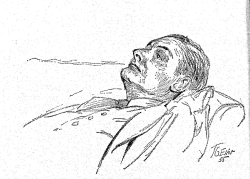
T.S. Eliot, Pencil and Chalk Drawing from life,
by his sister-in-law Theresa G. Eliot, 1955.
A strange convergence took place on Sunday, April 27, 1958, when Eliot was returning from appearing at an exhibition of his first editions and personal papers at the University of Texas at Austin. He and his second wife, Valerie Fletcher, stopped in New York to pay Levy a visit. Eliot arrived wearing a ten-gallon hat, having been made an honorary sheriff (I'm not making this up). After attending church with Levy's parents, the group retired to Levy's study for a martini brunch. Levy proudly showed off some books and papers he had purchased:
I next showed Tom another new acquisition, two pages in Dylan Thomas's handwriting, from a notebook which he had used during his poetry readings. The pages contained the poem "Chard Witlow" [sic] by Henry Reed, a facetious take-off on Tom's "Burnt Norton." Tom gave it a close scrutiny, and remarked, "You know, I've been chairman of the British group that has been raising funds for Dylan Thomas's family. Caitlin, his wife, asked me to—a very sad business." Thomas's death in New York had left his family almost penniless.
Tom removed his fountain pen from inside his breast pocket and wrote on the bottom of the second of the two pages. When he finished, he handed it to my parents, who read it and passed it to Valerie. When it reached my hands, Tom said, "You know, William, this is the only piece of paper in existence that has both Dylan's writing on it and mine."
I read what he had written: "Not bad. But I think I could write a better parody myself. T.S. Eliot, 27.iv.58."
Somewhere, out there in the world, in a drawer or filed away in some box, is a page from Dylan Thomas' notebooks, with a wry, handwritten note by T.S. Eliot. Not to mention the possibility of photographs of T.S. Eliot in a cowboy hat.
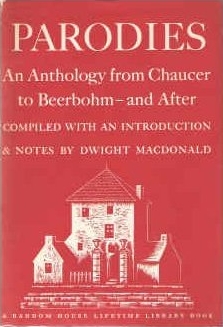
Last September, I complained of not being able to find the source of an oft-quoted comment by T.S. Eliot, who remarked that Reed's poem, "Chard Whitlow," was the only parody deserving of its success. Realizing that I have been less than devoted to updating here, and that I have been stockpiling items worthy of posting, let us begin at the top of the pile: Dwight Macdonald's (Wikipedia) Parodies: An Anthology from Chaucer to Beerbohm—and After (WorldCat).
Here, it seems, is the original source (.pdf) of Eliot's comment:
This famous parody was originally an entry in a New Statesman contest. 'Most parodies of one's own work strike one as very poor,' Mr. Eliot writes. 'In fact one is apt to think one could parody oneself much better. (As a matter of fact some critics have said that I have done so.) But there is one which deserves the success it has had, Henry Reed's Chard Whitlow.' Broadness is the sin of most Eliot parodies; Mr. Reed's alone seems to me to escape it. The one following, by 'Myra Buttle,' who is a Cambridge don, does not. I have included it because it is funny and because I thought some sample of The Sweeniad should be given.
(I apologize for the lousy scan from Parodies. I need to report that misbehaving copier to the library staff.)
Alas, Mr. Macdonald does not credit or cite the source of his 'Mr. Eliot writes'. As an editor of The Partisan Review, he did have reason to correspond with Eliot, and letters from Eliot in Macdonald's papers do appear from the right time period: 1959-1960 (see the "Guide to the Dwight Macdonald Papers," 230 page .pdf, from the Manuscripts and Archives department at Yale University Library).
Macdonald is careful to include permissions for using other quoted material in his text, but none is provided for Eliot. Did he write Eliot and ask the poet's opinion of his parodists? Is Eliot's letter residing in some box at Yale?
"Weird" Al Yankovic has an excellent song, "Bob," which is not simply a parody of Bob Dylan's "Subterranean Homesick Blues," but also an intelligent exercise in palindromes. The music video (YouTube) for "Bob" is a faithful re-creation of the opening sequence to the 1967 Dylan documentary by D.A. Pennebaker, Don't Look Back.
All this reminded me of a promotional gizmo which came out for the release of the Dylan retrospective on CD last year, which we will now use for our own purposes to summarize Henry Reed's poem, "Chard Whitlow," in ten cue cards or less:
"Chard Whitlow" is itself a parody of T.S. Eliot's Four Quartets, so the circle of life and satire is now complete.
The Rt Hon. Kenneth Baker, in his excellent anthology Unauthorized Versions: Poems and Their Parodies (OCLC WorldCat), assiduously includes this explanatory note with Henry Reed's famous send-up of Eliot's Four Quartets:
This parody by a poet celebrated in his own right won a competition in the New Statesman. Eliot himself commented: 'In fact one is apt to think one could parody oneself much better. (As a matter of fact some critics have said that I have done so.) But there is one which deserves the success it has had, Henry Reed's "Chard Whitlow".' There is no single poem to put beside Reed's parody, which cleverly manages to summon echoes from almost all Eliot's work, but a few examples are given here.
Lord Baker places "Chard Whitlow" side-by-side with lines from Eliot's "Little Gidding," "Gerontion," "Ash Wednesday," and "Choruses from 'The Rock'."
It seems unlikely (if not impossible) that Reed was parodying "Little Gidding," since that poem was written in 1942, after the publication of "Chard Whitlow" (.pdf). It's more likely Reed had in mind the earlier verse of Eliot's Four Quartets, such as "Burnt Norton" (1935). The possibility exists, therefore, that Reed's poem actually influenced Eliot's. Stephen Spender, however, in his book T.S. Eliot (New York: Viking, 1975), says that Eliot, in fact, 'relished' the parody, but that he was not seeking to 'emulate' it (p. 177).
Regardless of who influenced whom, the real mystery is the source of Eliot's admiration of "Chard Whitlow," quoted above. Baker's anthology includes acknowledgments for the poems he has compiled, but I'm fairly certain there is no attribution for Eliot's words, and no footnotes accompany the explanatory notes. Does anyone have a copy they can double-check for me?
1529. Sackville-West, Vita. "Seething Brain." Observer (London), 5 May 1946, 3.
Vita Sackville-West speaks admirably of Reed's poetry, and was personally 'taken with the poem called "Lives," which seemed to express so admirably Mr. Reed's sense of the elusiveness as well as the continuity of life.'
1st lesson:
Reed, Henry
(1914-1986). Born: Birmingham, England, 22 February 1914; died: London, 8
December 1986.
Education: MA, University of Birmingham, 1936. Served: RAOC, 1941-42; Foreign Office, Bletchley Park, 1942-1945.
Freelance writer: BBC Features Department, 1945-1980.
Author of:
A Map of Verona: Poems (1946) The Novel Since 1939 (1946) Moby Dick: A Play for Radio from Herman Melville's Novel (1947) Lessons of the War (1970) Hilda Tablet and Others: Four Pieces for Radio (1971) The Streets of Pompeii and Other Plays for Radio (1971) Collected Poems (1991, 2007) The Auction Sale (2006)