|
|
Documenting the quest to track down everything written by
(and written about) the poet, translator, critic, and radio
dramatist, Henry Reed.
An obsessive, armchair attempt to assemble a comprehensive
bibliography, not just for the work of a poet, but for his
entire life.
Read " Naming of Parts."
|
Contact:
|
|
|
|
Reeding:
|
 |
I Capture the Castle: A girl and her family struggle to make ends meet in an old English castle.
|
 |
Dusty Answer: Young, privileged, earnest Judith falls in love with the family next door.
|
 |
The Heat of the Day: In wartime London, a woman finds herself caught between two men.
|
|
|
|
Elsewhere:
|
|
All posts for "GoogleBookSearch"
|
|
|
26.7.2024
|
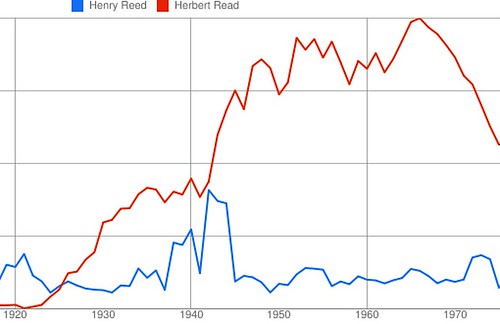
Click image to go to Google Labs' Books Ngram Viewer
Here's a comparison of the frequency of published appearances of the names "Henry Reed" versus "Herbert Read," made possible by Google Books Ngram Viewer, which searches a corpus of 5.2 million texts published between 1500 and 2008—approximately 500 billion words. Notice where Henry nearly rivals his arch-nemesis in 1942, with the publishing of "Naming of Parts." You can read the announcement for the launch in the official Google Blog.
It's interesting to see the difference in usage of the phrase "war poet" in American and British English, during World War I and World War II. (Is there a way to chart two corpora in the same graph?) Read more about the linguistic trends being discovered using the database in the New York Times.
|
1537. Radio Times, "Full Frontal Pioneer," Radio Times People, 20 April 1972, 5.
A brief article before a new production of Reed's translation of Montherlant, mentioning a possible second collection of poems.
|
In 1963, Poetry Northwest, of the University of Washington, Seattle, began sponsoring a Theodore Roethke Prize for poetry. This was followed up the next year with a Roethke Memorial Poetry Reading, in order to "preserve the university as a poetry center." The first of these readings, in 1964, was given by John Crowe Ransom.
I looked this up, because, tickling Google Book Search for information, this snippet emerges in the June, 1964 issue of Poetry, under "News Notes" (p. 196):
* The University of Washington has established a Theodore Roethke Memorial Reading, the first of which was given by John Crowe Ransom on Theodore Roethke's birthday, May 25th. The judges for this year's selection were Henry Reed, William Matchett, and Carolyn Kizer. *
So, Henry Reed had a small role in bringing Ransom, a fellow "major minor poet," to the first annual Roethke Memorial Reading (read Ransom's " Piazza Piece," and more). Carolyn Kizer had studied Creative Writing with Roethke in 1959, and was an editor of Poetry Northwest in 1964. William H. Matchett, we recall, had some nice things to say about Reed in Remembering Elizabeth Bishop.
The University of Washington diligently provides a list of previous Roethke Readers. This past May, the reader was Paul Muldoon.
|
1536. L.E. Sissman, "Late Empire." Halcyon 1, no. 2 (Spring 1948), 54.
Sissman reviews William Jay Smith, Karl Shapiro, Richard Eberhart, Thomas Merton, Henry Reed, and Stephen Spender.
|
Very well, then. Here are two hills. Here are two snippets from what I believe is the May, 1946 issue of Adam International Review—the title is an acronym for Art, Drama, Architecture, and Music—not the 1960s men's magazine of the same name (some images NSFW). Google Book Search doesn't particularly lend itself to any sort of exactness, but this would appear to be a book review penned by Alex Comfort, concerning Henry Reed's A Map of Verona, and perhaps Dylan Thomas's Deaths and Entrances, both published in 1946:
Alexander Comfort (1920-2000), M.B., Ph.D., was a poet, novelist, and physician, widely known for his writings on pacifism and gerontology. Perhaps to his dismay, however, Comfort will always be best remembered as the author of The Joy of Sex (1972).
One of the most prolific poets of the Forties, Comfort's early collections include: France and Other Poems (1942); A Wreath for the Living (1943); Elegies (1944); The Song of Lazarus (1945); and The Signal to Engage (1947). Here is just a small taste, from his "Sixth Elegy":
Love is not strong to fight with history
and those who love are sometimes buried together
sometimes apart, and move like shells
slowly into the heart of the cloudy hills... Comfort's personal papers are collected at University College London. The Adam Collection, the personal library of editor Miron Grindea, is housed at King's College London.
|
1535. Reed, Henry. "Talks to India," Men and Books. Time & Tide 25, no. 3 (15 January 1944): 54-55.
Reed's review of Talking to India, edited by George Orwell (London: Allen & Unwin, 1943).
|
I've found a few tasty morsels on Google Book Search in two publications put out by the Booksellers Association of Great Britain and Ireland, The Publisher and The Bookseller ("The Organ of the Book Trade"). Both the Publisher, and later The Bookseller, listed entries for the week's literary programs on the BBC, so here we find, in this volume from 1947, listings for February 23 at 10:38 pm, "Time for Verse: Compiled by Henry Reed, the poet", and for June 17 at 6:55 pm, "Book Review: Henry Reed on Shelley and Cecil Day Lewis".
In the Bookseller for April 20, 1963, however, we discover something of a mystery: a reference to Reed and several other authors being asked to contribute something to something:
It says: 'The contributors, who, among many others, include Nevill Coghill, Richard Hogart, Henry Reed, Alan Ross, Stephen Spender, and Philip Toynbee, were asked "to..."' (p. 1642). But the limitations of snippet view do not allow us figure out exactly what these authors were contributing to, or even what they might have in common.
Nevill Coghill was a literary scholar known for his modern version of the Canterbury Tales, which was first produced for the BBC; Richard Hoggart was an academician, who was a witness at the Lady Chatterley censorship trial; Reed, Ross, and Spender were, of course, primarily known as poets; and Philip Toynbee was an experimental novelist.
What were these writers contributing to, and what was they asked to do? Trying to find a library in the States with a 1960s run of the Bookseller is an exercise in exasperation. University of Georgia libraries? At least I have the exact date and page number, which means I can try to get a photocopy through interlibrary loan.
|
1534. Reed, Henry. "Radio Drama," Men and Books. Time & Tide 25, no. 17 (22 April 1944): 350-358 (354).
Reed's review of Louis MacNeice's Christopher Columbus: A Radio Play (London: Faber, 1944).
|
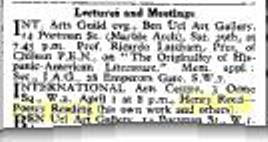
Here's a sliver of a New Statesman and Nation discovered in a Google Book search:
What's that? Can't quite make it out? Let's blow it up a bit, then:
It would appear to say, in the "Lectures and Meetings" column: 'INTERNATIONAL Arts Centre, 3 Orme Sq., W.2. April 1 at 8 pm., Henry Reed—Poetry Reading (his own work and others).'
I'll have to go flip through some old New Statesmans to confirm the year, but it looks like it's from 1947. ( Confirmed: this notice appeared on March 29, 1947.)
|
1533. Friend-Periera, F.J. "Four Poets," Some Recent Books, New Review 23, no. 128 (June 1946), 482-484 [482].
A short review calls A Map of Verona more pretentious than C.C. Abbott's The Sand Castle; influenced by Eliot, Auden, MacNeice, and Day Lewis.
|
This snippet from My Sister and Myself: The Diaries of J.R. Ackerley (edited by Francis King, 1982) made me laugh:
|
1532. Vallette, Jacques. "Grand-Bretagne," Mercure de France, no. 1001 (1 January 1947): 157-158.
A contemporary French language review of Reed's A Map of Verona.
|
This is really just for my own edification, though you may find it useful. Instead of just entering keywords, you can also add special search operators to a Google Books search—like commands—in order to narrow results to a particular author, subject, or date range. From the Advanced Book Search page:
|
1531. Henderson, Philip. "English Poetry Since 1946." British Book News 117 (May 1950), 295.
Reed's A Map of Verona is mentioned in a survey of the previous five years of English poetry.
|
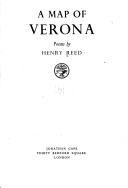
Google Book Search finally got around to digitizing the University of Michigan's copy of Reed's A Map of Verona: Poems (London: 1946) back in May of this year. It's still in copyright, so you can only view it in snippets, but it's still nice to have searchable text at a glance.
Google's keywords for the book are also telling, if not a little strange: 'kharma, dead ground, iseult, tower rises, unspeaking, central sector, draughty, worth describing, harbour, slow wave, gulls, wide road, grotto, never happen, dancers, christmas eve, chard whitlow.'
|
1530. Radio Times. Billing for "The Book of My Childhood." 19 January 1951, 32.
Scheduled on BBC Midland from 8:15-8:30, an autobiographical(?) programme from Henry Reed.
|
Two curious snippets turned up in Google Book Search today. The first is from Red Letter Days: British Fiction in the 1930s (Croft, 1990), and mentions several of Reed's contemporaries in Birmingham:
...Reggie Smith, a Communist and an old school friend of [Walter] Allen's. As an undergraduate at Birmingham University, Reggie Smith had published Allen's first work in the student magazine Mermaid, together with material by their friend Henry Reed and by Robert Melville.
A tidbit also appears in, of all places, Selections from Freedom, articles selected from the Freedom, the Anarchist Weekly (London). It appears to be a letter signed by many prominent writers and artists of the time, protesting conditions still to be found in Spain in the early 1950s: 'We insist that the Government of General Franco be obliged to honour the pledges which it gave on joining [ UNESCO].'
Lots of familiar names rally in support, including Reed, Laurie Lee, Hugh MacDiarmid, William Plomer, Sacheverell Sitwell, and Stephen Spender.
|
1529. Sackville-West, Vita. "Seething Brain." Observer (London), 5 May 1946, 3.
Vita Sackville-West speaks admirably of Reed's poetry, and was personally 'taken with the poem called "Lives," which seemed to express so admirably Mr. Reed's sense of the elusiveness as well as the continuity of life.'
|
Stumbled across an interesting lead today, poking and prodding around Google Print. Using Google Print is very much like browsing the index cards in an old-fashioned library card catalog's Subject drawers, except instead of only seeing the phonebook subject headings created by catalogers, there's an index card for every single word and phrase in the English language.
I was looking for information relating to Reed's training in the British army during World War II; specifically, the infamous "lessons" given by non-commissioned officers, on subjects like weapons training, fieldcraft, and self-defense.
What surfaced was a book called The British Army and the People's War, 1939-1945, by Jeremy A. Crang (Manchester University Press, 2000). Crang refers to research undertaken in 1942 by Professor C.W. Valentine, as part of an effort by the War Office to improve the quality of training British servicemen were receiving during the war. Valentine ' conducted a survey of weapons training among his former student-teachers serving in the army' (p. 79)
Among the complaints of these teachers turned soldiers? 'Too much material crowded into a given period.' 'Inadequate use of visual aids.' 'Lack of learning by doing.' ' Mechanical, parrot-like teaching' (emphasis mine), and an ' unnecessary enumeration of parts' (emphasis also mine).
Does that sound like anyone we know? Just a coincidence, of course. Perhaps the allusion is only in Crang's word choice. I'm sure the all servicemen Valentine surveyed made similar protests.
Valentine, however, just happened to be Professor of Education at the University of Birmingham, as well as the director of the university's Department for the Training of Teachers.
The University of Birmingham is, of course, Reed's Alma Mater, and Reed did teach for a year between graduating and getting called up for military service. Interesting.
Google is, of course, making news this week because they're being sued by publishers McGraw-Hill, Pearson Education, Penguin, Simon & Schuster, and John Wiley for violating copyright by scanning the contents of library collections for their Google Library Project. The Association of American Publishers claims Google is 'seeking to make millions of dollars by freeloading on the talent and property of authors and publishers.'
As near as I can figure, Google Print includes, or will include, Google Library Project scans, but also includes books scanned at the express request of publishers. The reference I discovered today makes an excellent argument in favor of these projects. After a simple keyword search, I was able to check the book out from the college's library, and I have it right here, sitting on my coffee table as I write this.
|
1528. Manning, Hugo. "Recent Verse." Books of the Day, Guardian (Manchester), 31 July 1946, 3.
Manning feels that 'Mr. Reed has worn thin much of his genuine talent in this direction by too much self-inflicted censorship.'
|
SearchEngineWatch has an article this week, " Going Under Cover With Books Search Tools" — about accessing books online with Google Print — in which I think the author gets one or two things wrong.
The "Here's how" section suggests narrowing a search to Google Print material by inserting the word "books" before your Google search words or phrase. Inserting the singular " book" is the preferred method, however; "book" works just as well, and saves typing dozens of extra Ss. That's what you do when you're scouring a resource: you type endless combinations of keywords and phrases in quotes into the search box.
To get to a Google Print search box, the article suggests picking one of the displayed results, and then scrolling to the bottom of the first page where the search box appears. Far better than doing all that scrolling, Google displays a " Book results for..." link, right at the top of your original search (with " book") result, which links right to all the Google Print results — with excerpts — and a Print-only search at the top. No need to cut through the backyard of a (possibly) useless result.
The article does have a good list of "[a] few things to keep in mind" when searching Google Print, and I love the quick and dirty "Add your search terms to this URL":
http://print.google.com/print?q=
I also discovered today that Google Print has a Recursive Book Factor of eight (RBF8):
book
"book book"
"book book book"
"book book book book"
...
"book book book book book book book book"
|
1527. Rosenthal, M.L. "Experience and Poetry." Herald Tribune Weekly Book Review (New York), 17 October 1948, 28.
Rosenthal says Reed shares with Laurie Lee 'that unhappy vice of young intellectuals—a certain blandness of which the ever-simple irony is a symptom.'
|
|
|
|
1st lesson:
Reed, Henry
(1914-1986). Born: Birmingham, England, 22 February 1914; died: London, 8
December 1986.
Education: MA, University of Birmingham, 1936. Served: RAOC, 1941-42; Foreign Office, Bletchley Park, 1942-1945.
Freelance writer: BBC Features Department, 1945-1980.
Author of:
A Map of Verona: Poems (1946)
The Novel Since 1939 (1946)
Moby Dick: A Play for Radio from Herman Melville's Novel (1947)
Lessons of the War (1970)
Hilda Tablet and Others: Four Pieces for Radio (1971)
The Streets of Pompeii and Other Plays for Radio (1971)
Collected Poems (1991, 2007)
The Auction Sale (2006)
|
Search:
|
|
|
Recent tags:
|
Posts of note:
|
Archives:
|
Marginalia:
|
|