About:

Documenting the quest to track down everything written by (and written about) the poet, translator, critic, and radio dramatist, Henry Reed.

An obsessive, armchair attempt to assemble a comprehensive bibliography, not just for the work of a poet, but for his entire life.

Read "Naming of Parts."

Henry Reed Henry Reed
Henry Reed, ca. 1960


Contact:


Reeding:

Enclosures and Disclosures: Mercer Simpson's most recent collection of poetry.
Anathem: A monastery of cloistered scholars must save their world from catastrophe.
Balthazar: The second title in Durrell's Alexandria Quartet.


Elsewhere:

Books

Libraries

Weblogs, etc.


All posts for "JudgingDistances"

Reeding Lessons: the Henry Reed research blog

20.11.2008


An Album of Modern Poetry

Last September, I mentioned discovering a letter to Henry Reed in the collection of Oscar Williams' correspondence at the Lilly Library in Indiana. The letter was from Henry J. Dubester, and was among a group of letters addressed to British and American poets, including Auden, William Empson, Frost, Roy Fuller, Archibald MacLeish, Roethke, and Stephen Spender (amidst many others). I wondered, at the time, what Mr. Dubester was doing, writing to so many prominent poets?

Not long after, I received an e-mail from none other than Henry Dubester, himself, which answered my question. Mr. Dubester informed me:

I was promoted and served as Assistant and then Chief of the General Reference and Bibliography Divisions of the Library of Congress. The Poetry Office was one of the sections of the Division. The Library also had a recording laboratory where recordings were made and preserved of many individuals, including poets. I had the opportunity of compiling a set of records with a selection from those recordings. Oscar Williams was my consultant who advised me on the selection. Following his advice, I contacted the poets and solicited their permission to include the text of their recorded poems with the (3) record album.

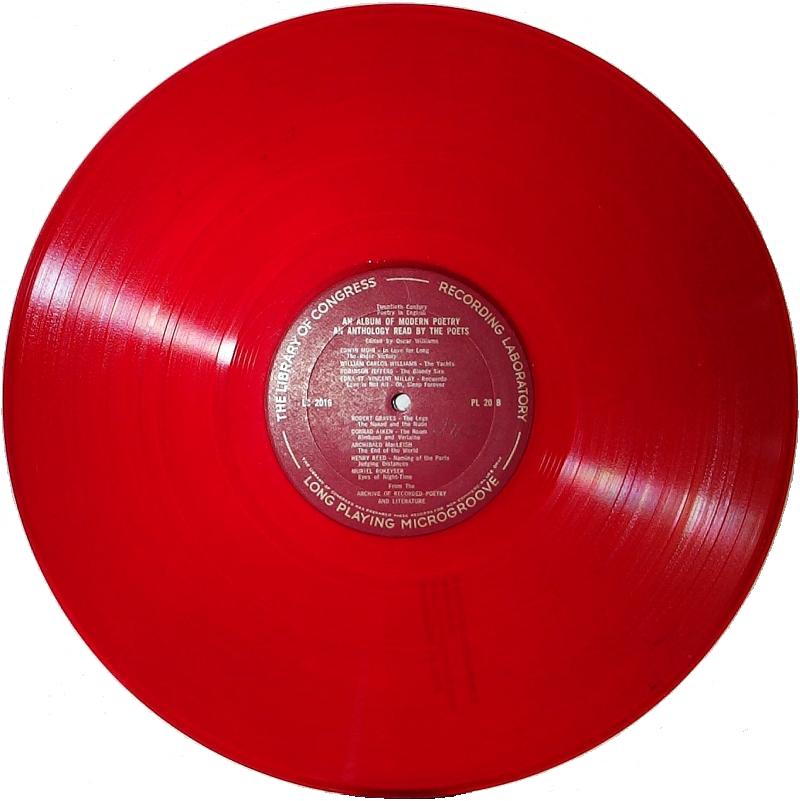
Mr. Dubester is referring to the Library of Congress Recording Laboratory's An Album of Modern Poetry: An Anthology Read by the Poets (1959), a set of recordings of the best 20th-century poets reading from their own work, edited by Williams.

LP record

My library actually owns these records, although I had to request them from the storage facility where they cache the more outdated or under-utilized materials. The library also possesses a spectacular media lab of its own, replete with soundproofed recording booths stuffed with just the right gear for analog-to-digital conversion. Which is? An ancient turntable plugged into a Mac.

So I snuck away for an hour today, and lifted the tracks of "Naming of Parts" and "Judging Distances" from Williams' Album of Modern Poetry. The boxed set is three 12", 33 1/3 microgroove LPs, pressed into a vinyl the color of which there is no word for in English ("vermillion" does not adequately convey the records' ethereal translucence).

As Mr. Dubester promised, the set includes a wonderful, 41-page printed anthology of the poems being presented by their authors, as well as an introduction from Oscar Williams on the box. And, I did enjoy a wonderfully surreal moment, when I heard Conrad Aiken's voice booming from the lab's speakers, repeatedly referring to Rambo, Rambo, Rambo, before I realized he was talking about Rimbaud. But, enough.

'This is Henry Reed, reading selections from his poems':

"Naming of Parts" (.mp3)

"Judging Distances" (.mp3)


1349. Grigson, Geoffrey, ed. The Concise Encyclopaedia of Modern World Literature. New York: Hawthorn Books, 1963.
Reed is listed among the contributors to this reference work.


Swivel Tips

One of the odd, esoteric things to the study of Henry Reed is becoming familiar with the arms of World War II and their proper use. For instance, when Reed writes to his sister, in 1941, that he is learning to manage an anti-tank rifle, it is helpful to know that he is talking about the "Boyes" anti-tank rifle (though not particularly useful).

Now, I am not a gun person. Far from it. I know less about firearms than I do about automobiles. Or women, for that matter. Nevertheless, I enjoy watching endless Second World War documentaries on the History Channel, and I'm always intrigued by any details of 1940s-era basic training which may have inspired Reed's "Lessons of the War." Which is why I was so happy to see this recent "Piling Swivel" thread in the Great War Forum, which discusses piling of arms, and includes step-by-step illustrations:

Pile Arms

Also, I stumbled across this compilation of old British Pathe newsreels on YouTube, which opens with a demonstration of rifle training with the Pattern 1914 Lee-Enfield, and mentions not only "easing the spring," but even "judging distances."

The other tangential area to studying Reed is the realm of WWII cryptography, and that gets even more weird and esoteric. Oh, and japonica: I know waaaay too much about japonica.


1348. Sonzogni, Marco. Afterword to Mottetti, by Eugenio Montale, translated by Henry Reed. PN Review 180 34, no. 4 (March-April 2008): 38-41.
Sonzogni appraises Reed's translations of Montale's Mottetti, and describes Reed's manuscripts and his history with the poems and the Italian language.


1st Lesson:

Reed, Henry (1914-1986). Born: Birmingham, England, 22 February 1914; died: London, 8 December 1986.

Education: MA, University of Birmingham, 1936. Served: RAOC, 1941-42; Foreign Office, GC&CS, 1942-1945. Freelance writer: BBC Features Department, 1945-1980.

Author of: A Map of Verona: Poems (1946)
The Novel Since 1939 (1946)
Moby Dick: A Play for Radio from Herman Melville's Novel (1947)
Lessons of the War (1970)
Hilda Tablet and Others: Four Pieces for Radio (1971)
The Streets of Pompeii and Other Plays for Radio (1971)
Collected Poems (1991, 2007)
The Auction Sale (2006)


Search:


LibraryThing


Recent tags:


Posts of note:


Archives: