|
|
Documenting the quest to track down everything written by
(and written about) the poet, translator, critic, and radio
dramatist, Henry Reed.
An obsessive, armchair attempt to assemble a comprehensive
bibliography, not just for the work of a poet, but for his
entire life.
Read " Naming of Parts."
|
Contact:
|
|
|
|
Reeding:
|
 |
I Capture the Castle: A girl and her family struggle to make ends meet in an old English castle.
|
 |
Dusty Answer: Young, privileged, earnest Judith falls in love with the family next door.
|
 |
The Heat of the Day: In wartime London, a woman finds herself caught between two men.
|
|
|
|
Elsewhere:
|
|
All posts for "BletchleyPark"
|
|
|
27.7.2024
|
I can't wait to get home and listen to the latest episode of BBC Radio 4's The Infinite Monkey Cage, with Brian Cox and Robin Ince. This week features comedian Dave Gorman, Simon Singh, and Dr. Sue Black, talking about the science of WWII cryptography and Bletchley Park.
The episode runs about 30 minutes.
|
1537. Radio Times, "Full Frontal Pioneer," Radio Times People, 20 April 1972, 5.
A brief article before a new production of Reed's translation of Montherlant, mentioning a possible second collection of poems.
|
When I was looking up sources for my previous post on the breaking of Japanese naval codes at Bletchley Park, I stumbled upon an excerpt from a poem by Patrick Wilkinson (1907-1985), a Vice-Provost of King's College and Horace scholar, who had been part of the Italian Naval Section at Bletchley.
In the book Diplomacy and Intelligence During the Second World War: Essays in Honour of F.H. Hinsley (Langhorne, ed. Cambridge University Press, 2004), Christopher Andrew quotes a poem by Wilkinson, "The Other Side," which he describes as an "epic wartime poem" in which the denizens of Bletchley Park are "transformed into the heavenly host." The book is a collection of essays in honor of Harry Hinsley, who studied traffic analysis of German intercepts at Bletchley, was instrumental in the Allied effort to capture Enigma codebooks from enemy weather ships, and later became an historian of British wartime intelligence. Wilkinson wrote:
Wings of all colours from their shoulders grew
From ADCOCK-pink to heavenly LUCAS-blue,
A dazzling sight. On Mrs. EDWARDS' head
There beamed a halo of unearthly red;
STRACHEY'S was black and of stupendous size,
But for extension HINSLEY'S took the prize. A footnote explains that " [Frank] Adcock had a very pink face; F.L. Lucas, another King's classicist, always wore a sky-blue jackets. Oliver Strachey, brother of Lytton and a founder member of GC & CS, wore a broad-brimmed black hat." (Apologies for the profusion of Wikipedia links in this post. I assure you, they are solely for my benefit, not yours!) "Mrs. Edwards" may be Professor Eve Edwards, in charge of the Japanese courses at the School of Oriental and African Studies during the war.
Aside from this one stanza, the only additional mention of the poem I can find is in a review of Hinsley and Stripp's Codebreakers (Oxford University Press, 1993), in which Noel Annan complains, "Why was not Patrick Wilkinson's droll account of the gaiety, the jokes, the scorn for the 'Other Side' — ie, the spy-masters — published?" Why indeed, when it would seem to be such a unique and colorful perspective of the staff and inner-workings of Bletchley?
I'm still looking for the "Ode to Colossus" mentioned in the General Report on Tunny, too.
|
1536. L.E. Sissman, "Late Empire." Halcyon 1, no. 2 (Spring 1948), 54.
Sissman reviews William Jay Smith, Karl Shapiro, Richard Eberhart, Thomas Merton, Henry Reed, and Stephen Spender.
|
Henry Reed spoke Japanese. Yet, as far as I know, he never hints at this particular skill in any of his poems, prose writing, or the scripts for his radio plays. The fact, however contradictory, remains. Henry Reed was a Japanese linguist for the latter part of World War II.
This is repeated in several places, the genesis of which appears to be Reed's obituary in the Times of December 9, 1986:
Called up in 1941, he served—'or rather,' he himself wrote, 'studied'—in the Army, until 1942 when he was seconded to Naval Intelligence at Bletchley. The 'studied' is perhaps explained by the crash-course he underwent in Japanese, and he served out the rest of the war teaching that language to Wrens.
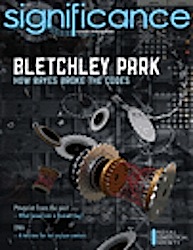
The quotations are from Reed's self-scribed entry for Who's Who. There seemed to be few sources which could illuminate this period in Reed's life, considering the secrecy surrounding the codebreaking efforts at Bletchley Park during the war. Then suddenly, quite recently, there materialized an article in the most unlikely place, Significance, the journal of the Royal Statistical Society: " Edward Simpson: Bayes at Bletchley Park" (June 2010, pp. 76-80), a memoir concerning the implementation of Bayes' Theorem in cracking the Japanese JN-25 and German Enigma codes, by the statistician Edward H. Simpson. "[H]ere, because I know it at first hand," Simpson says, "I describe the use made of Bayes in the cryptanalytic attack on the main Japanese Naval cipher JN 25 in 1943-1945, by the team in Block B which I led." This definitely raised my interest, for we know from the Bletchley Personnel Master List that Reed was assigned to Block B, Naval, for at least part of the war.
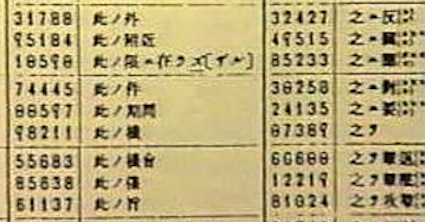
Unlike the German Enigma code, famously enciphered on the eponymous machine, the JN-25 code used by the Japanese Navy utilized a pre-selected vocabulary in printed codebooks, with corresponding values of five-digit numbers to be substituted for the words being transmitted. A bit of tricky addition then took place, resulting in a very secure coded message (albeit with a fatally exploitable flaw).
For an overview of the mathematics Simpson describes being utilized in breaking the Japanese code, you can read John Graham-Cumming's (author of O'Reilly's Geek Atlas) blog post, " Bayes, Bletchley, JN-25 and a 'Modern' Optimization." What grabbed my attention, however, wasn't the inscrutable math, but Simpson's colorful anecdotes of wartime life at Bletchley Park, and the great "diversity of minds" working (and playing) together:
Off-duty we mixed freely. With almost no contact with the people of Bletchley and the surrounding villages, and most of us far from our families, we were a very inward-looking society. All the civilian men (except for some of the most senior) had to serve in the Bletchley Park Company of the Home Guard: this was a great mixer and leveller. On the intellectual side, chess was probably the most glittering circle, with Hugh Alexander, Harry Golombek and Stuart Milner-Barry at its centre...[.] There was music of high quality. Myra Hess visited to give a recital. Performances mounted from within the staff included 'Dido and Aeneas', Brian Augardeís jazz quintet and several satirical revues. A group of us went often by train and bicycle to the Shakespeare Memorial Theatre at Stratford-upon-Avon. Scottish country dancing flourished. The Hall, which was built outside the perimeter security fence so that Bletchley people could use it too, provided for dances as well as the performances and a cinema. One memorable occasion was the showing of Munchhausen, in colour (probably the first colour film that most of us had seen) and in German without subtitles. I heard no explanation of how it came to be at Bletchley Park. I doubt that it was through the normal distribution channels. [p. 79]
Simpson concludes (after much elaboration on letter frequency, probability, alignments, and Bayes factors) with a few reminiscences on where staff went after the war, including:
Henry Reed, a Japanese linguist while in our JN 25 team, went back to poetry, radio plays and the BBC. His 'The Naming of Parts', which has been called 'the best-loved and most anthologised poem of the Second World War', voices his reflections while serving in the Bletchley Park Home Guard. [p. 80]
How, exactly, did Henry Reed—a Classics scholar fluent in Italian and French, who had taught himself Greek in grammar school—become a linguist on Edward Simpson's Japanese Naval team? Reed had been sent up from the Royal Army Ordnance Corps in 1942, to translate Italian intercepts at Bletchley Park. Following Italy's surrender in September 1943, the bulk of Bletchley's Italian section was absorbed into the Japanese teams. This required that Reed take (or be forcibly given) an intensive, six-month "crash-course" in Japanese. The Japanese course was the brainchild of Col. John Tiltman, who had challenged a retired Naval officer, Capt. Oswald Tuck, to create and head the Bedford Japanese School. Eleven such courses were given in Bedford between 1942 and 1945, beginning in rooms above the Gas Company showroom in Ardor House (under the watchful eye of Mr. Therm), on the corner of The Broadway and Dame Alice Street (opposite the statue of John Bunyan), moved to a house at 7 St. Andrews Road, before finally settling in at 52 De Parys Avenue. Of the 255 students rushed through the school, only nine failed to pass.
Bernard Keefe recollects, in The Emperor's Codes: The Breaking of Japan's Secret Ciphers (Smith, ed., 2001):
The Japanese course was held in a large house in De Parys Avenue, Bedford. We lived in digs. As you entered the house the Japanese course was on the left and a codebreaking course on the right. We knew each other, of course; one of the code-boys was Robert Pitman, a passionate lefty who turned into a right-wing columnist for the Daily Express. But even at that stage it was remarkable that we didn't discuss each other's activities. I was interested in music and had started singing as a baritone at school. Bedford was like musical heaven, because the BBC Symphony Orchestra had been evacuated there, giving broadcasts from Bedford School Hall, or from the Corn Exchange, and added to that were shows by Glenn Miller and his US Army Air Force Band. [pp. 236-237] similarly describes attending the fifth Japanese course—between August, 1943 and February, 1944—in his book, Codebreaker in the Far East (1989):
The course was held in a large room in a detached house in De Parys Avenue, a tree-lined road not far from the town centre. There were about 35 on the course, including two girls, all of us aged about 18 or 19, and most from university Classics courses. We eyed each other sheepishly. We realised later how sensible the intelligence service had been in choosing classicists and a few other dead-language students—for example embryonic theologians working in Aramaic—for these courses in written Japanese, and modem linguists, more accustomed to spoken languages, for spoken Japanese. If the legends are true of chefs being retrained as electricians for the Army, while electricians were turned into chefs, this was no mean achievement.
We had two instructors. The first was Oswald Tuck, a retired naval captain in his sixties, who had been persuaded to teach the first course, starting in February 1942. A bearded, spectacled, quiet and benevolent man, he had taught himself Japanese nearly forty years before, and was now in his element teaching it to others. The other was Eric Ceadel, another classicist and a student on that first course; quick, cool, lucid and methodical. Inevitably he became known as 'Chūi', the Japanese for lieutenant. Later they were helped by David Hawkes.
We worked every weekday, with just enough time at coffee and lunch breaks to prevent our going stale. Most evenings and weekends were needed to learn the language and above all to memorise the characters...[.]
Many of us were music-lovers; I learned much later that chess, crossword puzzles and music had long been considered pointers to a possible proficiency in codebreaking. Several played instruments, and I believe Michael Herzig was the accomplished horn-player whose arpeggios from the Mozart concerto finales often formed fanfares for the start of our classes. We were lucky in having the BBC Symphony Orchestra and the BBC Singers evacuated to Bedford and we could often get passes for the orchestral rehearsals; I remember sitting in while Henry Holst was the soloist in the Walton violin concerto, and realising for the first time that if you can sit behind the orchestra you can learn much more than from in front. One evening we persuaded Sir Adrian Boult to give an informal talk about conducting. [p. 5]
(He may not have enjoyed quite as much musical entertainment as Keefe and Stripp, if Reed was still billeted in or around Milton Keynes during this time, but we may see evidence of his connections to the BBC, with so much broadcasting from Bedford taking place.)
Stripp also provides an interesting observation in a book co-edited with F.H. Hinsley, Codebreakers: The Inside Story of Bletchley Park (1993), one of the best resources on British codebreaking during World War II:
A colleague has pointed out that we finished the course with a wide inter-service vocabulary (advance, submarine, aircraft-carrier, independent mixed brigade, commander-in-chief, and the like) but never learnt the Japanese words for 'you' and 'me'. Absurd as this could be for orthodox students, it made good sense for us. Personal pronouns rarely appear in army, navy, or air force signals nor in captured documents, all of which normally take the form of reports, requests, or orders. [p. 289]
This may provide at least a partial answer as to why there is no evidence of a working knowledge of Japanese in any of Henry Reed's writing: what use is any language to a lyric poet, lacking the words for "you" or "I"?
There still remains the question of the mention in his obituary of Reed having spent the remainder of the war teaching Japanese to members of the Women's Royal Naval Service (Wrens). The urtext, and final word, comes from the most reliable of witnesses: Reed's friend and fellow Brummie, the novelist Walter Allen. In his 1981 autobiography, As I Walked Down New Grub Street, Allen speaks of visiting Reed in Dorset; of Reed working on his life of Hardy—" the life of Hardy"—even as late as 1971; of Reed frequently traveling to London for theatre, opera, and ballet (especially ballet), after the war. Allen begins:
Henry Reed had been demobilised from Intelligence, whither he had been seconded from the Army. Among other things, he had learnt Japanese, which in turn he had taught to Wrens. He intended, he said, to devote every day for the rest of his life to forgetting another word of Japanese. [p. 149]
|
1535. Reed, Henry. "Talks to India," Men and Books. Time & Tide 25, no. 3 (15 January 1944): 54-55.
Reed's review of Talking to India, edited by George Orwell (London: Allen & Unwin, 1943).
|
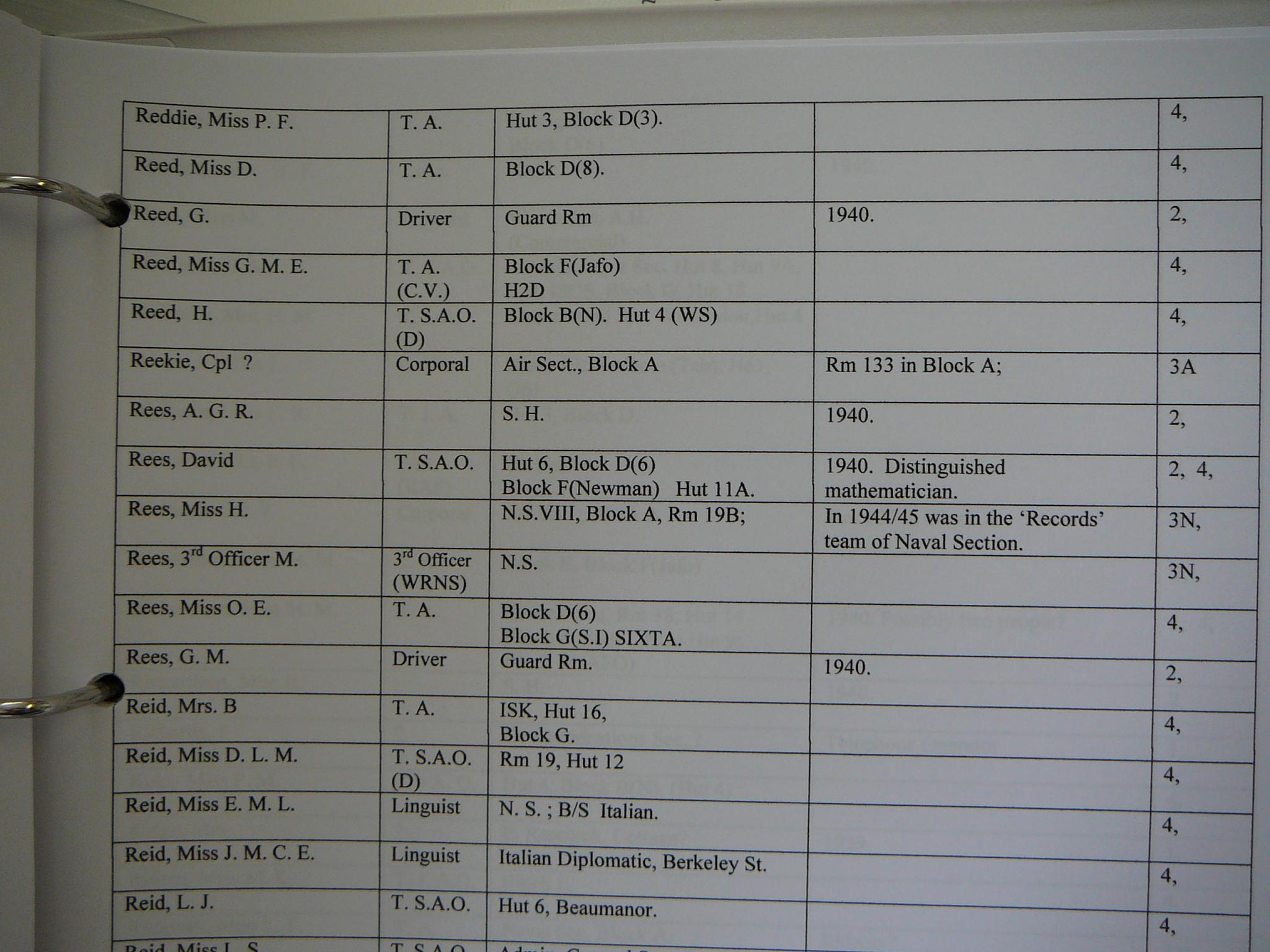
My friend the Webrarian has posted some snapshots from a recent visit to Bletchley Park: photographs of master personnel lists, the names and locations of cryptographers, mathematicians, WRNS, and support staff who worked at Bletchley between 1939 and 1945. And who should we find, of course, but one Reed, H. (Henry)! Click to see the images on Flickr:
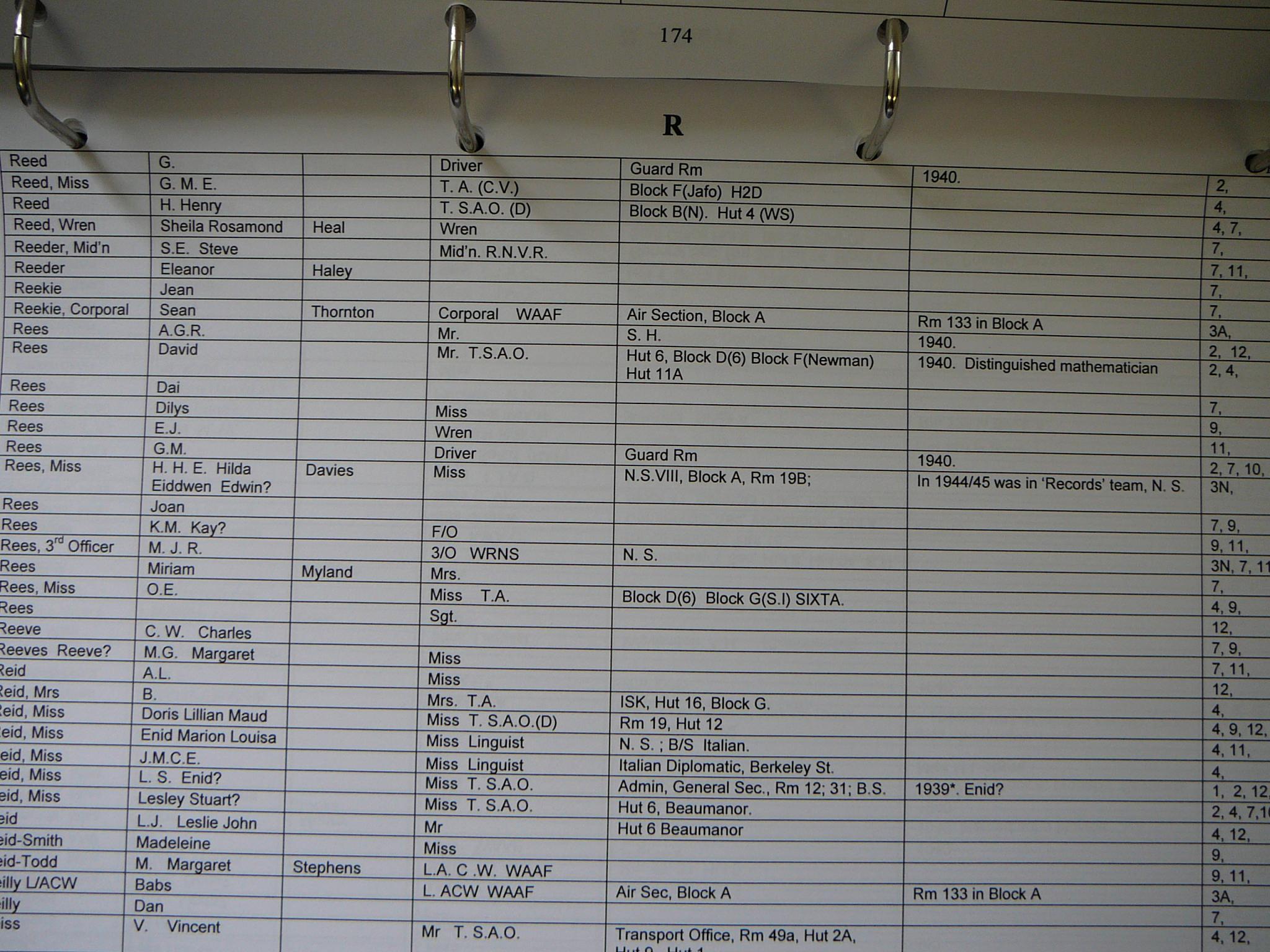 Reed, H. Henry. T.S.A.O. (D). Block B(N). Hut 4(WS).
Can we assume that the (N) after Block B is for "Naval"? But what does the mysterious T.S.A.O. (D) stand for? "T" for translator? And what's (WS)?
|
1534. Reed, Henry. "Radio Drama," Men and Books. Time & Tide 25, no. 17 (22 April 1944): 350-358 (354).
Reed's review of Louis MacNeice's Christopher Columbus: A Radio Play (London: Faber, 1944).
|
Hey! BBC Radio 4 has a new half-hour situation comedy coming out. What's the premise, you ask? Well, it's about a wacky bunch of codebreakers stationed at Bletchley Park during World War II. How's that sound? The show is called "Hut 33," after one of the (fictitiously numbered) pre-fab buildings where the cipher-breaking and translation work was done. From the BBC's website:
Set in Bletchley Park, in 1941, this sitcom focuses on three code-breakers forced to share a draughty wooden hut as they try to break German ciphers. Unfortunately they bicker constantly.
Archie, a Geordie socialist, must now work with Charles, the Tory snob who rejected him from Oxford for wearing brown shoes. Gordon, the child prodigy, tries in vain to act as peacemaker but they won't listen to someone who still wears short trousers.
The program stars Robert Bathurst, Tom Goodman-Hill, Olivia Colman, and Fergus Craig. The show's author, James Cary, has a shot of a " memo" for the show on his blog, with pics.
Unfortunately, I'm in a rather inconvenient time zone for casual listening, as the show will premiere at 11:30 a.m., BST, on Monday, June 25th.
|
1533. Friend-Periera, F.J. "Four Poets," Some Recent Books, New Review 23, no. 128 (June 1946), 482-484 [482].
A short review calls A Map of Verona more pretentious than C.C. Abbott's The Sand Castle; influenced by Eliot, Auden, MacNeice, and Day Lewis.
|
61 years after Henry Reed was released from military service as a translator at Bletchley Park, the codebreaking continues.
The M4 Project is attempting to break undeciphered Enigma messages from World War II, using open-source, distributed computing. Like the SETI@home project, M4 uses software installed on participants' computers to cycle through seemingly infinite (2x10 145) plaintext translations of the enciphered message. Using a "hill-climbing" algorithm to continually narrow the number of possible correct solutions, they have already succeeded in breaking their first message: Radio signal 1851/19/252: F T 1132/19 contents: Forced to submerge during attack. Depth charges. Last enemy position 0830h AJ 9863, (course]) 220 degrees, (speed) 8 knots. (I am) following (the enemy). (Barometer) falls 14 mb, (wind) nor-nor-east, (force) 4, visibility 10 (nautical miles). The three unbroken messages were originally presented as a challenge by Ralph Erskin, in a 1995 letter to the editor of the journal Cryptologia. The signals were intercepts from the North Atlantic in 1942, and are presumed to have been enciphered using Germany's M4 (4 rotor) Naval Enigma.
You can join the fight to defeat the Axis powers by downloading the M4 Project's Enigma Suite.
|
1532. Vallette, Jacques. "Grand-Bretagne," Mercure de France, no. 1001 (1 January 1947): 157-158.
A contemporary French language review of Reed's A Map of Verona.
|
I devoured a small book this evening: Bletchley Park People, by Marion Hill. It was everything Codebreakers (previously blogged here) was not. Where Codebreakers is a technical, scholarly work — dry at times, and impersonal — Bletchley Park People is a collection of warm, human stories from the people who helped break the Axis codes during World War II.
I took waaaaay too much time to read Codebreakers. The book is mostly recollections by cryptanalysts and engineers, and it's full of diagrams of letter squares and bigrams, cribs, relays, and circuits. It was my laundry day reading: I used it as a shield behind which I remained invisible, while sitting in the laundromat, watching my shirts and slacks tumble in the dryer. The only truly useful fact I gleaned from all those loads of laundry was that the Italian Naval Section at Bletchley was absorbed by the Japanese Section after the Italian armistice on September 8th, 1943. Which would explain how Reed, fluent in Italian, ended up teaching Japanese to Wrens for the remainder of the war.
Bletchley Park People, on the other hand, is a collection of more than 200 accounts made by the heart and soul of the codebreaking operation: Wrens and WAAFs, Colossus-tenders and signal-interceptors, lorry drivers and couriers. At its high point in 1945, Bletchley Park had over 2,000 support staff. At a mere 144 pages, laced with poems, cartoons, sketches and photographs, I read it cover to cover in a little more than two hours.
There's no narrative or attempt at storytelling, but the book is broken up into chapters on specific topics, comprised of managable chunks of quotations taken from transcripts and interviews with former Bletchley residents. There's sections on the working conditions, lodgings, food and entertainment, and the atmosphere of secrecy. The stories are personal and anecdotal. Most memorable were the poor ladies who found themselves lodged in cold, damp quarters, and who were forced to hang their freshly-washed underwear on clotheslines strung up over running Colossus computers to dry.
The prefixing author's note warns that "Many accounts have been amalgamated to give a composite picture of what life was like then." This is where I had problems with Hill's book. While the idea of creating a composite might work when telling a fictionalized history from one character's point of view, Bletchley Park People is mostly made of of long, unattributed quotes. There is a complete list of sources' names included as an appendix, but no way to know who said what. Several times I found myself paging back through the book, trying to put two quotes I thought were from the same person together. There is no index.
By far, the best thing about this book are the pictures. Where Codebreakers had mostly diagrams, and the requisite photographs of Bombe machines and Colossus, People is like a family photo album. There are pictures of folks on picnics and taking breaks, posing and mugging for the camera; wartime shots of the Bletchley mansion grounds, Milton Keynes, and the railway station; even cast photographs from plays put on by the drama club. We're even privvy to the handwritten inscriptions on the reverse. (Incidentally, Flickr has a bunch of pictures of the Bletchley Park museum, as it is today.)
I ordered the book sight unseen, in the hopes it might contain a reminiscence of Reed's time at Bletchley. There is a chapter, "Boffins and Debs," which contains stories about some of the more memorable characters who were stationed at Bletchley: the "boffins" being the somewhat eccentric academic dons and mathemeticians, geniuses who worked in their pajamas and (mis)behaved the way only absent-minded professors can. To my delight (and slight dismay), in this chapter there appears: ‘I worked with Henry Read [sic], the poet who wrote the fine poem "The Naming of Parts".’ (p. 63) No attribution, although it certainly came from one of the sources belonging to The Bletchley Park Trust Archives.
|
1531. Henderson, Philip. "English Poetry Since 1946." British Book News 117 (May 1950), 295.
Reed's A Map of Verona is mentioned in a survey of the previous five years of English poetry.
|
Long day today: having visited not one, but two, local Barnes & Noble bookstores. Sitting here now, idly typing, I can feel a thin film of dried sweat tightening over my entire body, from head to toes.
I was up early, again. I don't know why my circadian cuckoo clock won't allow me to get some decent rest, weekends. Up early, doused myself with a shower, and took a couple of Tylenol Sinus to fight off the effects of the previous evening's bottle of wine. That nice little Australian Shiraz, [ yellow tail]: the one with the 'roo on the bottle. Seven bucks; can't be beat.
After my first, unproductive visit to the (first) bookstore, I got stuck in a rain-induced traffic jam long enough to outlast the morning's 'pirin. This necessitated visiting the second bookstore, for a fistful of coffee. At which point I bought the book that I had lingered over at the first Barnes & Noble. Ridiculous? I know.
I bought a copy of Code Breakers: The Inside Story of Bletchley Park. I had looked it over once or twice before, and though it doesn't mention Reed specifically, it does have some nice bits on the Italian Naval Section and Japanese decrypts. (Actually, what I've read so far is dry, unspecific, full of jargon, and about as interesting as a phonebook in a foreign country.) It has a few photographs, a good map of the Milton Keynes estate as it was in its heyday, and decent glossary of terms and abbreviations.
The only hard fact I have ever found about Henry Reed's time at Bletchley Park is a mention in an interview with I. Jack Good and Donald Michie, from IEEE Annals of the History of Computing 17, no. 1 (Spring 1995), in which Good mentions he and Reed were in the same rooming house: '[Reed] complained about the food. He said we ought to get together and complain to Mrs. Buck, who was the landlady, about the food.'
That's a fantastic bit of detail that is severely lacking in most scholarly accounts. Complain to Mrs. Buck about the food!
The problem is, the whole Bletchley Park operation was so tippy-Top Secret, many documents were destroyed after the war; and those that weren't have only recently been released, if at all. So most of what's known about the day-to-day operations come from oral histories taken from the people who worked there (mostly former Wrens, it seems).
The Bletchley Park website's online store offers several tantalizing histories and memoirs that I'd give my left rotor for a peek at their indices:
The Road to Station X, by Sarah Baring,
Bletchley Park People, by Marion Hill,
My Road to Bletchley Park, by Doreen Luke, and
We Kept the Secret, by Gwendoline Page.
Conspicuously absent is the intriguing title Enigma Variations: A Memoir of Love and War (sometimes subtitled Love, War and Bletchley Park).
I've often wondered—given the time he spent among ciphers, cryptographers, and linguists—if there might be some code hidden away in Reed's poetry, some crossword puzzle jumble left to be discovered, some veiled reference to his experiences there. Most of the poems in A Map of Verona were written while Reed was at Bletchley, as well as his script for his radio adaptation of Moby Dick, but his wartime work seemed to be something he prefered to remain separate, and eventually altogether left behind.
|
1530. Radio Times. Billing for "The Book of My Childhood." 19 January 1951, 32.
Scheduled on BBC Midland from 8:15-8:30, an autobiographical(?) programme from Henry Reed.
|
I think that I shall never see
A sight so curious as BP,
This place called up at war's behest,
And peopled by the strangely dressed;
Yet what they do they cannot say,
Nor ever will 'til Judgement Day.
For six long years we have been there,
Subject to local scorn and stare.
We came by transport and by train,
The dull and brilliantly insane,
What shall we do, where shall we be,
When God at last redunds BP?
The Air Force types that never fly
Soldiers who neither do nor die,
Landlubber Navy, beards complete
Civilians slim, long-haired, effete;
Yet what they did they never knew,
And if they told it wasn't true.
If I should die think only this of me...
I served my country at BP.
And should my son ask: 'What did you
In the atomic World War Two?'
God only knows and he won't tell
For after all BP was hell.
—Anonymous I stumbled upon this ditty today, while trying to track down an apparent "Ode to Colossus." There's a paragraph of rather purple prose in Good, Michie, and Timms' General Report on Tunny with Emphasis on Statistical Methods, the 1945 document describing the early computers created at Bletchley Park during World War II to break the German "Fish" codes. This particular section laments the lack of language or skill required to describe the famous Colossus computer sputtering and hacking away at a decrypt like a demented Walter Mitty machine, concluding: Perhaps some Tunny-breaking poet could do justice to this theme; but although an ode to Colossus and various fragments appeared, all seemed to have been composed in times of distress and despondency, and consist almost wholly of imprecation or commination. (p. 327) The internets, alas, have not confirmed the existence of the hinted-at Ode.
But I did find " Bumph Palace," on a couple's photo journal of a visit to Bletchley (which includes some excellent shots of props used in the filming of " Enigma," as well as the reconstructed Colossus and bombe machines). The caption states the poem was 'found pinned to a BP notice board during the war' (though it must have been rather near the end, since the poem mentions 'atomic' war after 'six years'). It's a delightful insight into daily life and attitude at Bletchley, and perhaps even one of the comminations mentioned in the Tunny report.
I first thought the title must be a bastardization of some German word or placename. Bumph, I was tickled to discover, is British slang for easily-disregarded official paperwork (of which the Government Code & Cypher School must have had in superabundance), dis-affectionately nicknamed bum fodder. Toilet paper.
|
1529. Sackville-West, Vita. "Seething Brain." Observer (London), 5 May 1946, 3.
Vita Sackville-West speaks admirably of Reed's poetry, and was personally 'taken with the poem called "Lives," which seemed to express so admirably Mr. Reed's sense of the elusiveness as well as the continuity of life.'
|
|
|
|
1st lesson:
Reed, Henry
(1914-1986). Born: Birmingham, England, 22 February 1914; died: London, 8
December 1986.
Education: MA, University of Birmingham, 1936. Served: RAOC, 1941-42; Foreign Office, Bletchley Park, 1942-1945.
Freelance writer: BBC Features Department, 1945-1980.
Author of:
A Map of Verona: Poems (1946)
The Novel Since 1939 (1946)
Moby Dick: A Play for Radio from Herman Melville's Novel (1947)
Lessons of the War (1970)
Hilda Tablet and Others: Four Pieces for Radio (1971)
The Streets of Pompeii and Other Plays for Radio (1971)
Collected Poems (1991, 2007)
The Auction Sale (2006)
|
Search:
|
|
|
Recent tags:
|
Posts of note:
|
Archives:
|
Marginalia:
|
|