|
|
Documenting the quest to track down everything written by
(and written about) the poet, translator, critic, and radio
dramatist, Henry Reed.
An obsessive, armchair attempt to assemble a comprehensive
bibliography, not just for the work of a poet, but for his
entire life.
Read " Naming of Parts."
|
Contact:
|
|
|
|
Reeding:
|
 |
I Capture the Castle: A girl and her family struggle to make ends meet in an old English castle.
|
 |
Dusty Answer: Young, privileged, earnest Judith falls in love with the family next door.
|
 |
The Heat of the Day: In wartime London, a woman finds herself caught between two men.
|
|
|
|
Elsewhere:
|
|
All posts for "Radio"
|
|
|
26.7.2024
|
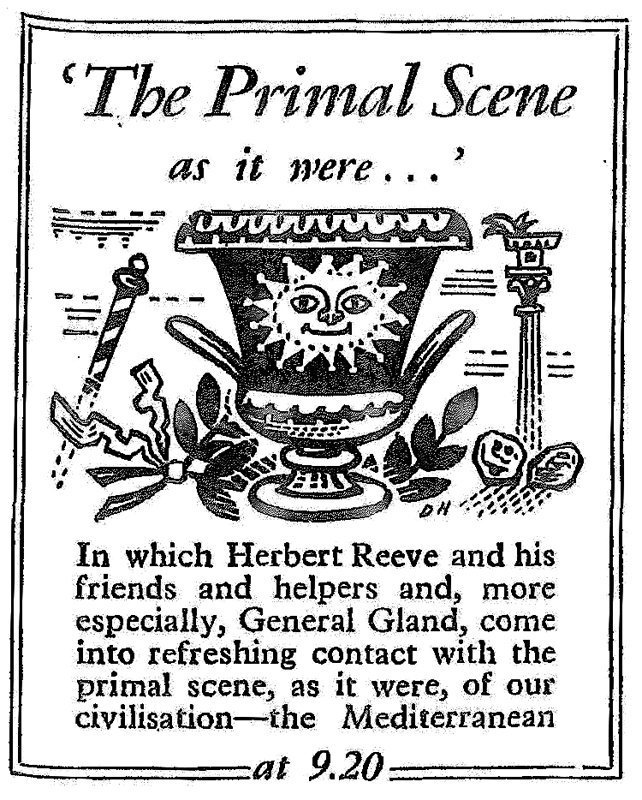
In the early months of 1958, the BBC Third Programme repeated the entirety of Henry Reed's sequence of Hilda Tablet plays—beginning with a 1953 recording of A Very Great Man Indeed—in anticipation of Reed's latest (and advertised as the last, but ultimately the penultimate) entry, The Primal Scene, As It Were.
Reed wrote a short re-introduction for the Radio Times on February 7, 1958, to give thanks and credit to the actors and musicians who brought the characters to life in his most famous and most listened-to of radio plays. He has special mention for Hugh Burden, Mary O'Farrell, the music of Donald Swann, Carleton Hobbs, and Deryck Guyler.
The Primal Scene takes place in the Mediterranean, and if I remember correctly, is the result of BBC paying for Reed's holiday to Athens and Greece, in order to research an historical play set in ancient Mycenae.
 Without the Actors . . .
Beginning on Thursday with 'A Very Great Man Indeed,' the Third Programme is to revive all the Henry Reed satires. The author contributes this preface
I HAVE been told that there was once a Derby winner who was heard, in a moment of morbid self-questioning, to observe: 'Without the horse, I doubt if I could have done it.' I am not given to this kind of introspection myself and among the actors who appear in the Herbert Reeve scripts, there is none that resembles, in any respect, a horse. But I am bound to confess that the tormented jockey's remark always comes to my mind whenever people say that they have enjoyed these programmes, since, apart from the first script, A Very Great Man Indeed, they all derive directly from the performances of the actors.
I think all of us concerned with that early piece enjoyed doing it. But for some time after, I was myself so much haunted by the realistic and touching intensity with which Hugh Burden and Mary O'Farrell had enacted the scene at Hilda's piano that I found myself wistfully craving to know exactly what happened afterwards. This, and nothing else, led to The Private Life of Hilda Tablet. (The word 'composeress' has been objected to in connection with Hilda; but it seems an innocent enough counterpart to the word 'paintress.')
Hilda's music had been potently realised by Donald Swann. It was Mr. Swann's devotion to Hilda, his voluminous invention on her behalf, and a certain gleam that always appeared in his eyes whenever she was mentioned, that led to the programme about her opera, Emily Butter. It was by this time felt that more might profitably be said by Carleton Hobbs on the subject of Stephen Shewin. It was said in A Hedge, Backwards, which was billed as the last of the series, We had not however counted on Deryck Guyler's General Gland, who seemed to call for profounder acquaintance. This has led to a new programme The Primal Scene, as it Were . . . , which will be broadcast next month. I think I may safely promise that this will be the end of Herbert Reeve, The title is a quotation from the piece itself, and refers to the Mediterranean.
|
1537. Radio Times, "Full Frontal Pioneer," Radio Times People, 20 April 1972, 5.
A brief article before a new production of Reed's translation of Montherlant, mentioning a possible second collection of poems.
|
A lovely little article on the current radio offerings for May, 1955, from the Literary Guide's "On the Air" column, by Philip Dalton. Discovered quite unexpectedly, using the extra morning hour afforded me by the ending of Daylight Saving Time (Summer Time, to *you* people). Among other nice things, Dalton laments that Reed's plays are consigned to the Third Programme, and not repeated on the Home Service.
Includes Henry Reed's official BBC headshot, taken circa 1950, when he was 35 years old (badly scarred in this microfilm scan):

On the Air
Covering the month's broadcasting and noting programmes to come, this radio commentary will in future be a regular feature
by PHILIP DALTON
Vastly Entertaining
Most of our poets or any reputation have written for the radio, even if few have made their' reputations on it. Louis MacNeice is better known to a wide audience than be might have been, but it is Henry Reed who has become almost completely identified with the microphone. It is almost ten years since he wrote 'Noises' and since then he has produced about seventy talks and thirty commissioned features. He has been prolific, diverse and, to my mind, almost always vastly entertaining, and he is certainly entitled to what we might call his 'benefit'—a series of revivals of some of his most popular pieces which has been running throughout April. Among these re-broadcasts were 'Return to Naples' (April 5), 'A By-Election in the Nineties' (April 11), 'The Streets of Pompeii' (April 21), and we shall hear 'Moby Dick' again on April 29. All these are Third programme offerings, although for Reed's sake I would like to have seen some of them broadcast on the Home Service: they could baffle no one. The Literary Guide has an interesting history, starting out in 1885 as Watt's Literary Guide (sort of propaganda for free-thinkers and the science-minded), and changing to the Humanist in 1956. Still published by the Rationalist Association as the New Humanist.
|
1536. L.E. Sissman, "Late Empire." Halcyon 1, no. 2 (Spring 1948), 54.
Sissman reviews William Jay Smith, Karl Shapiro, Richard Eberhart, Thomas Merton, Henry Reed, and Stephen Spender.
|
From the Radio Times for February 27, 1969, a blurb from Henry Reed's long-time producer, Douglas Cleverdon, regarding the rebroadcast of Reed's Hilda Tablet cycle after the death of actress Mary O'Farrell:
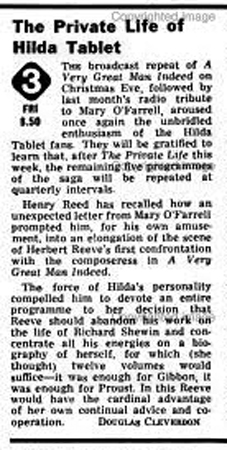 The Private Life of Hilda Tablet
The broadcast repeat of A Very Great Man Indeed on Christmas Eve, followed by last month's radio tribute to Mary O'Farrell, aroused once again the unbridled enthusiasm of the Hilda Tablet fans. They will be gratified to learn that, after The Private Life this week, the remaining five programmes of the saga will be repeated at quarterly intervals.
Henry Reed has recalled how an unexpected letter from Mary O'Farrell prompted him, for his own amusement, into an elongation of the scene of Herbert Reeve's first confrontation with the composeress in A Very Great Man Indeed.
The force of Hilda's personality compelled him to devote an entire programme to her decision that Reeve should abandon his work on the life of Richard Shewin and concentrate all his energies on a biography of herself, for which (she thought) twelve volumes would suffice—it was enough for Gibbon, it was enough for Proust. In this Reeve would have the cardinal advantage of her own continual advice and co-operation. Douglas Cleverdon
|
1535. Reed, Henry. "Talks to India," Men and Books. Time & Tide 25, no. 3 (15 January 1944): 54-55.
Reed's review of Talking to India, edited by George Orwell (London: Allen & Unwin, 1943).
|
In 1950 and 1951, there was a series of broadcasts on the BBC's Home Service, produced by Brandon Acton-Bond, wherein three travellers would make the same journey separately, and record their impressions.
There were four programs, in all: " Pictures of a Road: Coleford to Newnham through the Forest of Dean" (June, 1950, with Audrey Russell, Henry Reed, and Ralph Wightman); " Pictures of a River: The Dart from Dartmouth to Totnes" (August, 1950, William Aspden, Georgie Henschel, and Johnny Morris); " Pictures of a Railway Journey: Plymouth to Princetown" (May, 1951, Georgie Henschel, Ralph Wightman, and Johnny Morris); and " Pictures of a Ferry-Boat Journey: Lymington to Yarmouth (Isle of Wight)" (June, 1951, Audrey Russell, Charles Causley, and Brian Vesey-Fitzgerald).
The first program, broadcast on Sunday, June 18, 1950, was apparently not well-received by the locals. It featured Audrey Russell, Ralph Wightman, and Henry Reed walking through the Forest of Dean from Coleford to Newnham, and resulted in this criticism of their reporting in the Gloucester Citizen for June 22, 1950:
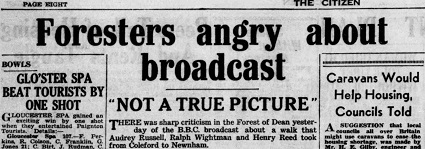 Foresters angry about broadcast
"NOT A TRUE PICTURE"
THERE was sharp criticism in the Forest of Dean yesterday of the B.B.C. broadcast about a walk that Audrey Russell, Ralph Wightman and Henry Reed took from Coleford to Newnham.
"If the purpose of the broadcast was to convey a true picture of the district they traversed," said the vicar of St. Stephen's, Cinderford (the Rev. D .R Griffiths) in an interview, "then the descriptions given were very unfiar and misleading."Henry Reed said that when he got into sight of Cinderford he found stretching out in front of him for miles a place of 'grey and pink hideousness.' We can allow poets to indulge in any amount of license, but to use 'hideous' as a term of Cinderford is an exaggeration. "Ralph Wightman said that St. Stephen's Church is just as 'Victorian and ugly as the huge chapels in the main street! Mr. Wightman doubtless knows a lot about pigs, poultry and sheep, but we cannot take his judgment on church architecture as possessing any value. The church was built just over 60 years ago, designed by a fine architect named Lingen Barker. The design was approved by the Ecclesiastical Commissioners Building Board of that time which had a panel of 13 architects. St. Stephen's church cannot be described as beautiful, but it is not ugly."
Said Henry Reed of Coleford "I didn't think Coleford had looked after itself very well. The cottages on its outskirts were horribly dilapidated; its church tower had no church; the little Town Hall, with its blue egg cosy on top, was one of the oddest buildings I've ever seen. I was only persuaded that it WAS the Town Hall by the backs of five uncomfortable-looking chairs in a first floor bow window."
Audrey Russell noticed that when the town clock struck the hour the hands were two minutes to.Said Mr. C. E. Gillo (chairman of the Coleford Parish Council): "The Forest of Dean has suffered at the hand of the B.B.C. I am tired of people coming here and running down the place. We are painfully aware of the lack of amenities and the ugly blots, but the Forest of Dean has suffered years of industrial depression and was often governed by men with a retarded outlook. "We are now trying to catch up on what we have lost. We are not helped by those who come here and condemn. It is grossly unfair to be measured by what might be called the municipal yardstick."
Imagine my delight, when perusing the travelled route through Google Street View, to find that Coleford's church tower still has no church.
|
1534. Reed, Henry. "Radio Drama," Men and Books. Time & Tide 25, no. 17 (22 April 1944): 350-358 (354).
Reed's review of Louis MacNeice's Christopher Columbus: A Radio Play (London: Faber, 1944).
|
In the Spring, 1972 issue of the journal of the Society of Teachers of Speech and Drama there appears an argument for the release of recordings of Henry Reed's radio plays. Jane Gregg reviews two collections of Reed's plays produced for the BBC Third Programme, published in 1971 by BBC Publications: Hilda Tablet and Others: Four Pieces for Radio, and The Streets of Pompeii and Other Plays for Radio.
Gregg calls the Hilda Tablet plays "the funniest and most sustained piece of social comedy written for radio," and expresses concern over the ephemeral medium of "aural" art such as radio, arguing that Reed's plays should get the same treatment as Dylan Thomas' Under Milk Wood, and be released as recordings.
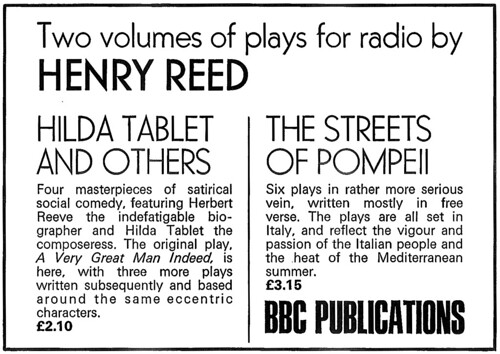
Hilda Tablet and Others — four pieces for radio
by HENRY REED. BBC: £2.10.
The Streets of Pompeii and other plays for Radio
by HENRY REED. BBC: £3.15.
All Third Programme listeners please note that the plays of Henry Reed you so enjoyed between 1949 and 1958 are now in print—a permanent memorial of the radio drama which otherwise has no permanent life.
As Reed says in a most interesting foreword to The Streets of Pompeii, 'They were not for the most part written with any idea that they might appear in print. When it was suggested that they should, I was naturally delighted: it seemed to imply that they had not entirely gone in one ear and out of the other'.
I have just taken up knitting and when reading the pattern I have tried to visualise the finished article. Possibly knit two together through back loops creates a picture for the experienced knitter but even so it remains for most of us simply a code. In the same way the printed word is a poor substitute for radio drama. 'Cross-fade rapidly' needs a great deal of aural imagination.
Hilda Tablet and Others consists of four pieces from what many regard as the funniest and most sustained piece of social comedy written for radio. They are A Very Great Man Indeed, The Private Life of Hilda Tablet, A Hedge, Backwards, and The Primal Scene, as it were. The productions were all by Douglas Cleverdon, with music by Donald Swann and the casts include most of the great BBC repertory names: Hugh Burden, Carleton Hobbs, Gwen Cherrell, Mary O'Farrell, Marjorie Westbury . . . (dear Marjorie Westbury as Steve in Paul Temple — there's nostalgia for you) . . . the list is endless and very well-loved. The plays arise out of the research by Reed's alter-ego Reeve into the life of Richard Shewin, novelist.
The Streets of Pompeii on the other hand contains those plays which have Italian themes and settings. They are Leopardi in two parts: The Unblest and The Monument; The Streets of Pompeii, Return to Naples, The Great Desire I Had, and Vincenzo. Again the productions were by Douglas Cleverdon with a cast which sounds like Who's Who in Radio.
The BBC are of course quite right and to be commended for publishing Henry Reed's radio plays but now, before they disappear aurally altogether, may we have them recorded? After listening to the record of Under Milk Wood recorded by Argo with the cooperation of the BBC, I am convinced that there is a market for radio plays on record.
JANE GREGG. I note with some dismay that a quick search of the British Library Sound & Moving Image Catalogue reveals no recordings of A By-Election in the 'Nineties (1951), The Great Desire I Had (1952), A Hedge, Backwards (1956), The Primal Scene, As It Were (1958), or Musique Discrète (1959). Perhaps, however, the current Save Our Sounds project might turn a few up.
|
1533. Friend-Periera, F.J. "Four Poets," Some Recent Books, New Review 23, no. 128 (June 1946), 482-484 [482].
A short review calls A Map of Verona more pretentious than C.C. Abbott's The Sand Castle; influenced by Eliot, Auden, MacNeice, and Day Lewis.
|
Online since October 2014, the BBC Genome project contains the text of program listings in the Radio Times from 1923 through 2009.
The search function at the top of the page allows keyword (and advanced) searching, as well as browsing by service, year, and issues in pull-down menus.
The search result for " Henry Reed" yields 1,013 results (many belonging to a popular band leader of the same name), but setting limits in the advanced options for "Radio only" brings us to Reed's possible first billing, for " New Poems" on August 3, 1944: 'The ninth of a monthly selection of very recent or unpublished poems : "The Jungle," by Alun Lewis , and "Philoctetes," by Henry Reed.'
The listings are OCR text which contain many errors, and there are no images from the original magazines — but the project does allow users to submit corrections (or notice of changes to the original schedule).
Read about the BBC's Genome at the About the BBC blog.
|
1532. Vallette, Jacques. "Grand-Bretagne," Mercure de France, no. 1001 (1 January 1947): 157-158.
A contemporary French language review of Reed's A Map of Verona.
|
This review of the premiere of Reed's second installment in the Hilda Tablet series, The Private Life of Hilda Tablet, appeared 59 years ago today, in The Listener for June 3, 1954. The reviewer was J.C. Trewin (later OBE), drama critic for The Observer for more than sixty years.
I began by typing a few excerpts of Trewin's (and Reed's) best bits. The "best bits" turned out to be the article entire.
 Sound Broadcasting DRAMAAlive and Dead
And now we must have the private life of Stephen Shewin. I can hardly wait for it. Henry Reed, who has discovered these curious people—clearly they have been hovering, in a lather of excitement, to come to the microphone—has just reached the story of Hilda Tablet. A very fine story it is. When it appears in print, if poor Herbert Reeve is still alive, it will run into twelve volumes—though that, as Reeve murmured in the plaintive, melancholy-desperate tones of Hugh Burden, must be years and years ahead. Years and years.
You must forgive me. I may be talking to myself, and you may not have met these people. I hope you have. It is eight months since Henry Reed, in the Third, has had his joke at the expense of the conscientious, burrowing biographer. The resolute Reeve looked for the facts beneath the work of the 'poets' novelist', Richard Shewin, and, in the course of his researches, he met the most extraordinary bevy of personages on and around the comic literary fringe. At the time I liked the 'composeress' Hilda Tablet. Now Herbert, even fainter than before, but still pursuing, has saddled himself with another assignment.
The title, 'The Private Life of Hilda Tablet' (Third Programme), says just what has happened. In seeking Shewin, poor Reeve has found Hilda coiling herself furrily about his neck. He is hers forever, and it is going to be a ticklish journey. As someone observes, it needs tact to write the biography of a living subject. And Hilda is living. Undeniably. Her all-woman opera, 'Emily Butter', 'embraces the whole of music'; she has written a quintet for eight instruments ('a lot of instruments for a quintet, I freely grant you'); and she seems to have a passion for adding to her works: at least, to works about her. The idea is simple when it begins: 'A couple of fellows called Faber and Faber are after my life—only 350 pages by this autumn'. But, a few months on, she has resolved, and Herbert has agreed—could he have done otherwise?—that the biography shall be in twelve volumes. It has to have Epic Scope (no doubt Cinemascope as well, if things go much further).
Once more, Mr. Reed has written with the sharpest, wittiest point. Some of his people are old friends; I plead—see first sentence—for a third installment on Stephen Shewin, who still lives, with his wife, in the cat-filled house, shooting his phrases (thanks to Carleton Hobbs) like poison-tipped arrows. But there are new pleasures also. We meet the librettist, who finds Hilda a trifle vexing. Has she not changed the original story of 'Emily Butter', set in the sixteenth century on a boat anchored off Rimini, to something about the bargain basement of a department store? Then there is the Vicar of Mull Extrinseca ('We rub along, you know'), who is delighted that Hilda's embalmed feet are to preserved in the church—in due course. There is the Duchess who begins every sentence with 'One wonders', and who can wonder with surprising effect. There is the Viennese singer who has not yet said 'Goodnight Vienna', though all her attempts are thwarted.
And there is always, and massively, our old acquaintance Hilda herself (Mary O'Farrell), to explain that 'Music fell for me; I was flirting with architecture at the time', or else that she is neither the marrying sort of girl nor a girl who easily offended. 'Please don't mind my saying it', she begins briskly, and at once a storm-cone is hoisted. Mr. Burden is a dolorous joy: then, most of this effort is a joy, though I think Hilda's speech to her old school goes on too long at the end. We know her reasonably well by then, and some of her effects are expected.
Still, the 'Life', which was produced by Douglas Cleverdon, is a cheerful find for what Mr. Reeve-Burden calls 'the ever-admirable Third Programme'. Now let us have a few more poisoned arrows from Stephen Shewin. And his wife, I am sure, can be helpfully elaborated.
[pp. 983-984]
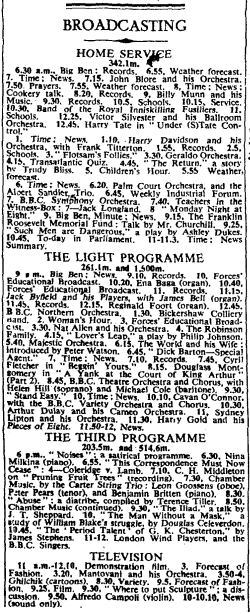
The Private Life of Hilda Tablet was followed by Emily Butter (1954), A Hedge, Backwards (1956), The Primal Scene, As It Were (1958), Not a Drum Was Heard (1959), and Musique Discrète (1959). The plays were collected (not including Emily Butter) in Hilda Tablet and Others: Four Pieces for Radio (British Broadcasting Corporation, 1971). Because of the poor quality of my Listener scan, I have illustrated this post with a picture from the Radio Times for Musique Discrète.
|
1531. Henderson, Philip. "English Poetry Since 1946." British Book News 117 (May 1950), 295.
Reed's A Map of Verona is mentioned in a survey of the previous five years of English poetry.
|
In 1971, the BBC issued two collections of Henry Reed's plays for radio: Hilda Tablet and Others: Four Pieces for Radio, and The Streets of Pompeii and Other Plays for Radio. The Hilda Tablet volume collects the plays A Very Great Man Indeed (1953); The Private Life of Hilda Tablet (1954); A Hedge, Backwards (1956); and The Primal Scene, As It Were (1958), including restoration of some "indelicate" scenes which had been censored or changed for broadcast.
To mark the publication of the plays, Reed was interviewed by Christopher Ford for an article in the Guardian, " The Reeve's Tale" (Herbert Reeve was the bumbling biographer in the Tablet plays, you see). A retrospective of the plays and their broadcasts, the article features this wonderful photograph of Reed (poorly scanned, sadly), taken by staff photographer Peter Johns:
Reed's quotes for the article amount to just a few paragraphs. Prodded about rumored accusations of libel from (the unnamed) composer Elisabeth Lutyens for his Hilda Tablet character (voiced by Mary O'Farrell), Reed deflects:
As long as the characters are funny it doesn't matter who you're getting at.... In fact I'm not 'getting at' anyone, only myself—there's a good deal of aboriginal Hilda Tablet in me.
The big revelation in the article is that Reed was actually working on an eighth Hilda Tablet script as late as 1968 (in his dedication for Hilda Tablet and Others, Reed says "Altogether, they totalled seven. The number is sometimes given as nine; but people exaggerate"):
I was writing another, it was going to be called 'After a Certain Age'—I was writing it one night and the next morning Douglas Cleverdon, the producer, came round for some other reason and had to break the news that Mary O'Farrell was dead. She was a sine qua non. So it was never completed, but Hilda was going to be the reason why Skalkottas had suppressed his music all his life. We were going to be make out that this was on Hilda's advice.
Mary O'Farrell died on February 10, 1968, more than eight years after the last play in the Hilda Tablet saga, Musique Discrète.
The article closes with a hilarious anecdote of Reed still having trouble coming to terms with his place in the canon of literature and broadcasting, even at the age of 57:
I saw the Penguin Dictionary of Modern Quotations in a shop. I remember thinking 'I've got 150 sleeping tablets at home, and if I'm not in that I'll take some of them with a large Pepsi-Cola.'
Ford reports more than three columns were devoted to Reed in the 1971 edition.
|
1530. Radio Times. Billing for "The Book of My Childhood." 19 January 1951, 32.
Scheduled on BBC Midland from 8:15-8:30, an autobiographical(?) programme from Henry Reed.
|
Henry had a cameo appearance on BBC Radio 3's Composer of the Week yesterday, in which Donald Macleod presented a history of musical fictions and hoaxes, " Unbelievable Spoofs." Well, not a cameo by the Old Man himself, but one of the plays from his Hilda Tablet series:
With the help of silent film accompanist Neil Brand we meet such dubious figures as Bolognese theatre composer Lasagne Verdi, famously submitted (and nearly printed) in the music world's most trusted encyclopedia, served for good measure with an accompaniment of Pietro Gnocchi. There's a chance to hear the music of Pietro Raimondi, the man who composed three oratorios to be performed simultaneously, centuries before Charles Ives conceived of such an adventure. Avant-garde composers reemerge from the BBC archive too, including Hilda Tablet whose 'reinforced concrete music' found its way into the repertory of Covent Garden in the 1950s. Plus a bizarre encounter with the man said to be a reincarnation of Merlin and Francis Bacon, variously described as a courtier, adventurer, charlatan, inventor, alchemist, pianist, violinist and amateur composer. But did he really exist? You'll have to make up your own mind.
Here, Mr. Macleod introduces a clip from Reed's satirical, all-female opera, Emily Butter (1954), ostensibly written by the twelve-tone composeress Hilda Tablet, supposedly performed at the Royal Opera House. This bit is "I Have a Little Mark On My Left Upper Arm":
Mr. Macleod says the performers are "unnameable," but Emily was, of course, famously voiced by Marjorie Westbury. Here is the 1960 Times "interview" with Dame Hilda, which is mentioned. The music for Emily Butter was written by the incomparable Donald Swann, and orchestrated by Max Saunders. Read The Times review of the original BBC Third Programme broadcast, from November 15, 1954.
Follow this link to listen to " Unbelievable Spoofs" in its entirety, until March 25. Thanks to the folks at the Friends of Radio 3 forums for leading me to this broadcast!
|
1529. Sackville-West, Vita. "Seething Brain." Observer (London), 5 May 1946, 3.
Vita Sackville-West speaks admirably of Reed's poetry, and was personally 'taken with the poem called "Lives," which seemed to express so admirably Mr. Reed's sense of the elusiveness as well as the continuity of life.'
|
Did you know Henry Reed's play, Return to Naples, was part of the same radio series that produced Dylan Thomas's Return Journey to Swansea?
According to Peter Lewis, in his chapter on Dylan Thomas in British Radio Drama (Drakakis, ed., 1981), "The Radio Road to Llareggub," the feature series Return Journey consisted of twenty-four episodes broadcast on the Home Service and Third Programme between 1945 and 1951 (p. 92). In The Growth of Milk Wood (1961), Douglas Cleverdon says the series was originally devised by the BBC Features Department
in order to lure writers of distinction into the radio field; they were commissioned to return to their native town, or to some other place that had powerful associations for them, and to write a programme about it, in the form of a semi-autobiographical talk interspersed by dramatized flashbacks, extracts from journals, actual recordings—anything, in fact, that might illuminate the theme. [p. 15]
Scanning the broadcasting schedules in The Times for those years finds these episodes:
- Eric Linklater to the Orkneys (October 31, 1945)
- John and Rosamond Lehmann on the Isle of Wight (April 13, 1946)
- Palace Court, Bayswater, revisted by Sir Francis Meynell and Viola Meynell (September 2, 1946)
- V.S. Pritchett, Return to the Fells (October 13, 1946)
- Edward Sackville-West to Knole (April 9, 1947)
- Dylan Thomas to Swansea (June 15, 1947)
- Stevie Smith to Syler's Green (August 5, 1947)
- Rayner Heppenstall to Strasbourg (September 16, 1948)
- Sean O'Faoláin to Cork (November 20, 1948)
- Christopher Sykes to Berlin (February 19, 1949)
- Henry Reed, Return to Naples (August 17, 1950)
W.R. Rodgers apparently also wrote for Return Journey, though I can't find the title. Mountpottinger, Belfast, perhaps? Several programs were produced by Stephen Potter, and the series was originally conceived by R.D. "Reggie" Smith.
|
1528. Manning, Hugo. "Recent Verse." Books of the Day, Guardian (Manchester), 31 July 1946, 3.
Manning feels that 'Mr. Reed has worn thin much of his genuine talent in this direction by too much self-inflicted censorship.'
|
This evening, I'm reading Reed's old "Radio Notes" columns from the New Statesman, scanning for any personal information he might have let drop, in passing: vital clues to his haunts and hangouts, friends and visits, or activities. Here, for example, on October 25th, 1947, we learn he has been to see the controversial "Exhibition of Cleaned Pictures" at the National Gallery ("I wish that he [the director, Philip Hendy] could be allowed to appeal for funds which might help in getting the muck off some of the others"). On December 20th, Reed reports having recently attended a performance of Carrisimi's "most dramatic and beautiful work," the oratorio Jefte (at the Umbria Sacred Music Festival, possibly, in Perugia, Italy, the previous September?).
Then, in this last paragraph of the column for January 24th, 1948, there appears a paramount of name-dropping, blandishment, and cleverly phrased self-congratulation:
Second Opinion, discreetly and amiably presented by Mr. Frank Birch, has made an excellent and entertaining beginning. The proceedings opened with a postcard from Mr. Bernard Shaw about a discussion of Paradise Lost in which I had myself been privileged to take part. Modesty restrains me from divulging on whose side Mr. Shaw seemed to have been; what genuinely moved me was the thought that one's own humble mumblings had reached those ears at all. I have felt no comparable emotion since I gave up prayer. [p. 70]
Between October and December of 1947, the BBC's Third Programme broadcast an eleven-part dramatization of Paradise Lost, produced by Douglas Cleverdon, who cast Dylan Thomas in the role of Lucifer. The program was not well-received, and reviewing it for his December 6th "Radio Notes" (.pdf), Reed was forced to invent the term "inauscultable" to adequately describe his disappointment:
New arts demand new words, and in its short day the radio has given us many, not always beautiful. Seeking during the last few weeks to compound a necessary word that should be at once inoffensive in sound, clear in meaning and traditional in formation, I have met with a philological difficulty. The transitive Latin verb auscultme, to listen to, hearken to, give ear to, produces in English the two verbs 'to auscult' ( rare) and 'to auscultate,' the latter being familiar in medicine. Normally I would not wish to have truck with such words; the wireless I would either listen to, or switch off. It was some such word as inauscultable or inauscultatable that I wanted. After careful consideration of the rival claims of medicine and radio, I venture to suggest that inauscultatable be reserved for those organs inaudible even to the stethoscope, and that inauscultable be dedicated to such radio-programmes as Paradise Lost, which has now been going on for seven weeks, and has been more or less unlistenable-to from the very start. [p. 449]
Thomas's performance was a particular sore spot: "Week after week," Reed says, "we have had the voice of Dylan Thomas coming up like thunder on the road to Mandalay; rarely can such gusty intakes of breath have passed across the ether."
The new series which received a postcard from George Bernard Shaw, Second Opinion, was a show of audio letters-to-the-editor, consisting of correspondence from listeners concerning the Third Programme's talk and discussion programming. Following shortly after the final chapter, Reed participated in "An Argument on 'Paradise Lost'," broadcast Sunday evening, January 4th, 1948, which must have been something of an airing of grievances. It sounds as if Reed found, in Shaw's response to the conversation, more than ample vindication for his negative review. You can almost hear him patting himself on the back! I wonder where that postcard is, today. Buried deep in the BBC Archive?
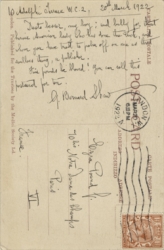
Curiously, the humble postcard seems to have been one of Shaw's preferred methods of communication (Brown University Library exhibit), and he even had personalized cards printed, some with statements of his frequently requested views on such subjects as capital punishment, vegetarianism, and his failure to garner support for a new, 42-character, British alphabet (bottom of this page). Here's a postcard from Shaw to Ezra Pound in 1922, concerning the publication of Joyce's Ulysses (at Indiana University's Lilly Library):
|
1527. Rosenthal, M.L. "Experience and Poetry." Herald Tribune Weekly Book Review (New York), 17 October 1948, 28.
Rosenthal says Reed shares with Laurie Lee 'that unhappy vice of young intellectuals—a certain blandness of which the ever-simple irony is a symptom.'
|
Last Monday on Radio 4, the BBC quiz program Quote... Unquote featured the theme of "Fakes," including a round of quotes from parodies. One question was on the opening lines from Reed's (of course) " Chard Whitlow": what is it parodying? Here's the relevant clip, featuring host Nigel Rees, reader Peter Jefferson, and guest Adèle Geras:
Chard Whitlow on Quote... Unquote
You can listen to the entire show—with additional guests Conn Iggulden, Christopher Luscombe, and Simon Pearsall—on the Quote... Unquote website, until next Monday, when the new program is scheduled to air.
(With thanks to Underbelly.)
|
1526. Blunden, Edmund. "Poets and Poetry." Bookman, n.s., 1, no. 4 (July 1946): 14-15.
Edmund Blunden says Reed's Lessons of the War poems 'have captured something of the time-spirit and ambiguity of the recent war in a style of wit and deep feeling united.'
|
Here's a small, but lovely thing: a record at the British Library Sound Archive for a recording of a birthday tribute for Henry Reed, produced by R.D. "Reggie" Smith, and broadcast on Friday, February 22nd, 1974, from 8:35 to 8:55 pm, on BBC Radio 3:
Henry Reed
Reed, Henry, 1914-1986 (speaker)
Broadcaster: BBC R3 19740222
Item title: Henry Reed
Performer name: Reed, Henry, 1914-1986 (speaker)
Item notes: A tribute on the occasion of the poet's 60th birthday. R.D. Smith introduces the recorded voice of Henry Reed reading his poetry (mostly archive material)
FIND FORMAT: M510W
LIST RECORDINGS: M5127BW
Here's a link to everything with Reed listed as a speaker in the Sound Archive catalog.
|
1525. "Reed, Henry," Publishers Weekly, 152, no. 15 (11 October 1947), 1945.
A note on the publication of the American edition of Reed's A Map of Verona.
|
Henry Reed was the radio critic for the New Statesman and Nation for five months, writing the "Radio Notes" column for the Arts and Entertainment section. Between October, 1947, and February, 1948, Reed's byline appears after seventeen reviews of various music programs, interviews, debates, speeches, and plays.
One such review resulted in a letter to the editor from none other than James Bridie, the Scottish playwright and screenwriter. Among his many film credits, Bridie worked on the scripts for no fewer than three films with Alfred Hitchcock, including The Paradine Case, in 1947.
In his January 31, 1948 "Radio Notes" column, Reed comments on an adaptation of The Bronze Horse, recorded previously and broadcast on Friday, January 16, on the BBC Third Programme:
Dull, verbose and platitudinous as a play, Mr. James Law Forsyth's Bronze Horse was given a production of unparalleled variety and magnificence by M. Michel St. Denis. It set a new standard for radio, and one hopes resident producers will not ignore it, for it suggested space and perspective in a way one had thought impossible on the air. The actors responded to the detailed drilling, and seemed to have overcome that boredom which usually sets in among them if a play is rehearsed for more than a day and a half. Mr. Ralph Truman and Mr. Paul Scofield were outstanding; I hope we may hear more of Mr. Scofield than we have hitherto.
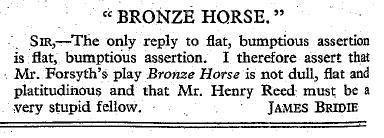
Here is Mr. Bridie's letter to the editor, from the January 31 New Statesman (p. 96):
Bridie obviously held Forsyth in high regard, as a playwright and a fellow Scot. Reed apparently declined to respond. As luck would have it, Bridie's letter appeared on the same day as a letter from Mr. Hans Redlich, to whom Reed did reply.
|
1524. Reed, Henry. Letters to Graham Greene, 1947-1948. Graham Greene Papers,
1807-1999. Boston College, John J. Burns Library, Archives and Manuscripts Department, MS.1995.003. Chestnut Hill, MA.
Letters from Reed to Graham Greene, including one from December, 1947 Reed included in an inscribed copy of A Map of Verona (1947).
|
Henry Reed gave any number of BBC radio talks during the 1940s and '50s, most of which are lost to time. He is not always given credit in the broadcasting schedules of the day, or if he is, his subject is not always named. Some of his book talks are quoted in publishers' advertisements for novels in contemporary journals and magazines, or he may be quoted by another critic in a print review.
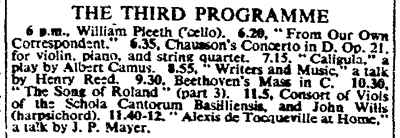
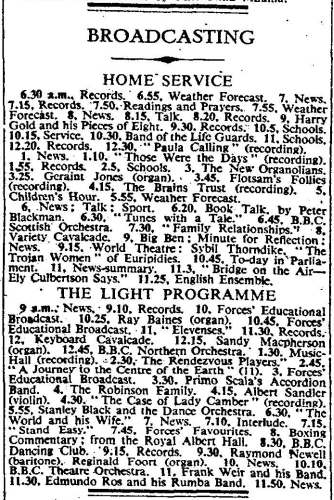
Here we have a record of a talk Reed gave on April 7, 1949, "Writers and Music," from the Times broadcasting schedule:
This talk is mentioned by W.R. Anderson in his "Round About Radio" column in the Musical Times for May, 1949 (p. 161):
Henry Reed, talking about 'Writers and Music', was not concerned with this sometimes nagging pre-occupation. One passage of his might well stand as a whimsical P.S. to our Editor's February thought-stirring article 'On Influence and Borrowing', in which vast ground I beg him, and others, to continue digging. Mr. Reed, whose beginning I missed, was, I take it, imagining the lay author's diversion with various fantasies of himself as a musicologist giving out new truths, or controverting the pestilent heresies of pretentious rivals. Reminiscence-hunting can be as futile as fifth-chasing; but we might have a bit of good writing about the real values of 'influences'. There is plenty of room for a good book dealing, more fully than a general history can, with this admittedly fascinating aspect of history. It is not only in theme or harmony that we can detect similarities; there is style, and the sort of overblown oddness that, one might think, was afflicting a clever man like Holst, in the 'Planets': one of the leading cases, to my mind, in which to exhibit both the stirs and depressions of a fin de siècle upthrust of quite irresistible force. Holst, so original in some ways, was a curious case. We should be given more of his best work; but nobody is served by shutting eyes and ears to the astonishing amount of pastiche in those 'Planets'. He was a strange mixture—in that way the most interesting modern English composer.
So here we have not only have a record of the time, date, and duration of Reed's talk, but also an ostensible review; and yet I still have no idea what Reed was talking about. Which writers, and what music?
|
1523. Reed, Henry. "Simenon's Saga." Review of Pedigree by Georges Simenon, translated by Robert Baldick. Sunday Telegraph (London), 12 August 1962, 7.
Reed calls Pedigree a work for the "very serious Simenon student only," and disagrees with the translator's choice to put the novel into the past tense.
|
In September of 2006, the BBC launched a website to commemorate the 60th anniversary of the launch of the Third Programme (later, Radio 3), with specially-written articles, memories by staff and performers, letters from listeners (both "satisfied" and "disgusted"), and held celebratory broadcasts.
I remember being very excited when I found that the BBC had reproduced the September 27, 1946 issue of the Radio Times, which provided an introduction to the Third, its intentions, and programming.
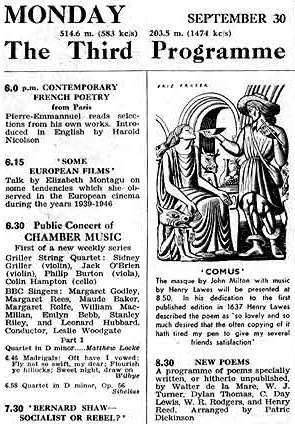
If I had bothered, back in 2006, to look a little more closely, I would have noticed that Henry Reed was scheduled to take part in a reading of new poems by Walter de la Mare, W.J. Turner, Dylan Thomas, C. Day Lewis, and W.R. Rodgers, on September 30, 1946:
The "New Poems" program was arranged by the poet and translator Patric Dickinson, who worked for the BBC from 1942 to 1948. I'm not sure, but I believe Reed may have read his poem "The Forest," which was printed in the Listener on October 17, 1946, titled simply, "Sonnet." W.J. Turner, I'm sorry to say, died shortly after the broadcast, on November 18, 1946.
The entire 28-page issue of Radio Times is available from the BBC as a PDF document.
|
1522. Reed, Henry. "Hardy's Secret Self-Portrait." Review of The Life of Thomas Hardy, by Florence Emily Hardy. Sunday Telegraph (London), 25 March 1962, 6.
Reed says this disguised autobiography is a "ramshackle work," but is still "packed with a miscellany of information not available elsewhere, and readers who care for Hardy will find it everywhere endearing, engaging, and full of his characteristic humour."
|
On the evening of December 24, 1944, the BBC Home Service broadcast an anthology of poetry called a "Poet's Christmas," with readings of new work by Laurie Lee, C. Day-Lewis, and Henry Reed. Reed's selection, "The Return," is a an allegory of remembrance and the Second Coming:
Remember on Christmas Eve, as you stand in the doorway there
And regard us as strangers, the forgotten love we bear,
And shall bear it always over the frozen snow
When the door is shut again, and once again we go.
The souls of the forgotten, for whom there is no repose
When the music begins again, and again the doors close,
For whom a thought of yours would come the length
Of a whole dark hemisphere to give us strength. The "Poet's Christmas" was printed in The Listener on December 28, 1944 (.pdf). "The Return" was not entirely well-received by later critics, including G.D. Klingopulos, who called it 'facile and unfocussed' ( Scrutiny, Summer 1946), and William Elton, who described it as a 'hurdy-gurdy of sentiment' ( Poetry, June 1948). The Christmas Eve broadcast, however, drew the attention of none other than the novelist E.M. Forster, who composed a letter to Reed that very night in order to commend the poem. Two copies of Forster's letter exist: one in Forster's papers at King's College, Cambridge; the other with Reed's papers at the University of Birmingham. The letter is noted in Birmingham's description of the Papers of Henry Reed (Archives Hub):
Unfortunately, Reed did not keep the correspondence he received; although, interestingly, the collection does contain a photocopy of a letter written to Reed by E. M. Forster and praising Reed's poem The Return which was broadcast on BBC radio on Christmas Eve 1944. To have kept the letter Reed must have highly valued Forster's praise.
In the Collected Poems of Henry Reed, Jon Stallworthy provides the following annotation for "The Return," which quotes from Forster's letter:
E.M. Forster, hearing this Christmas Eve poem on the BBC Home Service on 24 December 1944, wrote to the author the same evening of the poem's connection with 'the idea that the only reality in human civilization is the unbroken sequence of people caring for one another: an idea, Forster said, which 'cannot be prettified into reciprocity or faithfulness, nor is there any such prettification in your poem'. A photocopy of Forster's holograph letter was preserved among HR's papers. (p. 157)
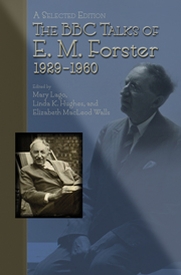
I had long thought that this was the first (and only) notice Forster had taken of Reed, until the recent publication of a collection Forster's radio scripts, The BBC Talks of E.M. Forster, 1929-1960: A Selected Edition (Mary Lago, Linda K. Hughes, and Elizabeth MacLeod Walls, eds., University of Missouri Press, 2008).
Between 1928 and 1963, E.M. Forster gave 145 talks for BBC radio, on literary topics ranging from Tolstoy's War and Peace, to contemporary Indian novelists writing in English. No fewer than 77 of Forster's talks were broadcast in India on the BBC's Eastern Transmission service. Forster, in fact, preferred the Overseas Services, as his talks were less subject to censorship (though still tightly controlled), and during the Second World War many of his India broadcasts were repeated in Africa, North America, and the Pacific (see B.J. Kirkpatrick's bibliography, "E.M. Forster's Broadcast Talks," Twentieth Century Literature 31, nos. 2-3, [Summer/Autumn 1985]: 329-341).
The BBC Talks reproduces the script of a wireless broadcast Forster gave as part of his monthly series "Some Books," in which he reviewed new books which would be of interest to English-speakers in India. Delivered on April 1, 1942, this particular review deviated from Forster's regular preference for prose, and was devoted to recent poetry. He recommends several new anthologies: The Little Book of Modern Verse (Anne Ridler, ed., Faber and Faber, 1941); Modern Verse, 1900-1940 (Phyllis Jones, ed., Oxford University Press, 1941); The Best Poems of 1941 (Thomas Moult, ed., Johnathan Cape, 1942); and Poems from the Forces (Keidrych Rhys, ed., Routledge, 1941).
Additionally, Forster suggests, '[I]f you take in the BBC periodical "The Listener," be sure you read the poems which appear in its pages: they are usually poems by the youngest generation, and I shall quote from one of them — Henry Reed's "Map of Verona" in a moment' (p. 179). Forster reads from two poems: George Barker's "To Robert Owen" (1939), and then from "A Map of Verona," which first appeared in The Listener on March 12, 1942 (.pdf):
It is a subtle haunting dream which has nothing to do with the war or with any practible peace. It plays with the idea of a map of an unvisited city, which we brood over, and upon which our imagination feeds...[.]
He has visited Naples once, after similar brooding, and knows that a map of a city cannot reveal a city, but his thoughts are of Verona now, and all his talk envisages her, and leads towards her...[.]
The Verona of this poem is not an enemy town, in Mussolini's possession, but a city of the heart, a possession of the imagination. The poem is personal, and since poetry, whether written by the old or the young, should be an individual expression, I am glad to conclude with it. (pp. 181-182)
There is an unfortunate but all-too-familiar postscript to this story. The notes for the April, 1942, "Some Books" broadcast indicate that the original typescript had the poem's author written as "Henry Green", and while Forster's BBC typist was known for making mistakes based on his handwriting, and Forster frequently improvised from his finished scripts, it seems unlikely the error was noticed before being aired. Forster even makes a point in his introduction that "Henry Green" is not to be confused with the critic, Herbert Read! Despite the misattribution, Forster's selection of Reed's poem is an estimable endorsement.
The BBC Talks of E.M. Forster was reviewed in The New York Review of Books, on August 14, 2008.
|
1521. Reed, Henry. "Leading a Dance." Review of Fokine: Memoirs of a Ballet Master, translated by Vitale Fokine. Sunday Telegraph (London), 26 November 1961, 6.
Reed finds Fokine's memoirs "very absorbing and intelligent."
|
Well, Hardy boys and girls, as with most things in life, the solution to yesterday's mystery would have been easily reached, had I simply paid better attention in math class. Or trusted in the radio times tables published in The Times.
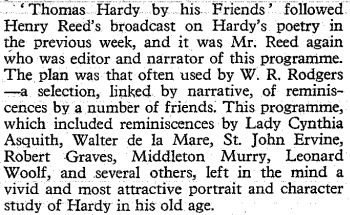
There is no great mystery: Henry Reed's radio tribute to Thomas Hardy was broadcast as advertised, on Sunday, February 20th, 1955, on the BBC Home Service, at 10:05 pm. Gibson's book had the date wrong, and I had mistakenly read "10.5" as 10:50, not 10:05. The Times, in their grand crusade for brevity and clarity, simply outsmarted me (not difficult to do, apparently). The program ran 47 minutes, until 10:52 pm. Here is the mention from The Listener's " Spoken Word" (.pdf) column for March 3rd, by Martin Armstrong:
(p. 399)
The clue to figuring this all out lies in that the seemingly ambiguous time references in The Listener. They're not ambiguous; they're rock solid. This Listener came out on Thursday, March 3rd, but covered broadcasting from Sunday, February 20th to Saturday, February 26th. Reed's 'broadcast on Hardy's poetry' falls in 'the previous week', even though it was broadcast only one day before "Thomas Hardy: a tribute from his friends."
Here is Armstrong's review of " The Poetry of Thomas Hardy: a study by Henry Reed," (.pdf) from The Listener of February 24th, 1955:
Thomas Hardy was a great English poet, but he wrote poetry as well as prose, or rather prose as well as poetry. On the previous evening Henry Reed gave an hour's discourse, with copious illustrations read by Mary O'Farrell, Michael Hordern and James McKechnie, on 'The Poetry of Thomas Hardy'. Listening to Mr. Reed I sometimes feel that I am back in the old classroom under the eye of one of the sterner and more intelligent of my schoolmasters and that if I were to venture a giggle or an independent view I would receive a disapproving glance. Nevertheless I enjoy myself and am the better for my lesson. Mr. Reed presented Hardy's poems in the light of his history, and this approach considerably enhanced one's appreciation of them. He suggested that a new edition of the poems is needed in which they run parallel with the biography—an admirable notion, it seems to me, but one that would involve a herculean job for its editor. The poems were excellently read by all three readers. Mary O'Farrell proved, if proof were necessary, that she is one of the two best women readers of poetry on the B.B.C. (p. 355)
Reed once had hopes of writing a biography of Hardy, and worked on this book on and off from the mid-1930s until the 1950s, when he finally gave in and gave up. These two, short broadcasts were the only tangible result of his 20 years of devotion and labor, his life's work. I sometimes also feel I am under the stern and disapproving eye of Mr. Reed, though sometimes, when I solve some particularly confounding problem, I feel him give me a wink.
|
1520. Reed, Henry. "Shocked into Life." Review of The Empty Canvas, by Alberto Moravia, translated by Angus Davidson. Sunday Telegraph (London), 19 November 1961, 7.
Of Moravia's most recent novel, Reed says "there is something unquestionably heroic about the whole enterprise."
|
 I'm sitting on a million-dollar idea. It's going to be the next Harry Potter, let me tell you. It's a Hardy Boys book, except instead of featuring boring old Frank and Joe, it chronicles the adventures of Thomas Hardy and his younger brother Henry: Tom and Hal Hardy, teenage sleuths in Victorian Dorset. Or maybe their adventures take place just before the publication of Tess of the d'Urbervilles. That would be contemporary to Sir Arthur Conan Doyle, and then Henry could play Dr. Watson to Thomas' Holmes, I can't decide. The Mystery of the Madding Crowd. The Clue Under the Greenwood Tree. A million bucks, I'm telling you.
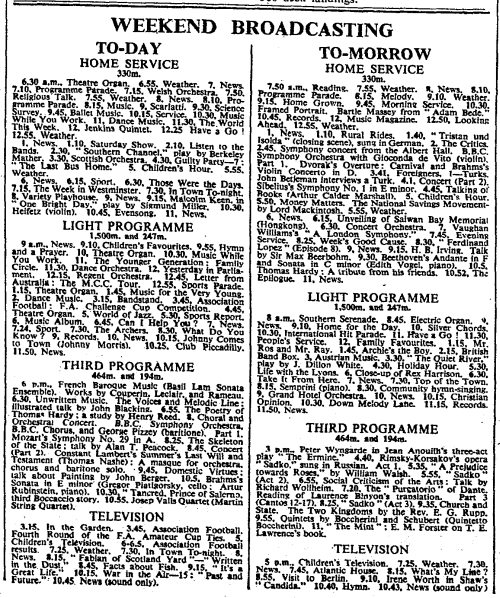
Maybe the Hardy boys could puzzle out this riddle: The Secret of the Two Radio Shows. In his chapter in British Radio Drama (John Drakakis, ed., 1981), " The Radio Plays of Henry Reed," Roger Savage mentions that in the 1950s, Reed presented "an anthology of recorded memories for the BBC called Thomas Hardy: A Radio Portrait by His Friends, observing that it is 'characteristic of a great deal of utterance on Hardy' that 'people prefer... to talk at length about themselves'" (p. 180). The Times' broadcast schedule for February 19th, 1955, lists two programs on Hardy that weekend (click for full size):
Under "To-day" (February 19, 1955), for the Third Programme: " 6.55, The Poetry of Thomas Hardy: a study by Henry Reed." Then, for "To-morrow" (February 20), there is listed on the Home Service: " 10.5, Thomas Hardy: A tribute from his friends." Which is the portrait mentioned by Savage? Either? Neither? The show following begins at 10.52, making the tribute only two minutes long. That can't be it.
Another clue comes from Michael Millgate, who sings Reed's praises in "The Hunter-Gatherers: Some Early Hardy Scholars and Collectors" ( Thomas Hardy: Texts and Contexts, Phillip Mallett, ed., 2002). Millgate refers to "a remarkable broadcast of 1955, made while [Reed] was working for the BBC, into which he incorporated the spoken reminiscences of Gertrude Bugler, Dorothy Allhusen, Robert Graves, May O'Rourke, Walter de la Mare, and several others who had known Hardy in his lifetime..." (p. 193). Surely Savage and Millgate are talking about the same program?
(Incidentally, I was set off on this mad quest by this audio recording of Walter de la Mare talking about meeting Thomas Hardy [BBC4, RealPlayer required], from April, 1955.)
I popped into the library on the way home from work tonight, and looked up a book called Thomas Hardy: Interviews and Recollections (James Gibson, ed., 2002), which mentions a BBC broadcast of February 19th, 1955, this time referred to as " Hardy and His Friends." Four excerpts from this broadcast are included, from: St. John Ervine, the novelist and playwright; Major General Sir Harry Marriott Smith; Llewelyn Powys, the writer (a single quote); and from May O'Rourke, who was Hardy's secretary during the final years of his life. Millgate specifically mentions O'Rourke as participating in Reed's broadcast, so it would seem that the Times' "study" is the program in question, though Gibson gives no credit or notation. Perhaps the title has gotten confused and concatenated.
I'll have to pull the Listener volume for 1955, and see if anything was written about the Hardy programs. Somewhere around here, too, I think I have a printout of the seventy-odd Reed broadcasts which were listed in the BBC's Programme Catalogue (before it went dark). Stay tuned! More Hardy Boys adventures to follow.
|
1519. Reed, Henry. "What the Master Kept Back." Review of Picasso's Picassos, photographed and introduced by David Douglas Duncan. Sunday Telegraph (London), 29 October 1961, 6.
Reed calls this book "much more than a retrospective" of unseen works by a master: this collection is "infinitely more touching, and possibly more absorbing."
|
Julian Potter, writing of his father's days as a radio writer and producer, in Stephen Potter at the BBC: 'Features' in War and Peace (Orford, Suffolk: Orford Books, 2004), devotes a short sub-chapter to Henry Reed's 1947 adaptation of Melville's Moby Dick for the Third Programme. The Third was all of four months old when Moby Dick: A Play for Radio from Herman Melville's Novel aired in two parts on the evening of Sunday, January 26th, 1947, and the play helped substantiate the new programme's reputation in providing dramatic productions for discerning listeners.
Stephen Potter (Wikipedia) produced the radio version of Moby Dick, and his correspondence and diaries lend some idea of what an arduous task such an undertaking could be: a year in the making; acquiring a composer and getting the music just so; editing Reed's script; with delays owed to casting and illness—everything down to the wire until just before broadcast.
Julian Potter falls victim to one of the classic blunders, however: he gets Reed's name wrong. Throughout the book he mistakenly confuses Henry Reed with the author Henry Green. This is simply unconscionable, and can only be forgiven if one supposes the senior Potter referring to Reed by Christian name only in his interoffice memos and diary entries.
Here is the section from Potter at the BBC concerning the production of Moby Dick, with Reed's name properly amended (pp. 195-197):
Moby Dick
Stephen's longest single production was Moby Dick, a radio adaptation of Melville's novel by Henry [Reed]. It lasted two-and-a-quarter hours and was of a length that only listeners to the Third were expected to tolerate. [Reed] had written it while working during the war as a cryptographer at Bletchley. Presumably he had a broadcast in mind, but at the time he affected to despise radio. He was converted by The Dark Tower [by Louis MacNeice]. After hearing it, he wrote to MacNeice in January 1946, 'I have always thought your claim for radio's potentialities excessive; I now begin, reluctantly, to think you may be right.' Stephen had read [Reed's] adaptation and promoted it: at a lunch with [Sir George] Barnes on 31 January it was agreed that he should produce it and that it should be earmarked for an early broadcast on the Third. 'Will [Benjamin] Britten do the music?' wrote Stephen in July. As Melville's Billy Budd was later to be the subject of a Britten opera, his treatment of Moby Dick would have been of great interest; but in the event the music was written by Anthony Hopkins.
Hopkins later described his task, saying that as soon as Stephen Potter asked him to do it, he realized that it would require a full orchestra and that since so many players crammed into the studio along with the actors would be disruptive, the music would have to be pre-recorded. He had the knack of reading aloud the text while at the same time playing his music on the piano. This helped to get the length of each stretch right, but in case of overruns, he had for the first time used two gramophones. The music that accompanied the more meditative speeches was such that if the actor overran, the music too could continue, while the music for the next scene could start with the other gramophone whenever the moment came.
For Ahab, Stephen wanted Ralph Richardson, who just at the wrong moment went down with 'flu. Stephen managed to get the already scheduled programme postponed until January. He wrote to [Laurence] Gilliam: Only by postponing can we get Ralph Richardson for Ahab. He is far and away the best actor for the part: he has the exact right combination of earthiness, ordinariness and inspired fanaticism.... If he acted Ahab, it would make this production (provided I could play my part) one of the most successful and exciting programmes that the Third Programme and indeed the BBC has ever done. Thursday and Friday, 23 and 24 January 1947. Now I start to get going with Moby, in the biggest production I have ever had to do with. Difficulty No. 1 is New Statesman and News Chronicle. I have to go to NC in the morning. In the afternoon we do the music and I like the sound. But I have to prepare tomorrow's gigantic readthrough with large cast, many of which I do not know. First horror — Ralph has 'flu (again!) and threatening laryngitis and must spend tomorrow in bed.
After many more distractions, I really get going on preparing the script (87 pages) at eleven pm and have broken the back of it at 6 o'clock in the morning. This late night made me in what I felt to be tense and therefore bad form for the read-through at Langham [Broadcasting House]. The Friday read-through, scheduled for 10.30 am to 5 pm, took place without Richardson, although he was well enough to take part in the actual production. Because of its length, it was pre-recorded in four parts over four days of the following week and broadcast in two parts on the Friday. The cast also included Bernard Miles as Starbuck. In line with the Third's new policy, a recorded repeat was broadcast on 18 February; and in September, there was a new production of the whole thing. Substitutes had to be found for Bernard Miles and two other actors, but Richardson was again Ahab: Saturday and Sunday, 6 and 7 September. Two days full rehearsal of Moby so as to leave Monday, transmission day, clear. I have been dreading this; but in fact I have enjoyed it. Ralph is in superb form. He shows us a correction of a misprint: the sentence which spoke of 'our defective police force' should of course have read 'our detective police farce'. The gorgeous thing about these rehearsals is that Ralph, the monarch, treats me as if I was Prime Minister, and sends my stock up with all the other actors in consequence. The programme was repeated a number of times thereafter. [Reed], as has been noted, became a prolific and admired contributor to radio. Nearly all his subsequent programmes were produced by Douglas Cleverdon.
Oddly enough, I was unable to find a listing for the new production of Moby Dick in the Times' BBC broadcasting schedule for the week of September 8, 1947, but there is a copy of a script with that date among Douglas Cleverdon's papers at the University of Indiana's Lilly Library. (This may be a good time to point out that the BBC taking their Programme Catalogue offline is a serious impediment to research.)
|
1518. Reed, Henry. "Ageing Passions." Review of The Complete Poems of Michelangelo, translated by Joseph Tusiana. Sunday Telegraph (London), 11 June 1961, 7.
Reed feels that Professor Tusiani's translations have "merely produced page after page of lifeless verse, often unscannable, and stuffed with many images and fantasies of his own."
|
Last Sunday, BBC Radio Three's Words and Music featured an episode with the theme of " Authority," including the "authority of armies and the law":
'The March to The Scaffold from Berlioz' 'Symphony Fantastique' is played in Liszt's piano transcription, over a reading from George Luis Borges amazing short story of a man, on the point of being executed, given the gift of a year of frozen time from God. Armies feature next, starting with Benjamin Britten's imperious War Requiem where the quiet, cruel words of Wilfred Owen are set against a grand and deliberately overbearing setting of the Latin Mass. Henry Reed's Second World War poem, 'Naming of Parts' follows, and we hear the final movement of Respighi's 'Pines of Rome', the Apennine Way, where scores of Roman Legions can be heard marching back to the Eternal City. From Joseph Heller's Catch 22 we move on to political power, with 'poems' by Donald Rumsfeld, and satire from Swift. Margaret Thatcher is the narrator in Copland's Lincoln Portrait, and we witness JS Bach encountering Frederick The Great of Prussia, offering a fawning dedication to him at the start of his 'Musical Offering' but slyly presenting the Emperor with fiendishly difficult music.
"Naming of Parts" is read enthusiastically by the actor Henry Goodman, and appears at about 19:54 (as I listen: YMMV. The playlist has it at 22:46). If you should care to Listen Again (RealPlayer), the August 19th, 2007 program should be available through next weekend.
|
1517. Reed, Henry. "Maigret's Master." Reviews of Maigret in Court, and The Premier, by Georges Simenon. Sunday Telegraph (London), 14 May 1961, 7.
Reed finds the translation of Simenon's The Premiere "fortunate," but not so for Maigret in Court, which is "crude" at best.
|
Hey! BBC Radio 4 has a new half-hour situation comedy coming out. What's the premise, you ask? Well, it's about a wacky bunch of codebreakers stationed at Bletchley Park during World War II. How's that sound? The show is called "Hut 33," after one of the (fictitiously numbered) pre-fab buildings where the cipher-breaking and translation work was done. From the BBC's website:
Set in Bletchley Park, in 1941, this sitcom focuses on three code-breakers forced to share a draughty wooden hut as they try to break German ciphers. Unfortunately they bicker constantly.
Archie, a Geordie socialist, must now work with Charles, the Tory snob who rejected him from Oxford for wearing brown shoes. Gordon, the child prodigy, tries in vain to act as peacemaker but they won't listen to someone who still wears short trousers.
The program stars Robert Bathurst, Tom Goodman-Hill, Olivia Colman, and Fergus Craig. The show's author, James Cary, has a shot of a " memo" for the show on his blog, with pics.
Unfortunately, I'm in a rather inconvenient time zone for casual listening, as the show will premiere at 11:30 a.m., BST, on Monday, June 25th.
|
1516. Reed, Henry. "Ego in Flight." Review of Saint-Exupéry, by Marcel Migeo. Sunday Telegraph (London), 26 March 1961, 6.
Reed describes Migeo's biography of "Saint-Ex" as "authoritative" but "unorganized."
|
Is this the humble beginning of Henry Reed's writing career with BBC radio?
Roger Savage, writing in the book British Radio Drama (1981), says Reed's first original writing for radio was a 1946 piece called Noises, produced first in a fifteen-minute version for an interlude between programs, and then extended to a full half-hour. Martin Armstrong, in The Listener, described the piece as
a short essay on the psychology of noises in which noises were used to play, wittily and suggestively, on the imagination of the listener (November 28, 1946).
British Radio Drama includes a bibliography of Reed's radio plays and the dates of their premieres— Noises is listed as having first aired on the BBC on March 4, 1946:
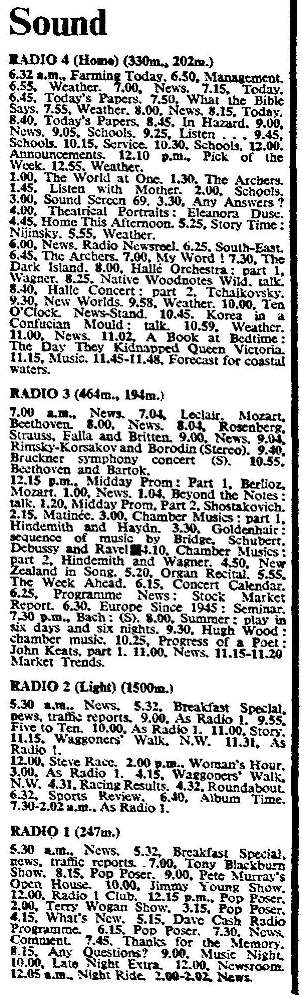
As you can see, the only "Interlude" scheduled is a five-minute break on the Light Programme at 7:10 p.m., although there is a fifteen-minute "Forces' Favourites" at 7:45 which could be a candidate.
The extended version of Noises which Armstrong reviewed for The Listener was broadcast later that year, on November 18, 1946, at 6:00 p.m. By that time, the Third Programme had been created, and the piece had earned a subtitle (as many of Reed's plays would) "A satirical programme":
Unfortunately, in some books the play is also listed as Noises On (as in the opposite of "noises off-stage"), and the longer version as Noises—Nasty and Nice, causing me all sorts of difficulties in searching and pinning down dates and times.
|
1515. May, Derwent. "Reed's Map." Sunday Telegraph (London), 14 December 1986, 20.
Derwent May, former editor at the Listener, reminisces about Henry Reed, shortly after his death in 1986.
|
Working from the (somewhat incestuous) bibliographies in British Radio Drama, Contemporary Authors, Contemporary Poets, and The Dictionary of National Biography, here's a nearly complete list of Henry Reed's writing for radio, including his translations from French and Italian (but not his talks or criticism): - Noises (4 March 1946)
- Noises—Nasty and Nice (1947)
- Moby Dick: A Play for Radio from Herman Melville's Novel (26 January 1947)
- Pytheas: A Dramatic Speculation (25 May 1947)
- The Unblest: A Study of the Italian Poet Giacomo Leopardi as a Child and in Early Manhood (9 May 1949)
- The Monument: A Study of the Last Years of the Italian Poet Giacomo Leopardi (7 March 1950)
- Return to Naples (17 August 1950)
- Canterbury Cathedral: An Exploration in Sound (with Elisabeth Lutyens, 7 November 1950)
- A By-Election in the Nineties (3 March 1951)
- The Dynasts (adapted from Thomas Hardy, 3-9 June 1951)
- Malatesta (translation, Henry de Montherlant, 26 February 1952)
- The Streets of Pompeii (16 March 1952)
- The Great Desire I Had: Shakespeare and Italy (26 October 1952)
- Westminster Abbey (with Elisabeth Lutyens, 1953)
- A Very Great Man Indeed (7 September 1953)
- All for the Best (translation, Luigi Pirandello, 22 November 1953)
- The Private Life of Hilda Tablet: A Parenthesis for Radio (24 May 1954)
- Hamlet; or, The Consequences of Filial Piety (translation, Jules Laforgue, June 20 1954)
- The Battle of the Masks (translation, Virginio Puecher, 6 September 1954)
- The Queen and the Rebels (translation, Ugo Betti, 17 October 1954)
- Emily Butter: An Occasion Recalled (14 November 1954)
- The Burnt Flower-Bed (translation, Ugo Betti, 23 January 1955)
- Vincenzo: A Tragicomedy (29 March 1955)
- Holiday Land (translation, Ugo Betti, 5 June 1955)
- A Hedge, Backwards (29 February 1956)
- Crime on Goat Island (translation, Ugo Betti, 7 October 1956)
- Don Juan in Love (translation, Samy Fayad, 5 November 1956)
- Alarica (translation, Jaques Audiberti, 22 September 1956)
- Irene (translation, Ugo Betti, 20 October 1957)
- Corruption in the Palace of Justice (translation, Ugo Betti, 19 January 1958)
- The Auction Sale (poem, 20 September 1958)
- The Primal Scene, As It Were: Nine Studies in Disloyalty (11 March 1958)
- Not a Drum Was Heard: The War Memoirs of General Gland (6 May 1959)
- One Flesh (translation, Silvio Giovaninetti, 12 June 1959)
- The Land Where the King Is a Child (translation, Henry de Montherlant, 3 October 1959)
- Musique Discrète: A Request Programme of Music by Dame Hilda Tablet (with Donald Swann, 27 October 1959)
- The House on the Water (translation, Ugo Betti, 3 February 1961)
- A Hospital Case (translation, Dino Buzzati, 22 November 1961)
- The America Prize (translation, Dino Buzzati, 18 June 1964)
- Zone 36 (translation, Dino Buzzati, 22 March 1965)
- The Complete Lessons of the War (poems, 14 February 1966)
- The Advertisement (translation, Natalia Ginzburg, 24 September 1968)
- Summer (translation, Romain Weingarten, 3 October 1969)
- The Two Mrs. Morlis (translation, Luigi Pirandello, 8 November 1971)
- The Strawberry Ice (translation, Natalia Ginzburg, 21 January 1973)
- Room for Argument (translation, Luigi Pirandello, 7 January 1974)
- The Wig (translation, Natalia Ginzburg, 23 March 1976)
- Like the Leaves (translation, Giuseppe Giacosa, 24 May 1976)
- Duologue (translation, Natalia Ginzburg, 3 January 1977)
- The Soul Has Its Rights (translation, Giuseppe Giacosa, 22 June 1977)
- Sorrows of Love (translation, Giuseppe Giacosa, 23 October 1978)
- Moby Dick (new production of 1947 play, 2 February 1979)
- I Married You for Fun (translation, Natalia Ginzburg, 7 January 1980)
It's likely some of the dates are incorrect, owing to frequent rebroadcasts and re-adaptations, and I've yet to find a record for the broadcast in 1953 of Reed's collaboration with the composer Elizabeth Lutyens on her BBC-commissioned Westminster Abbey. Still, this should be a fairly accurate and (almost) plenary list.
|
1514. Radio Times, "The Strawberry Ice," 18 January 1973, 43.
Billing for Natalia Ginzburg's "The Strawberry Ice," broadcast on Radio 4 at 3:00 pm, January 24, 1973.
|
Times (London), "Radio 3," Sound, 3 October 1969, 19. "8.00, Summer: a play in six days and six nights." Play by Romain Weingarten, translated from the French and adapted for radio by Henry Reed.
|
1513. Hodge, Alan. "Thunder on the Right." Tribune (London), 14 June 1946, 15.
Hodge finds 'dry charm as well as quiet wit' in "Judging Distances," but overall feels Reed is 'diffuse and not sufficiently accomplished.'
|
The BBC Programme Catalogue experimental prototype appears to have "entered a review phase", and is "currently unavailable."
Dear BBC: the Programme Catalogue is an important, valuable resource for scholarship and enthusiasts, and should be restored as soon as possible. Less reviewin', more inclusion! Thank you.
|
1512. Reed, Henry. "The Case for Maigret." Reviews of Maigret Hesitates and The Man on the Bench in the Barn, by Georges Simenon. Sunday Times (London), 2 August 1970: 22.
Reed reviews two translations of George Simenon's fiction.
|
In parsing through the new BBC Programme Catalogue, I've turned up five radio plays Reed translated late in his career. One is later, in fact, than even Reed's reworking of Moby Dick in 1979. And he's credited with none of them in any bibliography I've seen (not even the exhaustive Contemporary Authors entry from 1999). Not surprisingly, the plays are all adaptations from Italian, Reed's adopted mother tongue. Here are the details, in chronological order:
Room for Argument, by Luigi Pirandello. Broadcast on Monday, January 7, 1974 at 8:00 p.m., Radio 4.
Like the Leaves, by Giuseppe Giacosa, broadcast Sunday, May 30, 1976 at 2:30 p.m., on Radio 4. (The Programme Catalogue has Monday, May 24, but the London Times disagrees. Word Aloud also has the 30th.)
The Soul Has Its Rights, by Giuseppe Giacosa. Broadcast on Wednesday, June 22, 1977 at 3:05 p.m., Radio 4.
Duologue, by Natalia Ginzburg, broadcast on Tuesday, September 20, 1977 at 9:30 p.m., Radio 3. (The Catalogue says January 3rd. Duologue is listed in the Sound Archive catalogue, but is undated. I'm double-checking.)
I Married You for Fun ( Ti Ho Sposato per Allegria), by Natalia Ginzburg. Broadcast Monday, January 7, 1980 at 7:45 p.m., on Radio 4, and repeated Saturday, January 12 at 2:30 pm. ( Word Aloud confirms. Also in the Sound Archive catalogue.)
Because I'd never seen these titles before, they stood out like sore thumbs. But I'd say, even if that's all I turn up, the Programme Catalogue has already started earning its keep.
|
1511. William Phillips, and Philip Rahv, eds. New Partisan Reader: 1945-1953 London: Andre Deutsch, 1953. 164-171.
Collects Reed's poem, "The Door and the Window," published in the Partisan Review in 1947.
|
The experimental, prototype BBC Programme Catalogue went live today, and currently contains over 900,000 entries for radio and television programs. This represents only a "sub-set" of the data held by the BBC's Information and Archive Department.
Henry Reed has 77 entries! It's mostly recordings located in the Sound Archive, but there's a lot of metadata that's absolutely priceless.
Also, they've have mistakenly concatenated our Henry with that other Henry, a composer and conducter from the 1940s and '50s. How do you straighten that out? Birth and death years in the title field, or descriptors (Author, Composer), at the very least. If you please?
|
1510. Birmingham Post, "The Merchant of Venice," 5 March 1937.
Photograph of Henry Reed with members of the Birmingham University Dramatic Society's (BUDS) production of The Merchant of Venice. Shylock played by Ian Alexander.
|
The British Library Sound Archive lists 47 titles under the author heading "Reed, Henry, 1914-1986." I suspect there are a few more skulking about, which were cataloged with different headings. Somewhere around the apartment I have a printout, intending one day to go over it record by record, and sort out their holdings.
A curious visitor emailed me this week (thanks, Nancy!), and happened to bring to my attention an entry in the Sound Archive catalog for a 1970 recording of "The Complete Lessons of the War." I'd never heard of such a version. There it is, however: Item notes: A sequence of poems by Henry Reed. The fifth poem, Returning of Issue, has been largely rewritten since the programme was first broadcast in 1966. This new version has been re-recorded.
Recording notes: BBC recording broadcast Radio 3 December 28th 1970. A quick search of the broadcast schedule in the London Times confirms a rebroadcast on that Thursday, at 10:00 p.m.
That's not even the most amazing thing. While I was poking around in the chaos of the Sound Archive (three entries for each item, Work, Product, and Recording?), I saw a title I didn't recognize: " On the Terrace." The item notes describe the recording as being from the BBC program "Poetry Now" on November 2, 1970, introduced by producer R.D. Smith.
There is no poem entitled "On the Terrace" in the Collected Poems and, while there are undoubtedly many unpublished poems in Reed's personal papers, the collection description at the University of Birmingham does not mention this particular poem. Was it a piece Reed was trying out, but, ever the perfectionist, eventually abandoned? Is it one of his many translations? Did he change the title?
1970 was late in Reed's poetic life, but a time in which he seemed to rise from his long silence, publishing several poems in The Listener, and at last releasing the complete Lessons of the War in print.
|
1509. Reed, Henry, "'Tatty': The Year's New Word," Birmingham Post, 13 October 1937.
Discusses the history and usage of the word 'tatty'.
|
I have eight citations to articles written by or about Reed from the Radio Times, dating from the 1950s. Since the Radio Times is more or less the British TV Guide, I suspect there are a lot more references, but these are the only ones other folks have cited. (And one or two of them are suspect!)
So I wasted twenty or thirty minutes today, browsing online bookshops that deal in collectible magazines and periodicals. Even if they all don't turn out to contain anything of interest, it still wouldn't be entirely cheap to buy the issues outright. I'd rather have groceries.
My other option is to take a field trip to the Library of Congress in D.C., which is always productive, but a bit of an adventure for a hermit like myself. It would only cost me 20¢ per photocopy, and I would be able to peruse in relative leisure.
Photocopies are so sterile, though. Nothing like the feel of an old magazine: the brittle, yellow pages smelling warmly of neglected attics and dank basements.
The small treasure I found today was on the WordAloud website. WordAloud is a repository for information on radio broadcasts. They have airdates, synopsis, and credits for all sorts of BBC radio drama, including some of Henry Reed's. Hardy's "Battle of Trafalgar"? Never heard of it. Some adaptation of The Trumpet Major? "The Sergeant's Song"?
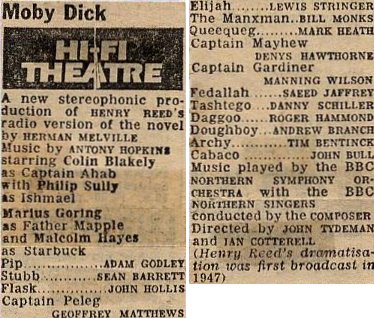
The prize among all these scraps and clues, was a clipping from a 1979 Radio Times, listing the credits for Reed's (stereophonic!) re-working of his 1947 radio adapation of Moby Dick:
Update: The London Times reveals that "The Battle of Trafalgar" was adapted for radio by Reed from Thomas Hardy's The Dynasts, which was orginally broadcast in its entirely as six ninety-minute episodes in June of 1951 (Savage, in British Radio Drama). Unfortunately, the Times was on strike at the time of the Moby Dick broadcast.
|
1508. Birmingham Post, Obituary for Henry Reed. 10 December 1986.
Reed's obituary in the Birmingham Post.
|
|
|
|
1st lesson:
Reed, Henry
(1914-1986). Born: Birmingham, England, 22 February 1914; died: London, 8
December 1986.
Education: MA, University of Birmingham, 1936. Served: RAOC, 1941-42; Foreign Office, Bletchley Park, 1942-1945.
Freelance writer: BBC Features Department, 1945-1980.
Author of:
A Map of Verona: Poems (1946)
The Novel Since 1939 (1946)
Moby Dick: A Play for Radio from Herman Melville's Novel (1947)
Lessons of the War (1970)
Hilda Tablet and Others: Four Pieces for Radio (1971)
The Streets of Pompeii and Other Plays for Radio (1971)
Collected Poems (1991, 2007)
The Auction Sale (2006)
|
Search:
|
|
|
Recent tags:
|
Posts of note:
|
Archives:
|
Marginalia:
|
|